


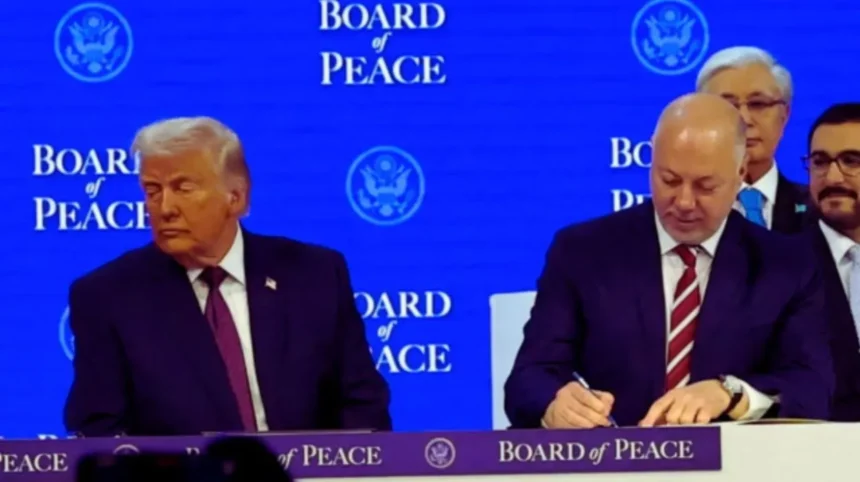
As reported by the English-language service of Novinite, Bulgaria’s Defense Committee has approved a draft resolution that advances the process for the country’s accession to U.S. President Donald Trump’s initiative known as the “Board of Peace.” According to Novinite, the draft obliges the Council of Ministers to submit to the National Assembly a bill on the ratification of Bulgaria’s accession, marking a key procedural step before full membership can take effect. The proposal was submitted by Delyan Peevski, leader of the Movement for Rights and Freedoms (MRF), whose party has pushed the initiative forward after it stalled in another parliamentary committee.
- What Is the “Board of Peace” and How Has Bulgaria Engaged?
- Context and Reactions: Why Is the Move Controversial?
- What Concerns Have Opposition Figures Raised?
- How Have Government Supporters Justified the Initiative?
- Supporting Details and Legal-Political Background
- Implications and Future Developments: What Comes Next for Bulgaria’s Accession?
Novinite reports that earlier attempts to move the measure through the foreign policy committee failed, largely due to boycotts by several political forces, including the Bulgarian Socialist Party (BSP). According to the same outlet, GERB convened the Defense Committee at short notice and secured a quorum, allowing the vote to proceed despite prior obstruction. Bulgaria’s outgoing government had already signaled its intention to join the Board of Peace, and Reuters has reported that Sofia’s participation is part of a broader regional alignment with the U.S.-led initiative.
According to the Bulgarian News Agency (BTA), members of the Defense Committee backed the draft resolution with nine votes in favor and one abstention, instructing the Council of Ministers to present a ratification bill to Parliament. BTA notes that the draft text was tabled by Delyan Peevski, who heads the MRF–New Beginning parliamentary group, underscoring his central role in promoting Bulgaria’s participation. The Council of Ministers had already published a decision endorsing accession to the Board of Peace, an initiative launched by President Trump, before this committee step.
What Is the “Board of Peace” and How Has Bulgaria Engaged?
The Board of Peace is described by public sources as an international body established with the stated aim of promoting peacekeeping and conflict-resolution efforts, operating under the patronage of the United States and President Donald Trump. According to BTA, the Bulgarian government decided to join the Board of Peace as part of a broader foreign policy orientation toward Washington and its regional security agenda. TIME magazine has reported that Bulgarian Prime Minister Rossen Zhelyazkov announced in January that Bulgaria would join the Board of Peace following a signing ceremony in Davos, emphasizing that Sofia would not make a financial commitment to the body at that stage.
Reuters has reported that Bulgaria’s outgoing administration opted to join the treaty establishing the Board of Peace, with parliamentary ratification expected to follow. In the same report, Reuters noted that Albania and Bulgaria were among the early European participants, with Bulgaria and Hungary identified as the only European Union countries that had committed to the initiative at that point. BTA further reported that the Council of Ministers approved Bulgaria’s participation in the inaugural Board of Peace meeting in Washington, D.C., in February 2026 as a non-voting member, in line with the organization’s charter provisions for states pending full ratification.
Novinite has also reported that the agreement with President Trump was initially signed by then-prime minister Rosen Zhelyazkov while his government was in resignation, and that this was done without prior consultation with Parliament or other state institutions. According to BTA, Zhelyazkov publicly stated that Bulgaria’s participation would take place “under the patronage of the United States and President Donald Trump,” framing it as an opportunity to secure a seat at an important diplomatic table. These steps laid the groundwork for the Defense Committee’s recent decision to push the ratification process forward.
Context and Reactions: Why Is the Move Controversial?
What Concerns Have Opposition Figures Raised?
As reported by Novinite, opposition lawmakers and critics have questioned both the timing and the substantive priorities behind advancing Bulgaria’s accession to the Board of Peace. According to the outlet, Gabriel Valkov of the Bulgarian Socialist Party argued that rising oil prices are exerting pressure on vulnerable groups in Bulgaria and contended that the move to join the Board of Peace does not address these immediate economic challenges. Novinite notes that Valkov also criticized the decision-making context, pointing to a caretaker government and a parliament facing imminent dissolution as reasons to delay major geopolitical commitments.
Further concerns have emerged around constitutional procedure. Novinite reports that caretaker Prime Minister Andrey Gyurov informed Parliament that Bulgaria had notified the United States it would temporarily refrain from implementing the statute of the Gaza-focused Board of Peace before ratification. According to Novinite, Gyurov’s written response explained that under the Bulgarian Constitution, the statute cannot be provisionally applied without parliamentary approval. The Bulgarian National Radio’s news service has reported similar details, noting that Sofia formally told the U.S. it could not implement the Board of Peace statute until ratified by the National Assembly.
These procedural objections have been joined by criticism of how the original agreement was concluded. Novinite reports that the signing took place when the Zhelyazkov government was already in resignation, and it notes that opposition figures see this as evidence that such a significant international commitment was made without proper institutional debate. According to TIME, some governments and institutions abroad, including the Vatican, have declined invitations to join the Board of Peace, adding to broader international debate over the initiative’s structure and objectives.
How Have Government Supporters Justified the Initiative?
While detailed pro-government statements are less prominent in the latest committee reporting, Bulgarian and international outlets have recorded earlier justifications from supporters of the Board of Peace. Reuters has reported that Albania’s leadership defended its own decision to join by arguing that the initiative guarantees a place “at the table” of international diplomacy, a line of reasoning echoed by supportive officials in other capitals. TIME notes that Bulgarian Prime Minister Rossen Zhelyazkov presented participation as an honor and an opportunity for increased international visibility, while clarifying that Bulgaria would avoid financial commitments at the outset.
BTA has reported that the Council of Ministers framed Bulgaria’s attendance at the inaugural Board of Peace meeting in Washington as a way to engage in discussions on peace and security while the ratification process is still pending. According to BTA, the government emphasized that Bulgaria’s status at that meeting would be non-voting, reflecting the incomplete domestic procedures. This staged approach has been presented by supporters as balancing constitutional requirements with the desire to align closely with U.S. diplomacy.
Supporting Details and Legal-Political Background
Novinite reports that the Defense Committee decision follows a sequence of institutional steps: the Council of Ministers approved joining the Board of Peace, a formal signing took place under the outgoing cabinet, and the government later clarified that implementation must await parliamentary consent. BTA notes that the Council of Ministers published its decision to join, making public the terms under which Bulgaria would participate in the Board of Peace. In its coverage of the Defense Committee vote, BTA specifies that the approved draft resolution compels the cabinet to present a ratification bill, thereby shifting responsibility for the final decision to the full Assembly.
According to Novinite, the political dynamics within Parliament have significantly shaped the pace of this process. The outlet reports that boycotts by parties such as the BSP previously blocked the initiative in the foreign policy committee, prompting GERB to convene the Defense Committee instead and secure a quorum for a vote. This maneuver allowed supporters of accession, including Delyan Peevski’s MRF, to keep the ratification track moving despite resistance.
BTA and Novinite both underscore that full membership in the Board of Peace still depends on a final ratification vote by the National Assembly. Novinite notes that Bulgaria’s authorities have already informed President Trump’s administration that they will not implement the Gaza Board of Peace statute provisionally, while BNR reports that this position has been communicated as a constitutional necessity. Together, these details indicate that Bulgaria is navigating between prior political commitments and the legal constraints of its domestic system.
Implications and Future Developments: What Comes Next for Bulgaria’s Accession?
The key immediate implication of the Defense Committee’s approval is that the Council of Ministers is now formally required to submit a ratification bill for Bulgaria’s accession to the Board of Peace to the National Assembly. According to Novinite, this ratification vote constitutes the final step before Bulgaria can become a full member of the initiative. Until that vote is held and the statute is ratified, Bulgaria has told the United States that it will not implement the Gaza Board of Peace’s provisions, in line with constitutional requirements described by caretaker Prime Minister Andrey Gyurov.
Reuters has reported that Bulgaria’s outgoing administration had anticipated parliamentary approval of the treaty, placing the country alongside Albania and Hungary among early European participants in the Board of Peace. BTA adds that Bulgaria has already taken part in the Board’s inaugural meeting in Washington as a non-voting participant, suggesting that Sofia intends to remain engaged even before full ratification. However, Novinite’s reporting on domestic criticism—from concerns over economic priorities to questions about the legitimacy of major foreign-policy decisions taken during a caretaker period—indicates that the ratification debate may be politically contentious.
The outcome will determine whether Bulgaria solidifies its role in President Trump’s peace initiative or pauses at the stage of limited, non-voting engagement. For now, the Defense Committee’s decision marks a significant procedural advance but stops short of final approval, leaving the ultimate decision to the full National Assembly once the government tables the required ratification bill.

