


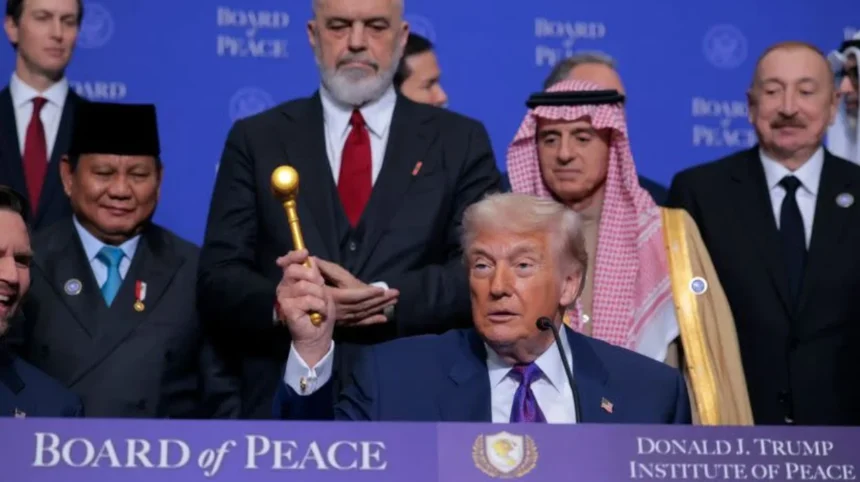
Every single country that has joined President Donald Trump’s Board of Peace has previously been formally criticized over human rights violations, according to a new investigative analysis that has intensified scrutiny of the Gaza-focused initiative. The findings add to existing concerns from human rights experts and diplomats about the credibility and composition of the board, which is central to Washington’s proposed reconstruction plan for Gaza.
General context
As reported by The Intercept, every state currently serving on the Board of Peace has been rebuked by international bodies or reputable watchdogs for human rights abuses, including alleged violations in armed conflicts, crackdowns on dissent, or systemic discrimination. According to social media posts amplifying the investigation, none of the board’s member governments is free from formal censure over its record, underscoring what critics say is a structural contradiction at the heart of a body tasked with overseeing a “peace” process.
According to AOL’s coverage of the Board of Peace, the body was created by President Trump to supervise a multibillion‑dollar Gaza relief and reconstruction scheme, with member governments pledging more than 7 billion dollars as part of an initial package. The same reporting notes that human rights specialists, Palestinian advocates, and some Western officials have condemned the project as a top‑down initiative that sidelines Palestinian political representation while concentrating power in the hands of foreign governments.
As outlined by the Next Century Foundation, the Board of Peace is designed to function as a supervisory authority for Gaza’s transition, working alongside new entities such as the National Committee for the Administration of Gaza and a Gaza Executive Board. However, analysts there point out that Palestinian political actors are largely absent from the top tiers of decision‑making, raising questions about both democratic legitimacy and the protection of local residents’ rights.
How have governments and experts reacted?
According to AOL, several key U.S. allies have already distanced themselves from the Board of Peace, with countries such as Italy and Poland among those that have declined to participate or have given the initiative a cool reception. Diplomats cited by that reporting describe skepticism in European capitals about the board’s structure, legal basis, and its heavy association with Trump’s personal foreign‑policy agenda.
Human rights experts quoted in AOL’s coverage and in policy analyses have denounced the Board of Peace as a form of “colonial” governance, arguing that decisions about Gaza’s reconstruction and security are being made by outside powers that have their own strategic interests and contested human rights records. Critics say this composition undermines the board’s moral authority, particularly in light of The Intercept’s finding that all member states have been rebuked for rights violations.
In commentary highlighted by AOL, California Governor Gavin Newsom used a public appearance to mock the initiative’s name, playing on the term “peace” to argue that any discussion of the board must also reckon with “the piece” taken from Palestinian rights and territory. His remarks reflect a broader wave of political criticism inside the United States, where some lawmakers and advocacy groups have questioned both the board’s transparency and its human rights safeguards.
Supporting details and structural concerns
According to the Next Century Foundation’s detailed analysis, the Board of Peace operates within a complex web of overlapping institutions, including the National Committee for the Administration of Gaza and various executive bodies, whose mandates and chains of command are not fully defined in public documents. The group notes that the draft charter for these arrangements does not explicitly mention Gaza or Palestine, despite the entities’ central role in governing the territory during the transition period.
The same analysis stresses that Palestinian representatives are largely missing from the Founding Executive Board and other senior structures, even though those bodies will shape investment, diplomatic engagement, and security policy in Gaza. Experts warn this could entrench a system in which external powers set priorities for reconstruction while Palestinians are confined to narrow administrative roles, with limited ability to influence decisions on justice, accountability, or long‑term political status.
AOL has reported that Trump has touted a 10‑billion‑dollar U.S. pledge to back the Board of Peace, pitching it as a way to stabilize Gaza and incentivize regional partners. Yet human rights organizations and policy analysts counter that large financial commitments do not resolve core issues around oversight, transparency, or the participation of people whose rights have been repeatedly violated, including in operations involving some of the board’s own member states.
What are the implications and what comes next?
According to experts cited by the Next Century Foundation, the combination of overlapping mandates, unclear rules of engagement, and the controversial human rights track records of Board of Peace member states could lead to bureaucratic paralysis, political competition, or misuse of Gaza reconstruction for broader strategic aims. They also highlight the lack of a published framework for how any international security force linked to the board would operate in potential clashes involving Palestinian groups or the Israel Defense Forces.
AOL’s reporting suggests that the board’s future effectiveness will depend heavily on whether skeptical allies remain outside the framework and whether current members address concerns about accountability and rights protections. Analysts warn that, if these issues are not resolved, the initiative risks deepening mistrust among Palestinians and some international partners, potentially complicating efforts to deliver aid and to move toward a durable political settlement.
For now, The Intercept’s finding that every Board of Peace member state has been formally rebuked over human rights violations has sharpened existing doubts about the body’s credibility and mission. As global attention remains focused on Gaza’s reconstruction and governance, pressure is likely to grow on both Washington and participating governments to explain how a board composed of such states will guarantee respect for the very rights it is ostensibly meant to uphold.

