


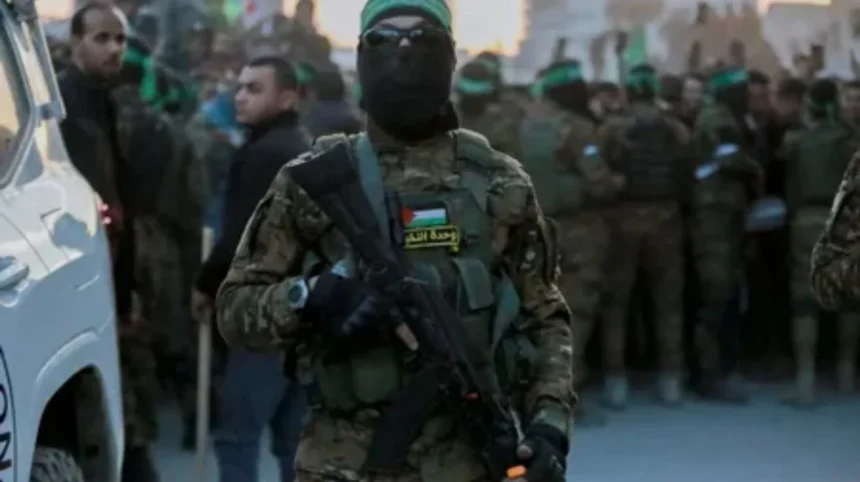
As reported by Reuters, Hamas is considering a proposal to give up its weapons in the Gaza Strip under a staged disarmament plan that would unfold over eight months and is tied to a broader United States initiative to rebuild the territory. According to Reuters, the proposal was presented by US President Donald Trump’s “Board of Peace” and would require Hamas to allow the destruction of its extensive tunnel network as it lays down arms in phases.
Reuters reports that the plan begins with a US-backed committee of Palestinian technocrats assuming security control of Gaza and ends with a complete withdrawal of Israeli forces once verification confirms the enclave is free of weaponry. According to Reuters, Hamas’ disarmament has emerged as a central sticking point in efforts to implement Trump’s plan for Gaza and to consolidate an October ceasefire that ended two years of full-scale war.
Reuters notes that Israel has stated it will not agree to withdraw from Gaza unless Hamas is fully disarmed. According to Reuters, Hamas has historically rejected calls to lay down its weapons, which Israel and others believe are largely transported and stored in an underground tunnel system across the Strip.
What does the disarmament plan propose?
According to Reuters, the Board of Peace plan has two main components: a 12-point document titled “Steps to Complete the Implementation of Trump’s Comprehensive Peace Plan for Gaza” and a five-stage timeline for Hamas to surrender its weapons over eight months. Reuters reports that the 12-point document sets out a framework in which all armed factions in Gaza, including groups such as Islamic Jihad, would participate in a disarmament process overseen by a technocratic body known as the National Committee for the Administration of Gaza (NCAG).
Reuters states that under this framework, Gaza would be governed according to the principle of “one authority, one law, one weapon,” meaning only individuals authorized by the NCAG could possess weapons and all armed factions would cease military activities. According to Reuters, verification of the weapons collection process would be carried out by a Weapons Collection Verification Committee to be established by Nickolay Mladenov, described as the Board of Peace’s lead envoy.
Reuters reports that reconstruction in Gaza would only be allowed in areas designated as demilitarized under the plan. According to Reuters, the full text of the plan was first reported by Al Jazeera and was later shared with Reuters by two Palestinian officials involved in the talks, with a Hamas official confirming its authenticity.
Context, reactions and political background
As reported by Reuters, the October ceasefire left Israel in control of well over half of the Gaza Strip, while Hamas retained a firm grip on the remaining part of the enclave and its population of around two million people, most of whom are homeless after two years of intensive Israeli bombardment. According to Reuters, Hamas is committed to armed resistance and has publicly rejected calls to disarm in recent months, even as some officials have privately indicated openness to disarmament if linked to a political process leading to a Palestinian state.
Reuters notes that a Palestinian official close to the talks, who requested anonymity due to the sensitivity of the negotiations, described the plan as “unfair” and suggested Hamas would seek amendments and improvements. According to this official, as reported by Reuters, the proposal does not include guarantees that Israel will fulfill its obligations and risks triggering a resumption of war by linking reconstruction and living conditions to political issues such as disarmament.
Reuters reports that Hamas has not issued a public position on the plan; a Hamas official said the group is currently studying the proposal. According to Reuters, three other Palestinian factions, including Islamic Jihad, released statements on Thursday criticizing the plan, saying it unfairly prioritizes disarmament over reconstruction and Israeli withdrawal.
Supporting details and additional reporting
According to Reuters, the Board of Peace presented the disarmament plan to Hamas in the preceding week, marking a new stage in efforts to translate Trump’s Gaza peace blueprint into concrete steps on the ground. Reuters reports that the National Committee for the Administration of Gaza, composed of Palestinian technocrats, would be responsible for both security oversight and coordination of the demilitarization process across all factions.
Reuters notes that the plan explicitly conditions reconstruction on demilitarization by stipulating that rebuilding can proceed only in areas formally declared demilitarized. According to Reuters, while some Hamas officials have privately discussed the possibility of disarmament within a broader political track, the 12-point document reportedly does not explicitly mention Palestinian statehood or independence.
Reuters reports that Israel’s position that it will not withdraw without full Hamas disarmament underscores the centrality of the weapons issue to any future political or security arrangements in Gaza. According to Reuters, the combination of security guarantees, reconstruction incentives and international oversight is intended to create a phased path from armed confrontation to a demilitarized, technocrat-administered enclave.
What are the implications and possible next steps?
As reported by Reuters, Hamas’ internal deliberations on the Board of Peace plan will be crucial in determining whether the eight-month disarmament framework can move forward or whether the ceasefire will remain vulnerable to breakdown. According to Reuters, the concerns voiced by Palestinian officials and factions about the absence of firm guarantees on Israeli withdrawal and the sequencing of reconstruction suggest that further negotiations and proposed amendments are likely.
Reuters notes that verification mechanisms such as the Weapons Collection Verification Committee and the requirement for demilitarized zones as a precondition for reconstruction indicate a strong emphasis on security benchmarks before political or economic gains are realized. According to Reuters, if the plan proceeds, a key milestone would be the eventual full withdrawal of Israeli forces, contingent on confirmation that Gaza is free of weaponry under the terms set out by the Board of Peace.
Reuters reports that for many Palestinians, the linkage between disarmament, reconstruction and broader political issues such as statehood remains a central point of contention that will shape the prospects of the proposed plan. According to Reuters, the absence of explicit language on Palestinian statehood in the 12-point document may complicate efforts to secure broader Palestinian buy-in, even as the humanitarian and reconstruction needs in Gaza remain acute after years of conflict.
In sum, Reuters reports that the Board of Peace plan presents Hamas with a detailed, time-bound pathway to disarmament in exchange for reconstruction and eventual Israeli withdrawal, but faces significant political objections from Hamas and other Palestinian factions over perceived imbalances and missing guarantees. According to Reuters, the outcome of ongoing internal consultations and regional diplomacy will determine whether the proposal becomes a framework for long-term stabilization in Gaza or another unimplemented blueprint in the territory’s protracted conflict.

