

According to Middle East Monitor, the article titled “A colonial choice: The Board of Peace, or the UN?” examines how former United States President Donald Trump’s newly created “Board of Peace” is positioned in relation to the United Nations in the context of Gaza and the wider Palestinian question. The piece is framed around the argument that both the Board of Peace and the UN are being presented as international mechanisms to manage post-war reconstruction and political arrangements while leaving core structures of power and displacement intact.
As reported by policy analysts writing about the Board of Peace, the body was launched by Donald Trump in early 2026 with the stated purpose of coordinating reconstruction in Gaza and attracting large-scale investment, while giving participating states and private actors a governance role that partly overlaps with or sidelines UN channels. According to commentary hosted by Middle East Monitor, this initiative is discussed as an extension of existing international practices in which Palestinian land and rights are treated as objects of management rather than as matters of self-determination.
The article, as summarized by Middle East Monitor’s own promotional snippet, contrasts two forms of what it describes as erasure of Palestinians: one through real estate development and investment-led reconstruction, the other through bureaucratic management of humanitarian visibility. In this framing, the Board of Peace is linked to land deals and reconstruction projects, while the UN is linked to managing aid, refugee status, and negotiations that have repeatedly deferred resolution of core issues such as occupation, settlements, and return.
Context and reactions: How are the Board of Peace and the UN being perceived?
According to a detailed policy analysis from the Centre for European Policy Studies, Trump’s Board of Peace has been met with mixed or cool responses in Europe and beyond, with many governments declining to join or delaying a formal position. The same analysis notes that some states see the initiative as a way for Washington and close partners to consolidate control over Gaza’s reconstruction while setting new terms that are not negotiated through existing multilateral structures such as the UN.
Social media and civil society commentary highlighted by Middle East Monitor and other observers has been critical of the Board of Peace’s design, describing it as an elite forum structured like a corporate board with Trump as a permanent chair and extensive veto powers. These reactions stress that Palestinians, and many of the communities most affected by the war in Gaza, are not central decision-makers in the new structure, despite being the stated beneficiaries of reconstruction.
At the same time, the UN itself continues to face sustained criticism over its record in Palestine, including its management of Palestinian refugees through UNRWA and its role in processes that have not halted settlement expansion or recurring large-scale violence. Commentaries cited by Middle East Monitor argue that the new Board of Peace does not replace these criticisms but rather adds another layer, raising questions about whether international governance is shifting from one contested framework to another without addressing underlying power imbalances.
Supporting details and expert commentary
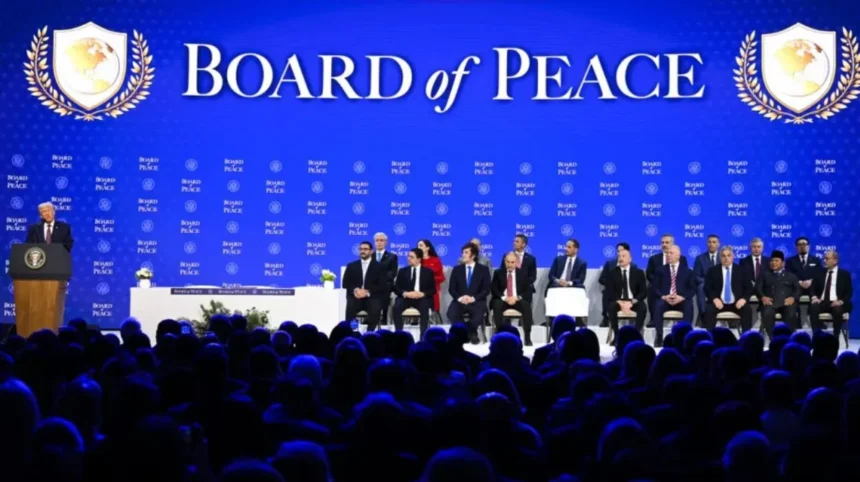
According to coverage of the Board of Peace’s launch, the structure is built around a charter signed by a group of invited states, with a smaller number actually attending the inaugural meeting and committing funds. Reports on that meeting describe a pledge of several billion dollars for Gaza’s reconstruction, mostly in the form of promised investments and aid from a subset of participating states, alongside an emphasis on public–private partnership and large-scale development projects.
Expert commentary cited in think-tank and media reporting has drawn attention to how this model fits wider trends in conflict and post-conflict governance, where reconstruction is framed as an investment opportunity and administered through boards, funds, and special authorities. In this perspective, the Board of Peace is interpreted as an example of how international actors may seek to monetize reconstruction and institutional legitimacy, while local communities navigate the consequences of displacement, damaged infrastructure, and ongoing military or political pressure.
According to Middle East Monitor’s earlier opinion-focused coverage on Pakistan’s decision to join the Board of Peace, critics inside and outside the region argue that participation can be seen as endorsing a post-war order that treats Gaza and wider Palestinian territories as spaces for externally designed “solutions.” That article presents the Board of Peace as an administrative follow-up to mass violence, indicating a concern that reconstruction frameworks may entrench, rather than reverse, the effects of war and occupation.
Implications and future developments: What could this choice mean?
Policy analysis suggests that the Board of Peace, if it gains momentum and funding, could emerge as a significant parallel track to UN-led processes in Gaza and potentially in other conflicts, particularly where major powers seek more direct control over reconstruction and governance arrangements. In practice, this could influence which projects are prioritized, which actors manage funds, and how conditions are attached to aid and investment, with implications for Palestinian governance and daily life.
At the same time, the UN remains central to a range of legal, humanitarian, and diplomatic mechanisms, including Security Council resolutions, General Assembly votes, and the work of agencies such as UNRWA and the Office for the Coordination of Humanitarian Affairs. Analysts note that any attempt to displace or bypass the UN in Gaza will likely encounter both institutional resistance and political debate, especially among states that favor multilateral frameworks and international law-based approaches.
Future developments will depend on whether more states formally join the Board of Peace’s governing body, how much of the pledged reconstruction funding materializes, and how ongoing debates about UN reform and accountability evolve in relation to Palestine. Observers indicate that the way reconstruction in Gaza is ultimately organized—through UN channels, the Board of Peace, or a combination of both—will shape not only physical rebuilding but also the political landscape Palestinians face in the aftermath of the war.
Taken together, the reporting and analysis depict a moment in which Palestinians and the international community are confronted with a choice between established UN mechanisms and a new, highly centralized Board of Peace, both of which are being scrutinized for how they manage power, resources, and representation in the wake of large-scale destruction in Gaza.

