


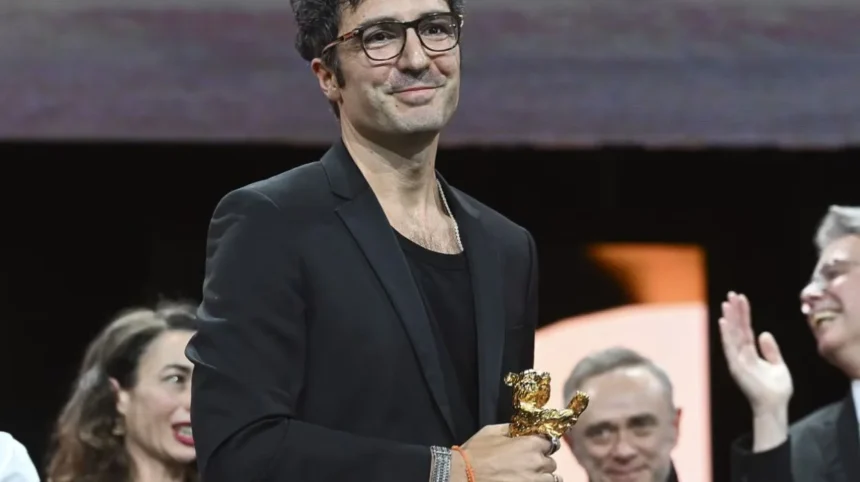
Berlin (February 21, 2026) – Turkish-German director İlker Çatak’s political drama Yellow Letters has won the Golden Bear for best film at the Berlin International Film Festival, securing the top prize at a ceremony marked by pointed references to global conflicts and political unrest. The feature, which explores the pressures placed on a marriage under an authoritarian climate, was honored by a jury led by German filmmaker Wim Wenders, who praised the film’s urgent relevance. The award marks the first time in more than two decades that a German film has taken the Berlinale’s highest honor.
General context and background
Yellow Letters centers on a creative couple whose careers and relationship come under strain as they are barred from working because of their political views in an increasingly repressive environment. According to synopses published by the Berlin International Film Festival, the story follows Derya and Aziz, an artist couple in Ankara whose seemingly stable life with their teenage daughter is upended after an incident at a theater premiere draws the attention of authorities. The film charts the impact of surveillance, blacklisting and social pressure on their family as they confront travel bans, legal obstacles and a tightening public sphere.
As reported by Eric Lavallée of Ioncinema.com, Yellow Letters emerged from a competition lineup that included international titles such as Salvation, Queen at Sea and Rose, which went on to win major Silver Bear awards. Screen Daily noted that Çatak’s win is the first Golden Bear for a German production since Fatih Akin’s Head-On in 2004, underlining the significance of the prize for Germany’s film industry. Euronews and other outlets described the film as a political drama that resonated strongly with the jury and audience amid broader debates about censorship and democratic backsliding.
As reported by journalists at France 24 and Euronews, the Berlinale’s 2026 edition unfolded against a backdrop of controversy over statements and protests linked to the war in Gaza, as artists and guests used the platform to comment on international crises. According to The Straits Times, the closing ceremony in Berlin was shaped by references to that conflict and other human-rights issues, giving a distinctly political tone to the festival’s final night. Within this charged atmosphere, the jury’s decision to honor Yellow Letters underscored the festival’s ongoing engagement with socially and politically focused cinema.
Why did Yellow Letters stand out?
Wim Wenders, serving as jury president, described Yellow Letters as “a terrifying premonition, a look into the near future that could possibly happen in our countries as well,” according to reports from The Straits Times and other international outlets. His remarks framed the film not just as a depiction of a specific national context, but as a warning about threats to artistic freedom and civil liberties more broadly. France 24 reported that the film’s narrative of a marriage strained by political persecution resonated with a jury keenly aware of the current global climate.
According to France 24 and Euronews, Yellow Letters was praised for its intimate portrayal of a family facing systemic pressure, rather than relying solely on overt depictions of state power. The film’s focus on personal consequences – job loss, social isolation, and the erosion of trust within the home – allowed audiences to connect broader political themes to everyday life. Commentators noted that Çatak’s direction balances tense domestic scenes with sequences that hint at the wider machinery of repression, emphasizing how authoritarian dynamics filter down into private spaces.
As reported by Screen Daily, Çatak’s Golden Bear marked a historic moment for German cinema at the festival, with Yellow Letters becoming the first German film in 22 years to win the top prize. This achievement added an additional layer of symbolic weight to the decision, highlighting the strength of locally produced, politically engaged filmmaking on an international stage. According to Ioncinema.com, the jury’s selections overall reflected a strong interest in stories that grapple with social justice, memory and the consequences of state power.
Reactions and other major winners
How did the festival community respond?
International media reported that the announcement of Yellow Letters as Golden Bear winner was met with sustained applause inside the Berlinale Palast, reflecting the film’s strong reception throughout the festival. France 24 noted that the award capped a competition in which several politically charged titles contended for the top honor. According to The Hollywood Reporter, the closing ceremony itself was described as “politically charged,” with some winners explicitly referencing the war in Gaza and other conflicts in their speeches.
Other films also left a significant mark on the awards list. Ioncinema.com reported that the Silver Bear Grand Jury Prize went to Salvation, while Queen at Sea secured the Silver Bear Jury Prize. The same report detailed that Sandra Hüller won the Silver Bear for Best Lead Performance for her role in Rose, a black-and-white drama about a woman passing as a man in 17th-century rural Germany. The Straits Times highlighted that Queen at Sea, directed by American filmmaker Lance Hammer and starring Juliette Binoche, collected two awards, including the supporting acting Silver Bear shared by Tom Courtenay and Anna Calder-Marshall.
According to The Straits Times, the festival also provided a prominent stage for Iranian filmmakers and dissident voices, including Jafar Panahi, who used appearances in Berlin to criticize the Iranian government’s crackdown on anti-government protests. Reports indicated that these interventions, combined with speeches invoking the civilian toll of conflicts in the Middle East, contributed to a politically resonant atmosphere around the ceremony. Within that context, Yellow Letters, with its narrative of censorship and professional bans, was widely seen as aligning with the festival’s focus on artistic freedom and resistance.
Supporting details on Yellow Letters and Berlinale 2026
Festival materials published by the Berlinale describe Yellow Letters as following Derya and Aziz, a celebrated artist couple from Ankara, whose life with their 13-year-old daughter Ezgi unravels after an incident at a premiere leads to political fallout. As travel restrictions, bureaucratic obstacles and public vilification mount, the couple faces stark choices about whether to remain in their home country or seek safety elsewhere. The narrative emphasizes how targeted measures against artists and intellectuals can destabilize families and communities, even when no formal charges are brought.
According to France 24, the film is set against a broader climate of political pressure in Turkey, though it is presented in a way that invites parallels with other societies facing democratic backsliding. Euronews likewise characterized the work as a political drama whose themes speak directly to contemporary debates over free expression, censorship and the role of artists in public life. Commentators noted that the film’s combination of personal drama and political commentary fits within a tradition of Berlinale winners that interrogate power structures through individual stories.
Screen Daily reported that the 2026 festival maintained the Berlinale’s reputation as one of Europe’s most politically engaged film events, with a program that foregrounded works addressing war, displacement and state violence. Ioncinema.com’s coverage of the awards list emphasized the diversity of the prizewinners, from intimate family dramas to films exploring historical memory and contemporary activism. Within this lineup, Yellow Letters was frequently cited as one of the most topical entries, given its focus on the mechanisms used to silence dissent in artistic circles.
What are the implications and what comes next?
Multiple outlets noted that the Golden Bear can significantly boost a film’s international profile, often leading to wider distribution deals and higher visibility on the global festival circuit. According to Screen Daily, Yellow Letters’ win is expected to draw increased interest from distributors and streaming platforms, particularly given its timely subject matter and the current appetite for politically aware storytelling. The recognition may also further raise İlker Çatak’s profile within European and international cinema, following his previous work in German-language film and television.
For the Berlinale, the decision to award its top prize to a politically charged drama appears to reinforce the festival’s identity as a platform for films engaging with contemporary social and political questions. Coverage by France 24, Euronews and The Hollywood Reporter suggested that the politically oriented speeches and award choices could shape how future editions of the festival are programmed and perceived. Observers noted that the 2026 lineup and closing ceremony may encourage filmmakers whose work tackles sensitive political themes to view Berlin as a receptive venue.
At the industry level, the success of Yellow Letters is likely to feed into broader conversations about the role of state funding and public broadcasters in supporting politically engaged cinema in Germany and beyond. The historic nature of the win for a German production, as highlighted by Screen Daily, may strengthen arguments for continued investment in films that address democratic values, civil society and human rights. Commentators also suggested that the film’s focus on an artist couple could inspire further projects examining how political polarization and repression affect cultural workers specifically.
In the immediate future, Yellow Letters is expected to feature prominently in discussions of the 2026 awards season and may appear at additional festivals and events throughout the year. As more audiences encounter the film, its exploration of censorship, professional bans and the strain on a family under surveillance is likely to fuel debate about similar dynamics in various parts of the world. For the Berlin International Film Festival, the 2026 edition will be remembered both for its politically charged context and for honoring a film that directly engages with the tensions between artistic freedom and authoritarian power.
Ultimately, the Golden Bear for Yellow Letters confirms the prominence of politically resonant storytelling at one of Europe’s major film festivals and spotlights İlker Çatak as a significant voice in contemporary cinema. The film’s success in Berlin underlines how narratives grounded in the experiences of individual families can illuminate broader questions about democracy, censorship and the cost of dissent.

