


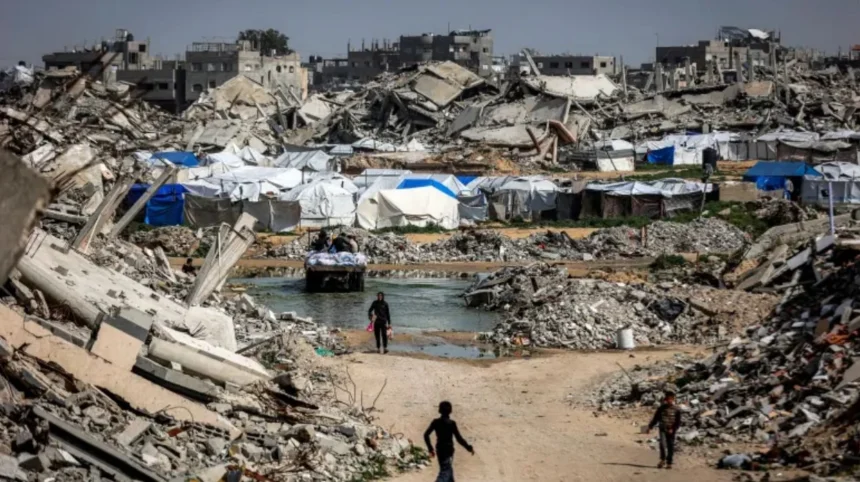
As reported by Al Jazeera, United States envoys have presented a written proposal that Palestinian analysts say aims at the complete political capitulation of Hamas in the Gaza Strip. According to Al Jazeera, the document links any large-scale reconstruction in Gaza and a broader political framework to Hamas’s agreement to disarm and relinquish its political role. The plan is described as part of the second phase of President Donald Trump’s 20-point initiative tied to the October ceasefire arrangement, under which Israeli forces would gradually withdraw from much of Gaza once armed groups lay down their weapons.
Al Jazeera reports that the US plan calls for the disarmament of Hamas and all allied Palestinian armed factions, extending even to personal firearms in some formulations of the proposal. According to the outlet, the strategy envisions reconstruction proceeding in areas classified as compliant, while zones suspected of retaining weapons could be labeled “rogue” and excluded from rebuilding efforts. The proposal, as described, embeds these security demands in a broader US effort to shape postwar governance in Gaza without a formal political role for Hamas.
What are the main elements and reactions?
Al Jazeera reports that the plan moves beyond a ceasefire framework by seeking Hamas’s effective political surrender, not only its military disarmament. According to the same reporting, the document ties the presence and withdrawal of Israeli forces, the pace of reconstruction, and the status of different areas of Gaza to measurable steps in disarmament and political restructuring.
Al Jazeera cites Gaza-based political analyst Wesam Afifa as saying the text reads more like a “threat message” than a genuine basis for negotiation, arguing it abandons earlier commitments made by Israel and the US in previous understandings. The outlet reports that Afifa and other Palestinian analysts view the plan as making reconstruction conditional on Gaza paying what they describe as a political price linked to wider regional confrontations involving Iran and Lebanon. According to Al Jazeera’s account, critics say the proposal offers few concrete incentives from Washington beyond previously announced reconstruction pledges, some of which have yet to materialize in dedicated funds.
Supporting details and broader background
According to Anadolu Agency, the broader US-backed framework emerging over recent months has focused on phased disarmament of Hamas, including pressure to surrender heavy and long-range weapons capable of striking Israel. Anadolu reports that a draft Gaza proposal prepared by an international team close to the Trump administration envisions Hamas handing over major weapon systems while potentially allowing some small arms to remain temporarily during a transition period. The New York Times has also reported on a related plan from Trump’s “Board of Peace” that would see Hamas and other groups gradually disarm in parallel with an Israeli military withdrawal from Gaza.
Policy analysis from the Center for a New American Security notes that US planning for a postwar Gaza has increasingly centered on removing Hamas from governance while avoiding a long-term Israeli military occupation. According to that report, Washington’s aim is to facilitate a new civilian administration in Gaza, potentially technocratic and described as “apolitical,” that would operate without Hamas’s formal participation. The Washington Institute has warned that unless the US clearly defines red lines on Hamas’s future role, regional mediation efforts could de facto legitimize Hamas’s influence in postwar governance structures despite formal exclusions.
What are the implications and possible next steps?
As reported by Al Jazeera, analysts say the latest US proposal could harden positions by demanding extensive disarmament and political concessions from Hamas before substantial reconstruction or full Israeli withdrawal take place. According to Al Jazeera, the concept of “piecemeal” reconstruction—rewarding areas deemed compliant while isolating those suspected of holding weapons—might deepen internal fragmentation within Gaza and complicate attempts at unified governance.
Anadolu Agency notes that Washington is working with regional mediators to present and refine disarmament proposals, with officials indicating that Hamas is expected to formally respond once the detailed text is conveyed through ongoing talks. The New York Times has reported that envoys associated with Trump’s Board of Peace have already briefed the UN Security Council on key elements of the disarmament concept, signaling that the plan is now embedded in wider diplomacy over Gaza’s future. Policy analysts cited by CNAS and the Washington Institute suggest that the outcome of these negotiations will shape who governs Gaza, the speed of reconstruction, and whether a durable ceasefire can be sustained without leaving a political vacuum or entrenching Hamas’s influence in new forms.
In sum, the current US proposal, as described by Al Jazeera and other outlets, seeks to tie Gaza’s reconstruction and Israel’s phased withdrawal to a far-reaching process of Hamas’s disarmament and loss of formal political authority, while regional and international mediators await the group’s response and the reactions of other Palestinian and regional actors.

