


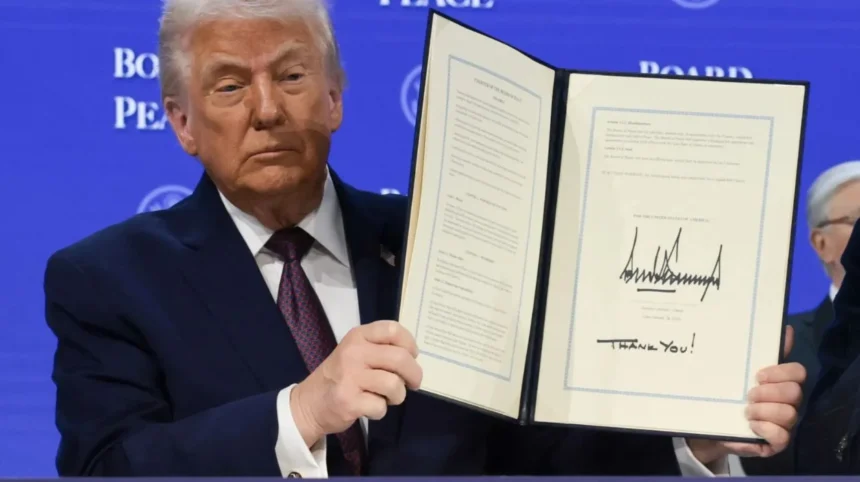
US President Donald Trump described Gaza as a “beautiful piece of property” while speaking at a “Board of Peace” event on the sidelines of the World Economic Forum in Davos, Switzerland, where he outlined his administration’s vision for rebuilding the war‑torn Palestinian enclave. As reported by the Times of India, Trump told the audience he is a “real estate person at heart” as he discussed Gaza’s location on the Mediterranean coast and his plans for its reconstruction. According to BBC News, the comments came during the signing of a new “Board of Peace,” which the US says will oversee efforts to end the conflict between Israel and Hamas and supervise Gaza’s redevelopment.
Trump framed Gaza’s geography as central to his vision, urging listeners to “look at this location on the sea” and describing it as a “beautiful piece of property” with potential to transform living conditions for people in the region. As reported by Le Monde, he told attendees that “it all began with a location,” highlighting the enclave’s coastal position as a foundation for his redevelopment concept. According to coverage citing his remarks, Trump suggested that, in his view, Gaza could become a place where “people are going to be living so well” if reconstruction proceeds according to the plans presented.
During the event, Trump also signed the charter for the new Board of Peace, describing it as an initiative that “everybody” wanted to join and saying it was “running beautifully,” according to reports summarizing his speech. BBC News notes that the Board of Peace is presented by the administration as the body meant to help secure a lasting ceasefire between Israel and Hamas and coordinate international participation in rebuilding efforts. The Times of India further reports that Trump linked the ceasefire and reconstruction agenda, portraying Gaza’s redevelopment as part of a broader push for stability and economic transformation in the Middle East.
Context and Reactions: How Have Trump’s Comments Been Received?
Trump’s description of Gaza primarily in terms of its real estate value follows earlier remarks in which he characterized the territory as a “large real estate opportunity” and a “big real estate site,” underscoring how frequently he uses property language when discussing the enclave. According to CNN’s earlier reporting, Trump has repeatedly framed post‑war Gaza in terms of ownership and development, saying the United States would gradually “develop it” as part of his broader Middle East strategy. Middle East Monitor has also documented past instances where he referred to Gaza as “incredible real estate” and “oceanfront property” that he would like to own, reinforcing the consistency of this framing.
Coverage from outlets including the Independent and Le Monde indicates that the Davos event included the unveiling of visual plans for a “New Gaza,” featuring images of high‑rise buildings, data centers, and coastal tourism facilities. As reported by the Independent, these renderings showed luxury apartments and large‑scale infrastructure, which critics described as “bizarre” given the ongoing humanitarian devastation in the territory. Le Monde notes that the vision presented evoked a “Middle East Riviera” style concept, with officials emphasizing private‑sector involvement and investment.
Other media reports have highlighted the contrast between these redevelopment plans and the continuing humanitarian crisis in Gaza. The Times of India, citing broader reporting, notes that despite a ceasefire framework, the enclave continues to face reports of Israeli fire, severe aid restrictions, food insecurity, flooding, and child deaths linked to harsh conditions. Hindustan Times reporting further recalls that Israeli military operations have killed tens of thousands of people in Gaza, underscoring how Trump’s focus on real estate and future resorts sits against a backdrop of large‑scale destruction and displacement.
Supporting Details on the Board of Peace and Reconstruction Vision
According to coverage from BBC News, the Board of Peace announced in Davos is intended to bring together dozens of countries to support a ceasefire and channel funds and expertise into rebuilding Gaza. The Times of India reports that Trump cited backing from 59 countries for his broader peace and reconstruction initiative, casting this participation as evidence of strong international support. Reports indicate that the Board is tasked with overseeing planning and financing mechanisms for Gaza’s reconstruction, though detailed, binding governance structures and timelines were not fully laid out in public remarks.
Le Monde reports that Trump and advisers referred to upcoming donor activity, including a promised conference in Washington in the weeks following the Davos event, as a key step in mobilizing resources for the plans unveiled. According to the Independent, Jared Kushner presented concept images for “New Gaza” at the same gathering, showing planned residential areas, technology hubs, and expanded coastal tourism zones. BBC News and other outlets report that the administration’s vision includes tens of thousands of new housing units and dozens of medical facilities, though financing and local governance arrangements remain subjects of broader diplomatic discussion.
Reporting from Hindustan Times notes that Trump has linked his push for peace between Israel and Hamas to the idea of turning Gaza into a “resort‑like city,” suggesting that economic transformation is a central component of his approach. Previous comments captured by CNN and other outlets show him emphasizing US control or leadership in Gaza’s post‑war development, describing an American role in “taking ownership” of the project over time. These elements together indicate an attempt to pair political agreements with a large‑scale reconstruction model rooted in real estate and investment language.
Implications and Future Developments: What Comes Next for Gaza Plans?
According to BBC News, the Board of Peace framework and the Davos announcements are positioned by the Trump administration as the opening phase of a long‑term reconstruction process for Gaza, contingent on the durability of the ceasefire and cooperation from regional actors. CNN’s earlier reporting on Trump’s comments suggests that he envisions a drawn‑out timeline in which the United States gradually develops projects in Gaza, linking these efforts to a broader goal of bringing “stability” to the Middle East. Le Monde reports that a donor conference in Washington is expected to clarify how much funding will actually be pledged and under what conditions, which will be critical to determining how much of the “New Gaza” vision can move beyond concept images.
At the same time, outlets including the Times of India and Hindustan Times underscore that the humanitarian and political realities on the ground remain fragile, with ongoing reports of hardship and unresolved questions over Gaza’s future governance. The viability of transforming Gaza into the kind of coastal investment hub described in Davos will depend on security arrangements, the role of Palestinian authorities, Israel’s stance, and international legal and diplomatic constraints, all of which are still being negotiated in various forums. For now, Trump’s characterization of Gaza as a “beautiful piece of property” and his self‑description as a “real estate person at heart” have become defining features of how his administration publicly frames the territory’s post‑war future.
In summary, Trump’s remarks at the Board of Peace event in Davos placed Gaza’s coastal location and development potential at the center of his reconstruction narrative, tying his real‑estate background to a proposed international effort to rebuild the enclave under a new US‑backed framework. Media coverage indicates that while grand designs and new institutional structures have been announced, the humanitarian crisis, political uncertainties, and questions over implementation continue to shape the context in which these plans will be tested.

