


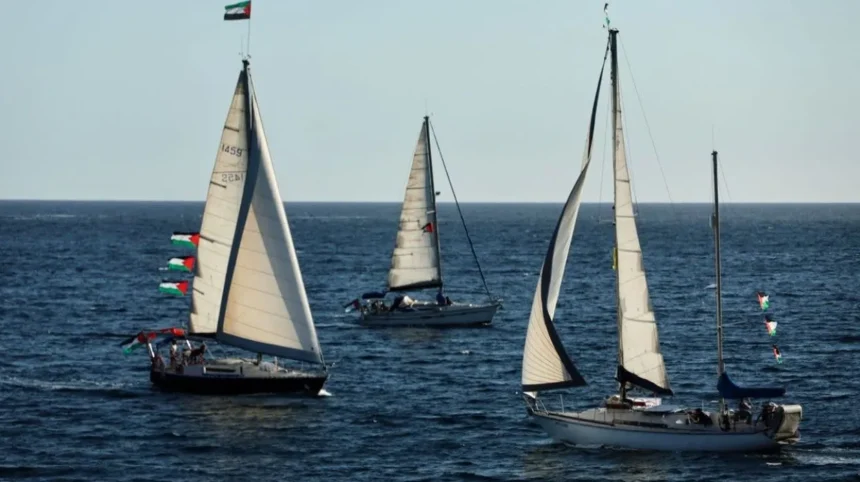
The Global Sumud Flotilla has announced what organizers describe as its largest humanitarian mission to date, aimed at challenging Israel’s blockade of the Gaza Strip by coordinating parallel operations on land and at sea. As reported by Bel Trew of The Independent, the initiative plans to sail toward Gaza on 29 March with a multinational civilian fleet while also assembling a large aid convoy to approach the territory overland. According to The Independent, the flotilla’s stated goal is to both deliver urgently needed supplies and draw international attention to the impact of the long-running closure on Gaza’s civilian population.
As reported by Bel Trew of The Independent, organizers say about 3,000 participants from more than 100 countries have registered to take part in the mission, including medical professionals, engineers, legal experts and human rights advocates. According to The Independent, the Global Sumud Flotilla characterizes its effort as a coordinated, non-violent challenge to what it calls an “illegal Israeli siege” on Gaza and to wider global “complicity” in the situation. The group says volunteers will receive training in non-violence and de-escalation ahead of departure, echoing the approach of earlier flotilla missions attempting to reach the enclave.
According to The Independent, the flotilla plans to depart from multiple ports, including Barcelona and locations in Italy and elsewhere in the Mediterranean, in order to widen participation and complicate potential efforts to block the mission at sea. Organizers say the maritime component will be accompanied by a substantial land convoy carrying medical supplies, food and other basic goods intended for Gaza’s civilian population. As reported by The Independent, activists argue that the scale and diversity of this year’s initiative mark an escalation from previous attempts that were intercepted by Israeli forces before reaching the Strip.
Context and reactions: How are governments and activists responding?
As reported by Bel Trew of The Independent, Israeli authorities have previously condemned similar flotilla efforts as political stunts and “provocations,” insisting that such missions are unnecessary and potentially dangerous. According to The Independent, Israel maintains that it regulates access to Gaza for security reasons and views unsanctioned flotillas as attempts to undermine those controls. Officials have also argued in the past that approved channels exist for delivering humanitarian aid, while critics counter that those mechanisms are inadequate and heavily restricted.
As reported by The Independent, a previous Global Sumud Flotilla mission in October involved nearly 500 activists, professionals and other humanitarians, including high-profile figures such as climate campaigner Greta Thunberg. The Independent notes that Israeli forces intercepted that mission, arresting hundreds of participants and seizing the vessels before they could reach Gaza. The operation drew strong condemnation from human rights groups and sparked demonstrations in multiple countries, with protesters accusing Israel of obstructing humanitarian relief and violating international law.
According to The Independent, organizers say the latest mission has been shaped by lessons from those earlier confrontations and by the international reaction they triggered. One flotilla member told a news conference in Johannesburg that the previous effort “motivated” people in different countries by showing that civil initiatives could have an impact, even if they do not succeed in physically reaching Gaza. The Independent reports that the group believes the arrests and vessel seizures helped galvanize a broader movement of solidarity actions worldwide.
Supporting details and expert commentary
As reported by Bel Trew of The Independent, one of the central features of the upcoming mission is the scale of professional participation, particularly in the medical field. Organizers say more than 1,000 medical workers, including doctors and nurses, have volunteered to join the flotilla in order to provide on-the-ground assistance and help deliver critical supplies to overwhelmed hospitals and clinics in Gaza. According to The Independent, activists describe this as a direct response to mounting reports of shortages in medicine, equipment and specialized care inside the territory.
According to The Independent, the Global Sumud Flotilla says it will also include eco-builders and war-crimes investigators, underscoring its dual focus on immediate humanitarian relief and longer-term accountability for alleged violations in the conflict. At a press conference held at the Nelson Mandela Foundation in Johannesburg, an activist emphasized that the presence of investigators distinguishes this mission from previous voyages. As reported by The Independent, organizers argue that documenting what happens during the attempt, and in Gaza itself, could strengthen future legal and diplomatic efforts related to the blockade and the conduct of hostilities.
As reported by Bel Trew of The Independent, the upcoming mission has attracted widespread interest from supporters, with organizers saying around 30,000 people applied to join last year’s flotilla. They have renewed calls for applications and financial contributions to cover the cost of vessels, equipment and aid cargo for the 2026 mission. According to The Independent, campaigners frame the initiative as part of a broader global civil-society push to pressure governments and international organizations to secure a ceasefire and expand humanitarian access to Gaza.
Implications and future developments: What could happen next?
According to The Independent, the mission is scheduled to depart on 29 March, meaning key decisions in the coming weeks will concern final routes, port logistics and security preparations. Organizers say they do not embark “with the intention to be intercepted,” but they acknowledge the possibility that Israeli forces will again move to stop the flotilla before it reaches Gaza’s territorial waters. As reported by The Independent, they argue that even an interception could draw renewed attention to conditions in Gaza and increase pressure on governments to take stronger action on humanitarian access.
As reported by Bel Trew of The Independent, the mission is unfolding against a backdrop of severe medical needs in Gaza, including thousands of wounded and chronically ill patients requiring treatment outside the enclave. According to The Independent, only a handful of critically ill Palestinians were recently allowed to leave via the Rafah crossing, leaving many more waiting for referral or evacuation. Against this context, organizers contend that the scale of the planned land and sea operation is justified by what they describe as an acute, ongoing humanitarian emergency.
According to The Independent, the success or failure of the Global Sumud Flotilla could influence future civil-society strategies for confronting the blockade and similar restrictions in other conflict zones. If the mission manages to deliver aid directly to Gaza, campaigners may see it as a model for coordinated, multinational civilian action in support of besieged populations. If it is intercepted again, organizers say they expect the resulting spotlight, documentation and political debate to feed into legal challenges, diplomatic initiatives and further grassroots mobilization.
In sum, the Global Sumud Flotilla’s latest operation is shaping up to be one of the largest civilian-led attempts yet to break the Gaza blockade, combining maritime and land convoys, large numbers of professionals and a strong emphasis on non-violent resistance. As reported by Bel Trew of The Independent, organizers insist that whether or not their vessels reach Gaza, the mission is intended to highlight the humanitarian crisis, test the limits of the existing access regime and intensify international scrutiny of the siege.

