


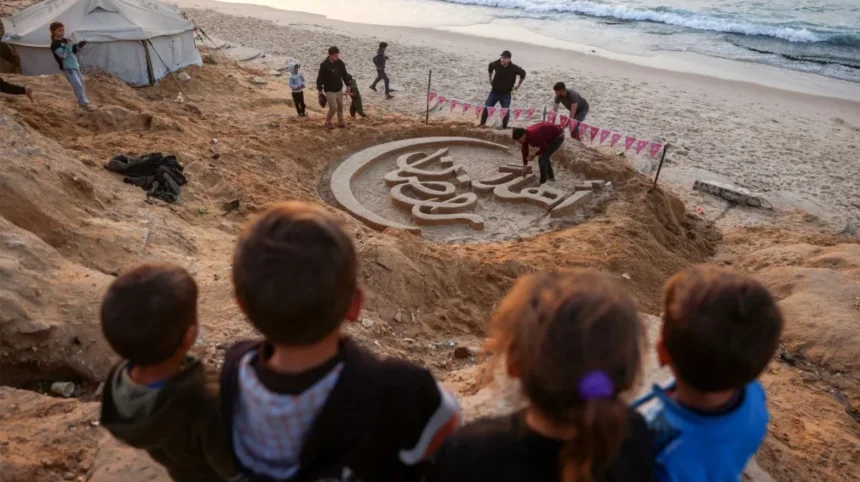
Gaza City (February 22, 2026) – Palestinians in Gaza are marking Ramadan in the shadow of mass displacement, deep personal loss and widespread destruction, with many observing the holy month in tents or makeshift shelters rather than their homes. Residents describe an atmosphere marked less by celebration than by mourning, hunger and uncertainty about the future. Families who have lost loved ones and homes say the current Ramadan feels like a painful extension of the war years. Despite a ceasefire that has reduced large-scale bombardment, many Palestinians in Gaza say their daily reality remains defined by grief, economic ruin and forced displacement.
General context of Ramadan under siege
According to Middle East Eye, the current Ramadan is the third consecutive holy month in which Palestinians in Gaza have had to observe religious rituals under the pressures of war or its immediate aftermath. The report notes that although large-scale Israeli bombardment has eased under a ceasefire, residents describe little meaningful change in their daily conditions, with grief over tens of thousands of deaths and ongoing displacement dominating their lives. As reported by Middle East Eye, Gaza has witnessed the killing of more than 72,000 Palestinians since October 2023, leaving a vast number of families to face Ramadan without parents, children, siblings and friends who were killed in air strikes and ground attacks.
Middle East Eye reports that a ceasefire agreement led to a reduction in heavy bombardment, but attacks and casualties have continued, including Palestinians killed and wounded in separate incidents during the first days of Ramadan. According to the same outlet, Gaza’s Ministry of Health has recorded hundreds of deaths and more than a thousand injuries since the ceasefire began, with many casualties occurring near the so‑called “Yellow Line” and in areas previously designated as safe. The report explains that the Yellow Line is a militarized no‑go zone enforced by Israeli forces in northern and eastern Gaza, which has been pushed westward over time, placing an estimated majority of the territory under direct Israeli control. This expansion has left large numbers of Palestinians unable to return to their homes and neighborhoods, turning Ramadan into a period of worship in exile for many.
How are Palestinians in Gaza experiencing Ramadan?
Middle East Eye recounts the experience of displaced Palestinian Ziad Dhair, originally from northern Gaza, who is now living in a tent in Nuseirat refugee camp and describes Ramadan as indistinguishable from the wartime periods except for the reduced intensity of bombardment. Dhair told the outlet that before the war, Ramadan in Gaza was marked by decorations, family gatherings, shared Iftar meals and a sense of community, all of which have largely disappeared amid displacement and loss. He said that most of his friends and several members of his family had been killed, leaving him with few people to greet or host during the holy month and turning Ramadan into a time dominated by memories of those who are no longer alive.
According to Middle East Eye, Dhair emphasized that he does not feel the war has ended because he remains barred from returning even to the rubble of his house, which lies in an area declared off‑limits under Israeli military control. He argued that, as long as he cannot see his home or neighborhood, any talk of a genuine end to the war feels hollow to him and other displaced Palestinians. His account reflects a broader sentiment described in the report, in which many Palestinians in Gaza view the current Ramadan as a continuation of wartime hardship rather than a normal religious season.
The outlet also reports on the situation of Umm Mohammed Abu Qamar, a long‑time resident of Jabalia refugee camp, who managed to remain in her house during previous Ramadans despite severe damage to the building but is now spending the holy month in a tent in central Gaza. She described the first day of Ramadan as particularly painful because she could not be in her home or neighborhood, expressing a strong attachment to Jabalia and a longing to return and “smell its soil.” Middle East Eye notes that large sections of Jabalia have been flattened, and while some parts are technically accessible, many residents have not returned due to the extent of destruction and continuing attacks in the area.
Voices of grief, loss and shattered families
As reported by Middle East Eye, Abu Qamar is observing Ramadan after the deaths of two sisters and two sons‑in‑law in Israeli attacks, which has fundamentally altered traditional family gatherings during the holy month. She recounted that her older sister had raised her and was like a mother, while her younger sister had been a close companion, making past Ramadan gatherings central to their family life. The report states that her two daughters, aged 19 and 24, are now widows, one having lost a husband who worked as a journalist and the other a husband who was employed as a chef in a cake factory. For Abu Qamar, Ramadan now underscores both the absence of loved ones and the breakdown of the communal rituals that once defined the month.
Middle East Eye also highlights the testimony of Fouad Hijazi, originally from Gaza City, who said that news of the Ramadan crescent moon sighting brought him to tears as he remembered his father, brother and about 20 friends who had been killed. According to the report, Hijazi described how, in previous years, he and his friends would shop together and share Iftar meals during Ramadan, habits that have now been replaced by solitary remembrance and survival concerns. His account adds to a broader picture of Palestinians in Gaza who associate the holy month less with festivity and more with mourning for relatives and friends lost in the conflict.
The article notes that, over the past two years, Palestinians have observed Ramadan under conditions of severe deprivation, including what has been described as Israeli‑imposed starvation and episodes in which Palestinians waiting for aid in Gaza City were killed in incidents that became known as “flour massacres.” These events have contributed to a collective memory of Ramadan intertwined with hunger, danger and grief, rather than the celebratory and communal atmosphere that traditionally accompanies the month. Residents quoted by the outlet portray this Ramadan as a continuation of that pattern, shaped by bereavement, economic collapse and a loss of communal spaces.
What daily challenges do displaced families face?
According to Middle East Eye, many Palestinians in Gaza are contending with the paradox of seeing stocked markets while being unable to afford basic goods due to widespread economic devastation. The report states that, compared with the height of the war, market shelves now more closely resemble pre‑war conditions, with various products available for purchase. However, high prices and the widespread loss of income have placed most items beyond the reach of many families, especially those who have been repeatedly displaced and have spent savings on tents, temporary shelter and basic survival needs.
Hijazi told Middle East Eye that he has been without work for two and a half years and cannot pay current market prices, forcing his family to rely on meals provided by charity kitchens. He explained that much of the day is spent collecting water and firewood, and that food from charity kitchens often arrives by midday and must be reheated over open fires by Iftar time. The article notes that, even in the absence of continuous bombardment, these routines dominate daily life for many displaced Palestinians in Gaza and shape how they experience Ramadan.
Middle East Eye reports that the ceasefire agreement included provisions for the entry of around 1,500 truckloads of cooking gas into Gaza by the end of January, aimed at alleviating shortages and easing daily life. However, Gaza’s General Petroleum Authority stated that only 307 trucks, carrying roughly 6,458 tonnes of gas, had actually entered, meeting only about 20 percent of Gaza’s needs. As a result, many families continue to rely on firewood for cooking, a practice that was common during the height of the war and that now persists into the current Ramadan. Hijazi was quoted as saying that, in some respects, the present situation feels harder than the periods of acute starvation because goods are visible in shops but unaffordable to those who have exhausted their resources through repeated displacement.
What are the implications for Gaza’s future Ramadans?
Middle East Eye’s reporting suggests that the current Ramadan may have long‑term implications for how Palestinians in Gaza remember and practice religious observances in the coming years. With tens of thousands of people killed, many neighborhoods destroyed and a significant portion of the population still displaced, traditional patterns of family gathering, neighborhood hospitality and communal worship have been profoundly disrupted. Residents quoted in the article portray a sense of rupture that extends beyond this year, raising questions about when and how communities will be able to re‑establish familiar rituals once reconstruction and safe return become possible.
The report indicates that, while a ceasefire has reduced immediate large‑scale bombardment, the enforcement and expansion of the Yellow Line and the ongoing restrictions on movement and access continue to limit Palestinians’ ability to return to their homes. This situation, combined with economic collapse and ongoing shortages of essential resources such as cooking gas, suggests that the social and economic conditions shaping Ramadan in Gaza may take a long time to improve. As long as large parts of the population remain in tents or temporary shelters and face barriers to rebuilding livelihoods, Ramadan is likely to remain intertwined with themes of displacement and hardship for many Palestinians in Gaza.
For now, Palestinians in Gaza mark Ramadan in landscapes of ruin and camps rather than in the homes and neighborhoods where they once gathered, with grief and remembrance overshadowing traditional celebrations. Families like those of Dhair, Abu Qamar and Hijazi observe fasting and Iftar under conditions that they describe as a continuation of war‑time suffering, even as formal hostilities have decreased. Their accounts, documented by Middle East Eye, underscore how the holy month has become a lens through which the ongoing human cost of the conflict in Gaza is felt and expressed by Palestinians in Gaza.

