


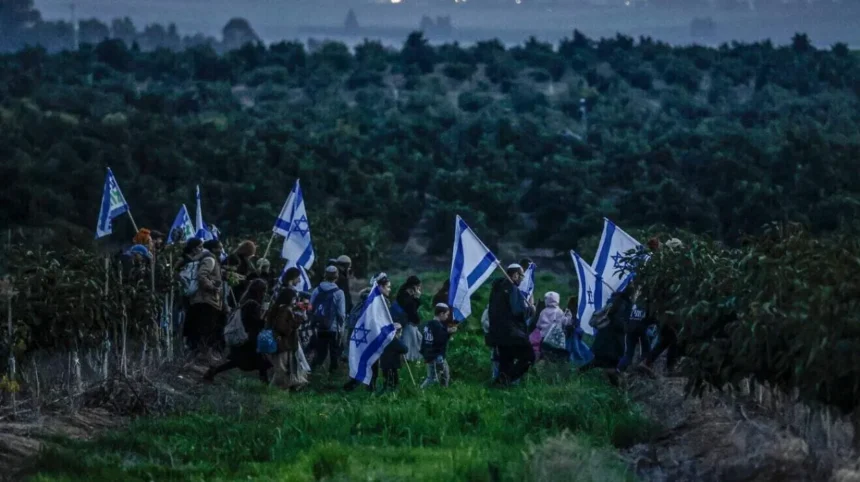
According to JNS, hundreds of Israeli demonstrators gathered near the Gaza border during a resettlement rally calling for the return of Jewish communities to the Strip. The event was described as part of a broader campaign by nationalist and settler activists to press for renewed Israeli civilian presence in Gaza after years of disengagement.
As reported by multiple Israeli media outlets, similar rallies in recent months have been organized or promoted by far-right and religious-nationalist groups advocating “Jewish resettlement” of Gaza and the encouragement of Palestinian emigration from the territory. These events have typically taken place in or near frontline communities close to the Gaza border, under heavy security restrictions imposed by the Israeli military.
JNS reported that during the latest rally, groups of participants moved toward areas adjacent to the border fence in an attempt to enter Gaza. According to Israeli media, security forces have repeatedly sought to prevent such incursions in recent months, citing the area’s status as a closed military zone and the ongoing security risks along the frontier.
Context and reactions: How have Israeli leaders and activists framed Gaza resettlement?
According to The Times of Israel, National Security Minister Itamar Ben Gvir has used similar rallies in Sderot to call for rebuilding Israeli settlements in Gaza and promoting what he describes as the “voluntary emigration” of Palestinians from the territory. At a previous mass gathering near the border, he urged supporters to “return” to Gaza and framed the idea of resettlement as a central component of Israel’s security policy.
As reported by The New Arab, Ben Gvir and other far-right politicians have repeatedly described Jewish resettlement of Gaza as the “true solution,” while supporting measures to encourage Palestinians to leave the Strip. These positions have drawn criticism from human rights groups and international commentators, who view such plans as incompatible with international law and Palestinians’ rights.
According to reporting in The Nation, the Nachala settler movement has played a prominent organizing role in efforts to promote a physical return to Gaza, with its leaders openly discussing long-term strategies to send activists into the Strip and resist orders to withdraw. The group has previously staged events near IDF bases and in closed zones abutting Gaza, encouraging supporters to prepare for eventual resettlement attempts.
Supporting details and security considerations
Israeli outlets have noted that the recent rally near Gaza followed a pattern of far-right demonstrations where participants approached restricted zones and, in some earlier cases, managed briefly to cross into the Strip before being removed by the army. According to a report carried by AFP and other agencies, several Israelis in a prior incident entered Gaza in defiance of military orders to hold a symbolic flag-raising ceremony advocating reoccupation and resettlement.
As reported by The New Arab and The Times of Israel, these rallies have drawn thousands of attendees, including coalition lawmakers and cabinet ministers, illustrating the political traction of resettlement ideas within segments of Israel’s right wing. Organizers such as Nachala have presented detailed plans for new settlement “cadres” in Gaza, unveiled at conferences and public events, with maps and organizational frameworks for prospective communities.
Security officials, however, have repeatedly cautioned that the Gaza border area remains an active combat zone where unauthorized civilian movement is prohibited. According to Israeli reporting, the military has used checkpoints, barriers, and on-the-ground forces to prevent demonstrators from entering Gaza during such rallies, citing both the risk of confrontation and the need to maintain operational control.
Implications and future developments: What could come next?
According to The Nation’s analysis of the settler movement’s strategy, far-right activists see repeated rallies, symbolic incursions, and public campaigns as steps toward normalizing the idea of long-term Jewish resettlement in Gaza. Leaders have indicated that they may seek future opportunities to bring larger groups of activists into military-controlled areas, testing the limits of government and army opposition.
Israeli political coverage suggests that calls for resettlement could continue to shape internal debate, particularly as ministers like Ben Gvir leverage public events near Gaza to push for policy shifts within the governing coalition. According to regional reporting, any attempt to formalize or operationalize resettlement plans would likely face significant international scrutiny and legal challenges, given the status of Gaza as occupied territory under much of the international community’s interpretation.
For now, Israeli authorities continue to treat the Gaza periphery as a restricted military zone, intervening when activists try to enter or establish unauthorized outposts. The latest rally, during which hundreds of Israelis attempted to reach Gaza, underscores the persistence of the resettlement push and the tensions between far-right civilian initiatives and official security policy.

