


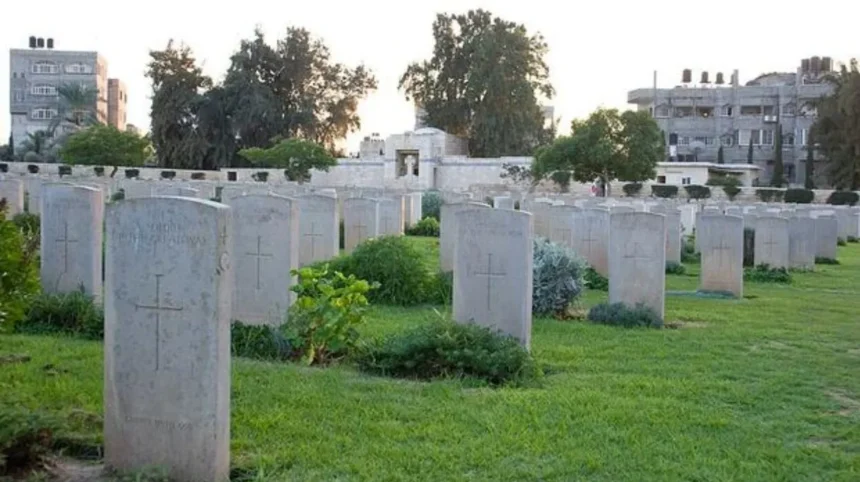
As reported by Military.com, Israeli Defense Forces bulldozed sections of the 106-year-old Gaza War Cemetery in al-Tuffah, eastern Gaza City, during recent military operations. The cemetery contains more than 3,600 graves of service members from over a dozen countries, most of them British troops killed in the 1917 Battles of Gaza.
According to Military.com, the destruction is believed to have affected more than 100 Allied graves from World War I and World War II. Nearly 800 markers at the cemetery bear no names, carrying only the inscription, “A Soldier of the Great War, known unto God,” and are among those feared to be damaged or destroyed.
Military.com reports that the cemetery has been maintained for generations by a Palestinian family working with the Commonwealth War Graves Commission (CWGC). Longtime caretaker Ibrahim Jeradeh, whose father was the first head gardener at the site, was awarded a Member of the Order of the British Empire for his decades of service.
The article notes that those buried at the cemetery include Victoria Cross recipient Stanley Boughey, as well as Australian, New Zealand, Canadian, Indian, Polish and former Ottoman soldiers. Outside the main walls, a separate plot held Canadian UN peacekeepers who served with the United Nations Emergency Force between 1956 and 1967.
How Extensive Is the Damage and What Evidence Shows It?
According to Military.com, The Guardian first revealed the extent of the damage on February 4, publishing satellite images from August 8 and December 13, 2025. The photos showed large earthworks in the southern corner of the cemetery, missing rows of headstones, disturbed earth and a new earthen berm cutting through the grounds.
Former caretaker Essam Jaradah told The Guardian, as cited by Military.com, that he witnessed two phases of bulldozing. He said the first operation stripped olive tree plantings around the perimeter outside the walls, while a second operation inside the cemetery carved out an area in a corner containing Australian soldiers’ graves.
Military.com reports that the internal bulldozing covered roughly 1,000 square meters. Satellite analysis suggests that two entire sections of World War II graves and four sections of World War I graves were flattened, with many of the damaged plots belonging to Australian and British soldiers, along with Polish service members.
The article adds that a burial plot for 22 Canadian UN peacekeepers outside the main cemetery walls was completely erased. Memorials honoring the British Army’s 54th (East Anglian) Infantry Division, an Indian UN contingent and dedicated Hindu, Muslim and Turkish sections were also damaged in the operations.
What Is Israel’s Explanation for the Damage?
According to Military.com, the Israel Defense Forces acknowledged that it conducted operations in and around the cemetery area. An IDF spokesperson told The Guardian that at the time, the cemetery and its surroundings formed part of an “active combat zone,” where militants attempted to attack Israeli troops and took cover in nearby structures.
The IDF stated that “operational measures” were taken to neutralize identified threats and that “underground terrorist infrastructure” was found within the cemetery and its surrounding area. Military.com notes that the IDF released a photograph in August 2025 showing what it said was a rocket launcher positioned among the graves, and that a Hamas supply tunnel was reportedly discovered nearby.
Military.com reports that Israel has not provided additional independent evidence beyond the photograph to substantiate its claims about the scale of militant use of the cemetery. The article points out that international humanitarian law prohibits deliberate destruction of cemeteries unless they are being used for military purposes and become legitimate military objectives.
The cemetery had suffered damage in previous conflicts. Military.com recalls that an Israeli airstrike in the mid-2000s led to compensation payments to the CWGC, and roughly 350 headstones required repair after Operation Cast Lead in 2008–2009.
How Have Allied Nations and Veterans’ Groups Responded?
According to Military.com, the reported destruction has prompted sharp reactions across Commonwealth countries, including Australia, the United Kingdom, Canada and New Zealand. In Australia, the issue became a point of contention during Israeli President Isaac Herzog’s visit, as Independent Senator David Pocock pressed Foreign Minister Penny Wong on whether the government would ask Israel to fund restoration.
Military.com recounts that Pocock read a message from an Australian constituent whose World War II veteran father is buried at the site, expressing distress and anger after previous assurances that few Australian graves were affected. RSL Australia president Peter Tinley called the reports “distressing,” while historian Peter Stanley highlighted the contrast between Israel’s calls for the return of hostages’ remains and the bulldozing of Commonwealth soldiers’ graves.
In Canada, Global Affairs described the situation as “deeply concerning,” and the Royal Canadian Legion said it was “devastated,” according to Military.com. Ottawa has opened an investigation into the extent of the damage, particularly in relation to the erased graves of Canadian UN peacekeepers.
Military.com reports that New Zealand’s Ministry of Foreign Affairs also expressed grave concern and confirmed that its ambassador raised the issue directly with Israeli officials. Retired Major Simon Strombom, a New Zealand veteran who served in Gaza, said that 20 New Zealand and two Rarotongan soldiers’ graves were among those destroyed. The Royal British Legion stressed that war graves honor those who “made the ultimate sacrifice” and must be treated with “the utmost respect.”
What Are the Implications and What Happens Next?
According to Military.com, the Commonwealth War Graves Commission has stated that it intends to restore the Gaza War Cemetery once conditions on the ground are safe enough for staff to return. In a statement on February 9, the CWGC said it is currently unable to access the site or prevent additional damage and has relocated its local maintenance team to Egypt.
Military.com notes that UK Veterans Minister Al Carns told Parliament the CWGC initially estimated that around 10 percent of headstones across the cemetery had been damaged. However, satellite imagery suggests the real extent of destruction may be significantly greater, and a full assessment will only be possible once security improves.
For now, the Gaza War Cemetery remains inside an active conflict zone, with many of its historic graves disturbed or destroyed. The eventual restoration is expected to require detailed surveying, replacement or repair of headstones and memorials, and coordination among affected Commonwealth governments.
In the meantime, the bulldozing of World War I and World War II Allied graves has become a sensitive diplomatic issue, adding a powerful symbolic dimension to wider international debates over the conduct of Israeli military operations in Gaza and the protection of cultural and historical sites in wartime.

