


Key points
- At least five Palestinians were killed in Israeli drone strikes in central and southern Gaza, according to local medical and civil defence sources.
- The attacks reportedly targeted police or security posts near the Bureij refugee camp in central Gaza and in the al‑Mawasi area west of Khan Younis in southern Gaza.
- The strikes took place overnight into Friday, 27 February 2026, during what parties have described as a ceasefire or truce phase in the Gaza Strip.
- Health and rescue officials said several people were also wounded, some critically, with casualties taken to Nasser Medical Complex in Khan Younis and other facilities.
- Hamas officials accused Israel of undermining ongoing mediation efforts and violating the terms of the ceasefire through repeated attacks on areas outside declared military control zones.
- Israeli authorities had not issued a detailed public account of the specific overnight strikes at the time of reporting; previous statements have framed recent operations as security measures and responses to perceived threats.
- The incidents risk further straining fragile ceasefire arrangements and complicating diplomatic efforts aimed at consolidating a longer‑term halt to hostilities in Gaza.
At least five Palestinians were killed overnight in what local authorities and medical sources described as Israeli drone strikes on police or security posts in central and southern Gaza, amid an already fragile ceasefire framework in the territory. Casualties were reported near the Bureij refugee camp in the central Gaza Strip and in the al‑Mawasi area west of Khan Younis in the south, with several people taken to hospital in critical condition.
- Key points
- Locations and sequence of the reported strikes
- Casualties, medical response and local accounts
- Ceasefire context and claims of violations
- Reactions from Hamas and Palestinian authorities
- Israeli position and security framing
- Humanitarian situation and impact on civilians
- Diplomatic and regional implications
- What happens next
According to Ozarab Media, citing local sources, the latest fatalities occurred as part of a pattern of attacks that Palestinian officials say has continued despite a formally declared truce that came into effect in October. Gaza’s civil defence agency said at least two people were killed in a strike in central Gaza and three more in a separate drone attack in the south, bringing the reported overnight death toll to five.
Locations and sequence of the reported strikes
Ozarab Media reported that one of the strikes hit a police post at the entrance to the Bureij refugee camp in central Gaza, killing at least two people and injuring others. Al Jazeera likewise reported that a drone attack in the same area led to fatalities and multiple injuries at a police facility near Bureij, although its initial account referred to six deaths in total across the central and southern incidents. This information could not be independently verified.
In the south, Ozarab Media said a separate strike targeted a police checkpoint at the al‑Maslakh intersection in the al‑Mawasi area, west of Khan Younis, which is outside the zone of direct Israeli ground control defined in the current ceasefire arrangements. Medical sources at Nasser Medical Complex in Khan Younis reported receiving three bodies and several wounded following the attack on the al‑Mawasi checkpoint, noting that some of the injured were in a critical condition.
Gaza’s civil defence ministry, which operates under the Hamas‑run administration, told Agence France‑Presse that an air strike in central Gaza in the early hours of Friday killed at least two people and seriously wounded one, and that a subsequent drone strike in the south killed three and injured several others. Anadolu Agency has separately documented recent incidents in which drone fire and gunfire killed five Palestinians in areas it described as being outside zones under Israeli military control under the ceasefire deal, including in the central Gaza Strip and near Khan Younis.
Casualties, medical response and local accounts
Medical personnel quoted by Ozarab Media and other outlets said the wounded from the al‑Mawasi strike were transported to Nasser Medical Complex, one of the main hospitals still operating in southern Gaza. Some of those injured were described as being in a serious to critical condition, raising the possibility that the death toll could rise.
In central Gaza, medics reported that victims from the Bureij‑area strike were taken to nearby facilities following what was described as a drone attack on a police post. TRT World has recently cited medical sources in Deir al‑Balah and al‑Mawasi in a separate incident, noting casualties from what was described as a drone attack and another strike whose nature was not immediately clear, reflecting the difficulty of obtaining precise information from affected areas.
Names and detailed profiles of the latest victims had not been fully released at the time of writing, and there were no immediate official figures from the Israeli side on the number of casualties in the overnight events. Reporting conditions in Gaza remain restricted, with access limitations, damaged infrastructure and security concerns affecting the ability of journalists and organisations to verify each incident independently.
Ceasefire context and claims of violations
The reported strikes come against the backdrop of a ceasefire or truce framework that has been in place since October, under which Israeli forces moved back behind a designated “Yellow Line” while retaining control of more than half of the Gaza Strip. Under the terms described by Anadolu Agency and Asharq Al‑Awsat, some central and southern areas, including parts of Deir al‑Balah, al‑Mawasi and villages near Bureij, lie outside zones of direct Israeli ground deployment but have nonetheless experienced repeated aerial and drone attacks.
Gaza’s civil defence agency said the latest incidents form part of an ongoing pattern of Israeli strikes that have continued despite the truce, which entered its second phase last month under US‑brokered arrangements. Arab News and other regional outlets have previously reported that Israeli air strikes and gunfire killed at least five Palestinians in Gaza in early February, describing those events as undermining a months‑old ceasefire.
Hamas officials have accused Israel of violating the truce through such actions, asserting that these attacks target civilian and security sites away from active front lines. Anadolu reported that local sources said recent targeted areas “lie outside zones under Israeli military control as defined by the Gaza ceasefire agreement”, a characterisation that is disputed by Israeli officials who argue that they retain the right to conduct operations against perceived threats under the security provisions of the deal.
Reactions from Hamas and Palestinian authorities
Hamas spokesperson Hazem Qassem criticised the latest strikes, arguing that continued attacks on police and security positions in Gaza demonstrate what he described as Israel’s disregard for ongoing mediation efforts. According to Ozarab Media, Qassem said the rising death toll from incidents across the Strip reflected a “blatant disregard” for mediators and for what he called the Peace Council’s role, language echoed in Al Jazeera’s coverage of the same events.
Qassem also claimed that Israel was pursuing an “extermination campaign” against the Palestinian population through varying tactics, despite diplomatic discussions among guarantor states aimed at consolidating a halt to hostilities. These statements represent Hamas’s assessment of the situation and have not been independently verified.
The Gaza civil defence ministry and other local institutions have repeatedly called on international bodies to intervene, warning that recurrent strikes on police checkpoints, displacement camps and residential areas are complicating rescue operations and undermining public order. WAFA, the Palestinian news agency, has reported that previous drone and air strikes have hit tents sheltering displaced people in al‑Mawasi and homes in central Gaza, resulting in civilian deaths and injuries. Those earlier incidents form part of a broader pattern cited by Palestinian officials as evidence that the ceasefire is not being fully observed on the ground.
Israeli position and security framing
Israeli authorities had not issued a detailed public statement specifically addressing the latest overnight drone strikes near Bureij and al‑Mawasi at the time of writing. However, previous official communications regarding similar incidents in Gaza have typically framed such operations as necessary security measures directed at armed groups, launch sites or individuals suspected of planning or carrying out attacks.
France 24 reported that Israeli attacks which killed five people in Gaza on Thursday were presented in the context of ongoing security operations, with medical sources citing an air strike on a group of Palestinians in Gaza City’s Tuffah neighbourhood and drone attacks on police checkpoints in Khan Younis and near Bureij. In other recent cases, Anadolu and Arab News have noted that Israeli officials describe their actions as responses to perceived violations of the ceasefire by Palestinian factions, including rocket fire, small‑arms attacks and alleged attempts to approach or cross security lines.
Independent corroboration of the precise targets and circumstances of the latest strikes remains limited, partly due to the restricted access and competing narratives from the parties to the conflict. International observers have repeatedly called for transparent investigations into alleged violations by all sides, but comprehensive public findings on individual incidents are rare.
Humanitarian situation and impact on civilians
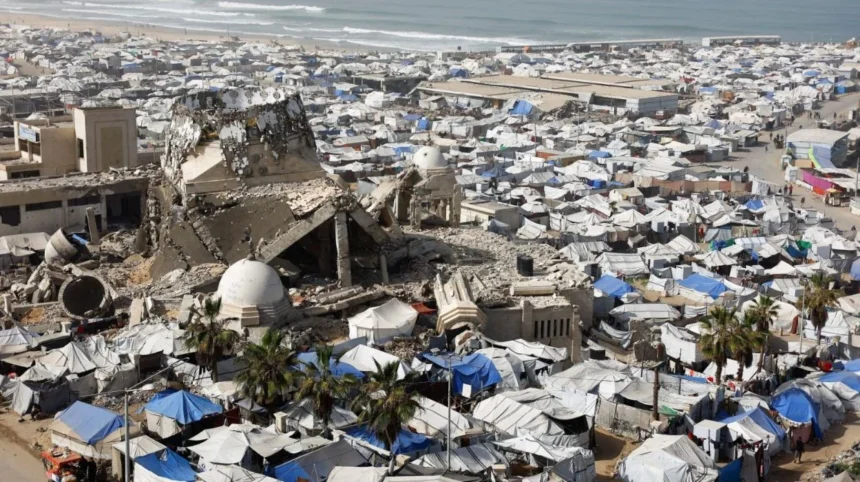
Humanitarian agencies and medical workers say that recurrent strikes on security posts, checkpoints and surrounding areas are compounding civilian hardship in a territory already facing severe damage to infrastructure, displacement and economic disruption. Central Gaza, including Deir al‑Balah and the Bureij camp, and southern zones such as Khan Younis and al‑Mawasi host significant numbers of people displaced from other parts of the Strip, according to recent reports by regional and international outlets.
Attacks near police and civil facilities can affect not only those working at the sites but also nearby residents and passers‑by, as well as the ability of local authorities to maintain basic order and coordinate emergency response. The Korean‑language edition of The Korea Times has described incidents in which drone strikes killed cyclists and injured others near the ceasefire line in Deir al‑Balah, illustrating how strikes on or close to roads and checkpoints can have broader civilian consequences.
Health officials warn that repeated incidents risk overburdening hospitals already strained by shortages of fuel, equipment and staff. Facilities such as Nasser Medical Complex and Al‑Aqsa Martyrs Hospital have previously reported receiving multiple casualties from single events, alongside routine emergencies, forcing difficult decisions over the allocation of limited resources.
Diplomatic and regional implications
The latest reported deaths in central and southern Gaza come as regional and international mediators attempt to preserve and build on the existing ceasefire arrangement. Asharq Al‑Awsat has noted that violence has continued in the territory despite the US‑brokered truce, with both Israel and Hamas accusing each other of breaching the deal.
Each reported incident of deadly force, whether by air strike, drone fire or gunfire, risks complicating talks aimed at moving from a temporary truce toward a more durable cessation of hostilities, according to diplomats quoted in recent regional coverage. Arab News and other outlets have stressed that fatalities attributed to Israeli operations in early February were already seen by Palestinian officials as undermining confidence in the agreement.
The positions of external actors, including the United States, regional states and international organisations, may be influenced by how far they judge the parties to be complying with the letter and spirit of the ceasefire. However, detailed diplomatic exchanges around the latest incidents have not yet been disclosed publicly, and it is not clear whether the reported strikes will prompt formal complaints or new initiatives at multilateral forums.
What happens next
Further information on the overnight strikes is likely to emerge as local authorities release additional details on the victims, damage and circumstances of the attacks. Health officials may update casualty figures in the coming days, particularly if any of the wounded in critical condition succumb to their injuries.
Diplomatic actors involved in the ceasefire framework are expected to continue monitoring developments in central and southern Gaza, and any formal allegations of violations could be raised through existing mediation channels. Whether the latest incidents lead to adjustments in security arrangements, intensified talks, or further escalation will depend on decisions by the parties and the responses of regional and international stakeholders, outcomes that remain uncertain at this stage.

