


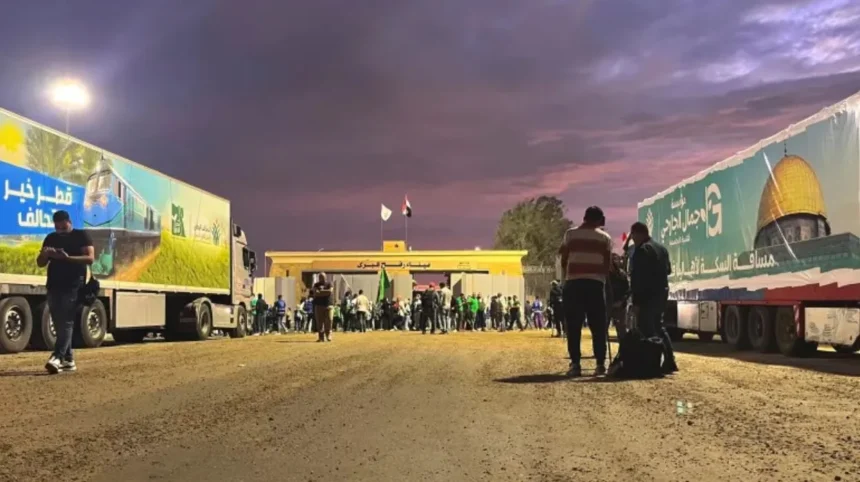
According to Haaretz, Israel and Egypt have significantly restricted the movement of Palestinians approved to travel through Gaza’s Rafah border crossing, allowing only a small fraction to transit despite prior clearances. The report states that Rafah, Gaza’s main gateway to Egypt and the outside world, reopened in a limited fashion under arrangements tied to the ceasefire but now operates with far tighter controls than many Palestinians had expected. Haaretz notes that most Palestinians who had received approval to cross remain stuck in Gaza or outside the Strip, as new Israeli and Egyptian procedures sharply reduce the number of people actually permitted to pass.
Haaretz reports that Israeli authorities are applying stringent security vetting and limiting daily quotas, while Egyptian authorities are also enforcing their own restrictions on entry and exit. The outlet explains that these measures have created a bottleneck at Rafah, where lists of approved travelers do not translate into actual passage for the majority. According to Haaretz, this has left many Palestinians in limbo, including those seeking medical treatment abroad, students, workers, and families trying to reunite after years of separation.
How Are Palestinians and Officials Reacting?
Haaretz describes growing frustration and anger among Palestinians who were told they had been cleared to transit Rafah but were later blocked at checkpoints or informed they could not travel. The outlet reports that some Palestinians have waited for months or longer for their names to appear on approval lists, only to discover that only a small group is allowed through each day. According to Haaretz, travelers have complained of a lack of transparency about the criteria used and sudden last-minute changes in procedures.
The report notes that Palestinian officials and local representatives have criticized the restrictions, arguing that the current system effectively denies freedom of movement to most Gazans despite formal announcements that the crossing has reopened. Haaretz states that some officials have called on both Israel and Egypt to honor commitments related to Rafah’s operation under the ceasefire framework and to provide clear, consistent rules. According to the outlet, human rights advocates also warn that blocking most approved travelers undermines humanitarian efforts and violates basic rights to travel, work, and access medical care.
Supporting Details and Border Arrangements
Haaretz explains that control and coordination at Rafah involve multiple actors, including Israel, Egypt, and Palestinian authorities, under security arrangements linked to the broader ceasefire and border management agreements. The outlet reports that Israel retains significant influence over who can exit or enter Gaza, even at Rafah, through security screenings and decisions on which categories of travelers may cross. According to Haaretz, Egyptian authorities also enforce national security and policy considerations, which further limit the number of Palestinians admitted to their territory.
The report notes that daily crossing figures remain far below both the crossing’s technical capacity and the number of Palestinians who have received initial approval or registered to travel. Haaretz adds that many of those blocked include urgent medical cases and students with deadlines for university enrollment, as well as Palestinians abroad who are unable to return to their homes in Gaza. According to the outlet, the slow and selective reopening contrasts sharply with earlier expectations that Rafah would serve as a key humanitarian and civilian lifeline after nearly two years of war.
What Are the Implications and Next Steps?
Haaretz reports that the severe limits on Palestinian movement through Rafah could have significant humanitarian and political implications if they continue. The outlet notes that restricted transit affects access to medical treatment, education, employment, and family reunification, deepening the sense of isolation among Gaza’s population. According to Haaretz, the situation may also strain relations between Palestinian communities and both Israel and Egypt, particularly if promises of eased movement under the ceasefire are perceived as unfulfilled.
The report indicates that any substantial change will depend on new understandings or adjustments between Israel and Egypt regarding security, vetting procedures, and daily quotas at the crossing. Haaretz notes that international actors monitoring the ceasefire and humanitarian situation may also press for broader access through Rafah as part of efforts to stabilize Gaza and support reconstruction and recovery. For now, most Palestinians approved to transit remain unable to move, highlighting the gap between official announcements of Rafah’s reopening and the reality on the ground.

