


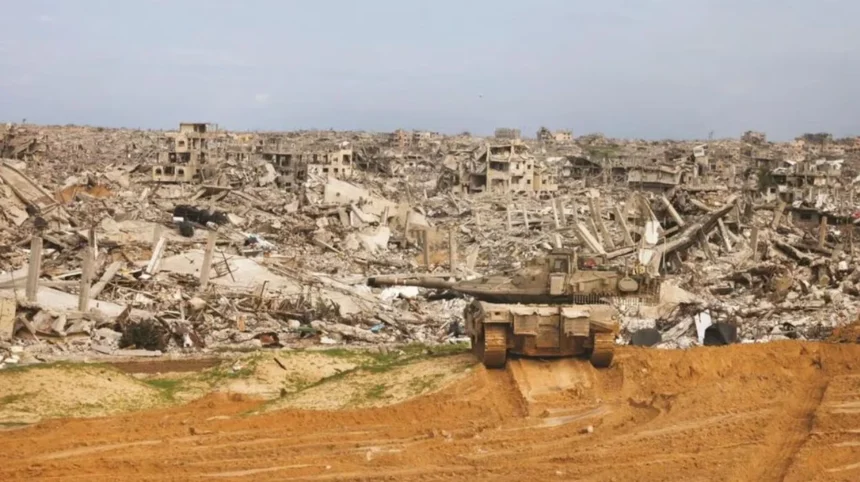
Tel Aviv (January 8, 2025) – Israel drifting in Gaza as global plan advances without it, amid intensifying international efforts to shape the territory’s postwar order and reconstruction. The widening gap between Israel’s declared objectives and realities in the Gaza Strip is drawing growing concern among regional and global actors. While outside powers move toward a technocratic administration and multinational arrangements, Israel remains focused on military control and long-term presence inside the enclave. Analysts warn that this disconnect could limit Israel’s influence over Gaza’s future and deepen internal tensions at home.
General context and emerging postwar framework
As reported by Dr. Michael Milshtein of Ynet, Israel drifting in Gaza reflects a broader loss of direction regarding the enclave’s political and security future. He notes that Israeli debate has fixated on symbolic issues, such as the resemblance between the eagle emblem of a planned technocrats’ committee for Gaza and that of the Palestinian Authority, even as more substantive diplomatic moves take shape. According to Milshtein, these developments include the establishment of a liaison committee between the technocratic framework and the Palestinian Authority, formed with the approval of an international body he terms the Board of Peace.
The article explains that recent discussions at the Board of Peace centered on the creation of a multinational force in Gaza, though such a force is not expected to disarm Hamas. Efforts are also under way to mobilize funds for Gaza’s reconstruction, even without full demilitarization, signaling that donors and key states are willing to move ahead despite unresolved security issues. Qatar is described as returning to a central role in the enclave’s future, a prospect that troubles Israel, which would prefer leadership by other Arab states, especially Saudi Arabia, while resisting their insistence on renewed political negotiations over the Palestinian issue.
Milshtein writes that a technocratic government is expected to be installed in Gaza, ostensibly to provide administrative governance and an alternative to direct Hamas rule. However, he cautions that such a body could become a cosmetic façade behind which Hamas attempts to operate according to what he calls the Hezbollah model, maintaining armed capabilities and influence while allowing an ostensibly civilian structure to manage formal affairs. This dynamic, he suggests, underscores the complexity of designing a postwar political framework that curbs Hamas power while securing international support.
Why is Israel’s approach diverging from global efforts?
As reported by Milshtein, Israel drifting in Gaza is partly rooted in its insistence on returning to intensive military operations as the primary answer to emerging international plans. In the face of global moves toward a new, if imperfect, order for Gaza, he notes that the main solution advanced by Israeli leaders is renewed war, including talk of occupying the enclave and maintaining a long-term presence. Some domestic voices, he adds, have gone further by proposing Jewish resettlement inside the Strip and the removal of Gazan residents, ideas that lack international backing.
According to the analysis, there has been no comprehensive public debate inside Israel over “the day after” the war, leaving slogans and aspirations to fill the vacuum where detailed policy should be. Milshtein highlights that Israel continues to invest in informal local militias and clans in Gaza in the hope that they might become an alternative to Hamas, despite the organization’s continuing dominance over the territory’s education system and public consciousness. At the same time, he points to ongoing construction of new mosques by Turkey, including one named after Abdullah Azzam, a historical mentor to Osama bin Laden and a figure admired by Hamas, as evidence that ideological radicalization has not been reversed.
The article notes that Israel has entrenched forces along what is referred to as the Yellow Line, an internal division across Gaza that many now call the new border. This positioning forms part of a new security doctrine that requires a presence deep inside enemy territory to protect Israel’s frontiers. Milshtein warns that such a doctrine demands a thorough, transparent strategic process, which he argues is lacking under the current leadership, given the failures that preceded the October 7 attack and the subsequent conflict.
He further writes that the security concept assumes minimal external pressure and future freedom to resume large-scale combat, an assumption that appears increasingly tenuous. In his assessment, President Donald Trump continues to signal limits on Israeli operations and may eventually press for deeper withdrawals from the enclave. This external constraint, he suggests, complicates Israel’s plan to maintain robust control in Gaza while ignoring or sidelining international diplomatic tracks.
What reactions and internal dilemmas are emerging?
Milshtein describes how Israel drifting in Gaza has produced daily frictions and serious ethical and operational challenges tied to an extended static deployment. He notes that holding the Yellow Line without clearly defined goals and timelines has led to routine confrontations, as well as alleged misconduct, such as smuggling cases involving individuals like Bezalel Zini and others under suspicion. He also cites incidents in which civilians have reportedly entered Gaza in attempts to establish unauthorized settlements, echoing patterns seen in Syria and Lebanon and raising concerns about the intersection of ideology and military needs.
The article references the case of IDF soldier Gur Kehati, who was killed in what Milshtein describes as a tragic event linked to civilian incursions and the clash between messianic aspirations and operational requirements. Such episodes, he warns, could culminate in severe disasters and provoke deep internal ruptures within Israeli society. These tensions illustrate how Israel drifting in Gaza risks undermining both security discipline and social cohesion.
Another key reaction comes from bereaved families, whose voices are beginning to question the long-term rationale for continued military presence inside the Strip. Milshtein recounts that the father of IDF soldier Ofri Yafe, who was mistakenly killed by friendly fire in Gaza, publicly asked what purpose remained in staying in the enclave once major fighting had ceased. This question, he argues, encapsulates a growing dilemma for Israeli decision-makers: whether maintaining the current posture justifies the increasing human and political costs.
Milshtein contends that the government’s reluctance to develop a structured strategy or to investigate the roots of the failures leading to the October 7 disaster reflects a broader difficulty in acknowledging mistakes and presenting complex realities to the public. Instead, he writes, officials have tried to conceal or blur gaps between aims and outcomes, and sometimes to portray setbacks as achievements. This pattern, he suggests, contributes to the sense of Israel drifting in Gaza at a time when external actors are shaping the future of the territory.
Supporting details and expert assessments
In his capacity as head of the Forum for Palestinian Studies at the Dayan Center at Tel Aviv University, Milshtein uses his analysis to outline concrete examples of what he calls misguided or collapsed initiatives in Gaza. He notes that the end of the war came under external compulsion and not in line with the Israeli government’s preferences, with ceasefire arrangements imposed twice and followed by a transition to a so-called second phase. This process, he implies, diminished Israel’s leverage at the moment when future arrangements for Gaza were being discussed.
Milshtein writes that several Israeli-backed projects, including an initiative he identifies as the Gaza Humanitarian Foundation, have failed to achieve their intended goals. He also characterizes ideas about relocating large numbers of Gazans to other countries as unrealistic and detached from political reality. In his view, these outcomes underscore the limitations of unilateral approaches that do not take into account international constraints, regional dynamics, and the enduring presence of Hamas and other actors on the ground.
According to his assessment, one of the most significant trends is the growing influence of Turkey and Qatar over developments in the Gaza Strip. Despite Israeli objections, he notes that both countries now play central roles in shaping reconstruction, political arrangements, and broader public narratives. Milshtein argues that this shift is partly the result of what he calls Israeli stubbornness driven by domestic political considerations, which has, in his view, contributed to a gradual internationalization of Gaza and a reduction in Israel’s direct influence.
The expert analysis suggests that Israel drifting in Gaza is not merely a short-term tactical problem but a strategic challenge that could determine the balance of power in and around the enclave for years. Milshtein emphasizes that, although international mechanisms and technocratic structures may be imperfect, they are moving forward, while Israel has yet to articulate a coherent alternative that aligns military, diplomatic, and political objectives.
What are the implications and possible future moves?
Milshtein anticipates that Israel will soon face additional demands from President Trump and other international stakeholders regarding Gaza’s future trajectory. He writes that, just as foreign pressure twice forced an end to major combat and a shift to a second operational phase, Israel may now be pressed to support reconstruction, accept a multinational presence, and allow a technocratic government to assume administrative duties. Such steps, he argues, could restrict Israel’s freedom of action, especially if accompanied by proposals to strip Hamas only of heavy weapons while enabling a deeper Israeli withdrawal from parts of the Strip.
The article warns that Israel drifting in Gaza, without a clearly defined and publicly debated strategy, increases the likelihood that external actors will set the parameters of any long-term settlement. Milshtein asserts that there are no ideal solutions available and that Israeli leaders must therefore identify what he calls the least bad option among a series of difficult choices. He stresses that this process requires clarity about national priorities, including security, international legitimacy, and the prevention of hostile forces gaining a foothold along Israel’s borders.
In outlining potential policy directions, Milshtein suggests that Israel should concentrate on three core objectives. These include preserving operational freedom of action along the lines of its posture in Lebanon, ensuring that the Philadelphi Corridor on the Gaza–Egypt border remains under non-Palestinian control, and retaining a veto over the deployment of any hostile forces in the Gaza Strip. He frames these aims as essential elements of a viable security concept, even if broader political arrangements remain fluid or contentious.
At the same time, he argues that Israel must recognize that a technocratic government in Gaza is likely to be the least damaging of the realistic options currently on the table. In his view, such a structure could function as a temporary framework while Israel works to design a more comprehensive strategy to weaken and ultimately uproot Hamas over time. He stresses that any such strategy would have to be proactive and backed by both domestic consensus and international support, conditions that he says are not currently in place and that help explain why Israel appears to be drifting as others move ahead.
Final overview
Milshtein’s analysis portrays Israel drifting in Gaza as the product of a mismatch between ambitious objectives and limited tools, compounded by political hesitation and an absence of transparent strategic debate. While international forums develop plans for reconstruction, a multinational presence, and technocratic governance, Israel remains focused on holding lines inside the Strip, deterring threats, and resisting political concessions it views as risky. This divergence has contributed to a situation in which Israel’s influence over Gaza’s future may be narrowing even as its military footprint remains significant.
The article concludes that, in a landscape with no ideal choices, Israel will have to decide whether to engage constructively with emerging international frameworks or to continue relying on unilateral military approaches that have already encountered substantial constraints. For Milshtein, recognizing the reality of Israel drifting in Gaza is a necessary first step toward devising a coherent strategy that balances security needs, political durability, and international legitimacy in the Gaza Strip.

