


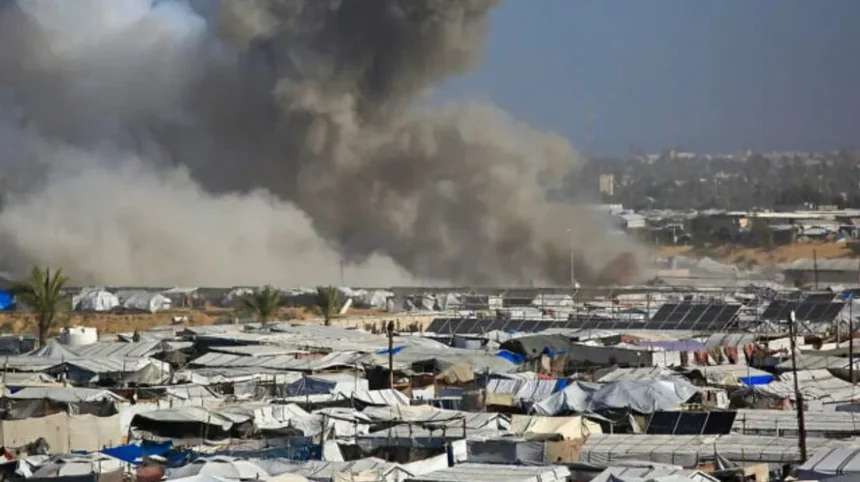
The Israel Defense Forces (IDF) say they carried out a wave of airstrikes across the Gaza Strip targeting senior figures and military infrastructure belonging to Hamas and Palestinian Islamic Jihad (PIJ), which Israel designates as terror organizations. According to the IDF, the strikes were launched in response to what it described as a “violation of the ceasefire” in southern Gaza’s Rafah area. The military says the operation focused on commanders, weapons facilities, and rocket-launching positions linked to the groups.
According to The Times of Israel, the IDF says the airstrikes followed an incident on Friday in which eight gunmen allegedly emerged from a tunnel in Rafah. The military reports that three of the gunmen were killed in subsequent strikes, while a fourth, described by the IDF as a key Hamas commander, was captured. The IDF says this tunnel incident constituted a breach of the existing ceasefire agreement in Gaza.
The military adds that, since last night, its forces have targeted four commanders from Hamas and PIJ, a weapons depot, an arms manufacturing site, and two rocket launching positions. In its public statement, the IDF links these targets to efforts to prevent further attacks on Israeli troops and civilians. Hamas’s civil defense agency, cited by The Times of Israel, says it has retrieved the bodies of 28 people killed by the strikes at seven different locations in the Gaza Strip since the morning.
What Are the Reactions and Claims?
According to The Times of Israel’s report on the IDF statement, the military accuses armed groups in Gaza of “systematically” violating international law by operating within civilian areas and using civilian infrastructure. In its comments, the IDF alleges that Hamas and PIJ “brutally” exploit civilian institutions and conduct operations in the presence of the local population. These claims form part of Israel’s broader justification for targeting sites it describes as dual-use or embedded within urban areas.
The IDF further states that it, along with Israel’s internal security agency, the Shin Bet, views any violation of the ceasefire agreement “gravely.” The military says it will continue acting against attempts by Hamas and other armed factions in Gaza to carry out attacks against Israeli forces and Israeli civilians. The Times of Israel notes that, in this context, the IDF frames the latest strikes as a direct response to the Rafah tunnel incident and a deterrent against future ceasefire breaches.
Hamas’s civil defense agency, as cited in the same report, focuses on the human toll of the strikes, saying bodies have been recovered from multiple locations hit across Gaza. While the IDF emphasizes the targeting of commanders and military assets, the civil defense account underscores the number of people killed, without distinguishing between combatants and civilians in the brief statement reported. No additional detailed response from Hamas or PIJ leadership is included in the cited liveblog entry.
Supporting Details and Background
The Times of Israel report places the strikes within the framework of a ceasefire that has been in place but remains fragile, with both sides accusing each other of violations at various points. The IDF says the emergence of armed men from a tunnel in Rafah was a clear breach of the agreement, prompting what it describes as a calibrated military response against leadership figures and strategic assets of Hamas and PIJ. The tunnel activity, according to the military, was interpreted as preparation for or execution of attacks against Israeli forces.
In its statement, the IDF highlights a series of targets: four commanders from Hamas and PIJ, a weapons depot, an arms production facility, and two rocket launching positions. These details, reported by The Times of Israel, align with Israel’s broader pattern of targeting what it identifies as the command-and-control network, weapons storage, and rocket infrastructure of armed factions in Gaza. The military’s language links these types of targets to efforts to deter rocket fire and cross-border attacks.
The report also notes that Hamas’s civil defense agency has accounted for 28 bodies recovered after the strikes, spread across seven locations. This toll provides an initial indication of the scale of the operation’s impact on the ground, though the report does not break down the fatalities by affiliation or status. The figures highlight the continuing risk to people in areas where armed groups and military targets are present or alleged to operate.
What Are the Implications and What Happens Next?
According to the IDF’s statement reported by The Times of Israel, Israeli security authorities signal they will continue to respond forcefully to what they see as ceasefire violations by Hamas and PIJ. The military’s warning that it and the Shin Bet will “continue to act” against any attempts to attack Israeli troops and civilians suggests that further strikes remain possible if similar incidents are detected. This stance indicates that the ceasefire’s durability is closely tied to how both sides interpret and act on events such as the Rafah tunnel episode.
The reported death toll of 28 from Hamas’s civil defense agency, alongside the IDF’s claims of targeted strikes on commanders and military infrastructure, underscores the potential for each new incident to fuel further tensions over the ceasefire’s implementation. The lack of additional detail on the identities of those killed may become a point of contention in public and diplomatic discourse as more information emerges. Questions may also arise among international observers about the balance between Israel’s stated security objectives and the humanitarian impact of such operations.
In the near term, developments will likely center on whether similar tunnel or cross-border incidents occur, how Hamas and PIJ respond to the loss of commanders and facilities, and whether international mediators or governments call for renewed restraint. The IDF’s framing of the Rafah tunnel incident as a serious ceasefire breach suggests that any repetition of such activity could trigger additional strikes. At the same time, casualty reports from Gaza, as cited in The Times of Israel, will continue to shape perceptions of the ceasefire’s stability and the broader trajectory of the conflict.

