


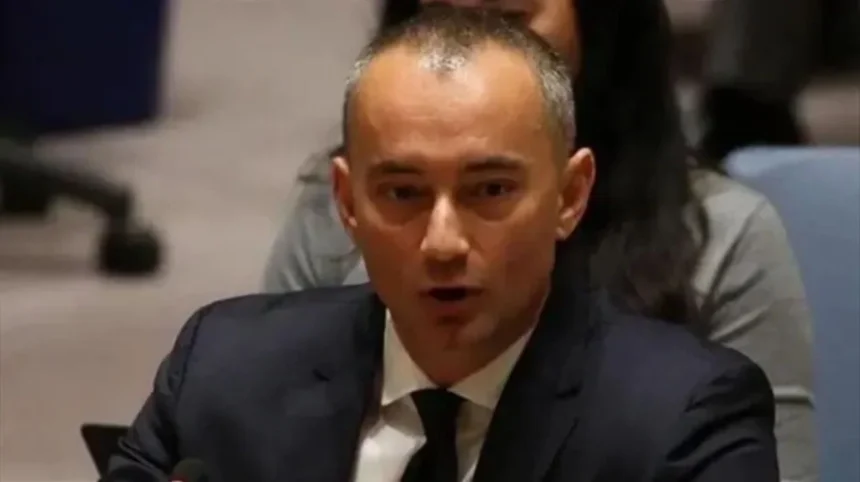
As reported by Anadolu Agency via Yeni Safak, Board of Peace High Representative for Gaza Nickolay Mladenov told the UN Security Council that conditions in the enclave remain “very, very difficult” despite progress under the first phase of the ceasefire agreement. According to Anadolu Agency, he said essential services in Gaza are operating at a fraction of their pre-war capacity, with the health care system in collapse and “no functioning economy.” Mladenov described his briefing as a warning that early gains from the ceasefire have not yet translated into a sustainable improvement in daily life for civilians.
As reported by Anadolu Agency, the current ceasefire is structured in phases under a plan endorsed by the UN Security Council to end the conflict that began with Israel’s large-scale offensive on Gaza in October 2023. According to Yeni Safak’s report, the first phase has brought some improvement in security conditions, but infrastructure damage, displacement, and economic breakdown continue to shape living conditions. Mladenov’s briefing framed the situation as a race between implementing the agreed roadmap and the risk that humanitarian and governance failures could undermine the ceasefire’s second phase.
Context and reactions: what did the envoy highlight?
According to Anadolu Agency’s account of the UN session, Mladenov outlined three immediate priorities to stabilize Gaza: keeping the Rafah crossing open, expanding humanitarian access, and accelerating temporary housing solutions. He warned that any restriction on the Rafah crossing’s operation “directly impedes the implementation of phase two of the ceasefire,” underscoring its role as a critical entry and exit point for people and supplies. As reported by Yeni Safak, he also said current aid flows are “not adequate for the scale of need,” noting that logistical pipelines exist but access must be improved.
According to Yeni Safak, Mladenov stressed that more than 2 million people in Gaza “cannot continue to endure undignified living conditions,” urging an acceleration of temporary housing and reconstruction efforts. He acknowledged that “no plan is perfect” but argued that the current ceasefire framework remains the only document that links decommissioning of armed groups, reconstruction, civilian transition, and reunification of Palestinian institutions into a single sequence. Anadolu Agency reported that he framed full implementation of this plan as essential for any realistic advance toward peace between Israelis and Palestinians.
Supporting details: ceasefire framework and Board of Peace role
According to earlier reporting by Yeni Safak, the Board of Peace is a U.S.-proposed international body endorsed by the UN to help manage Gaza’s post-conflict transition, with participation from Türkiye, Egypt, Jordan, Indonesia, Pakistan, Qatar, Saudi Arabia, and the United Arab Emirates. As reported by that outlet, the Board’s mandate is tied to the “Comprehensive Plan to End the Gaza Conflict,” which was endorsed by the UN Security Council in Resolution 2803 and aims to cement a permanent ceasefire, support reconstruction, and advance Palestinian self-determination within international law.
Yeni Safak’s earlier coverage noted that the Board of Peace forms part of a broader structure that also includes a National Committee for the Administration of Gaza, designed to oversee the territory’s transitional phase. According to that reporting, regional governments backing the Board have framed their involvement as a way to lend operational capacity and regional legitimacy to the UN-endorsed framework. In his latest briefing, Mladenov referred to the ceasefire plan as a sequence that, if implemented, would link security steps with reconstruction and institutional reunification, underscoring the Board’s role in advancing that process.
Implications and future developments: what are the next steps?
According to Anadolu Agency, Mladenov told the Security Council that maintaining the Rafah crossing’s openness and scaling up humanitarian deliveries are essential for moving into phase two of the ceasefire, which is expected to deepen reconstruction and civilian governance measures. His warning implied that any tightening of crossing restrictions or prolonged underfunding of aid could delay or derail that next phase. As reported by Yeni Safak, he urged UN member states to support full implementation of the ceasefire plan if they are “serious about advancing peace between Israelis and Palestinians.”
Earlier reporting on the Board of Peace’s creation indicated that international and regional backers see the phased plan as a path toward a more durable ceasefire and a political framework grounded in Palestinian statehood. Mladenov’s latest assessment suggests that, while active fighting has decreased under the ceasefire, living conditions and institutional collapse in Gaza will remain central tests of the plan’s credibility in the coming phases.
Mladenov’s briefing to the UN Security Council, as carried by Anadolu Agency and Yeni Safak, portrays a Gaza Strip where an initial ceasefire has reduced immediate violence but left core humanitarian, economic, and governance crises largely unresolved. His call to keep Rafah open, expand aid, and accelerate housing and reconstruction underscores that the success of the Board of Peace’s phased plan will depend on whether these urgent needs are met while the ceasefire framework moves into its next stage.

