


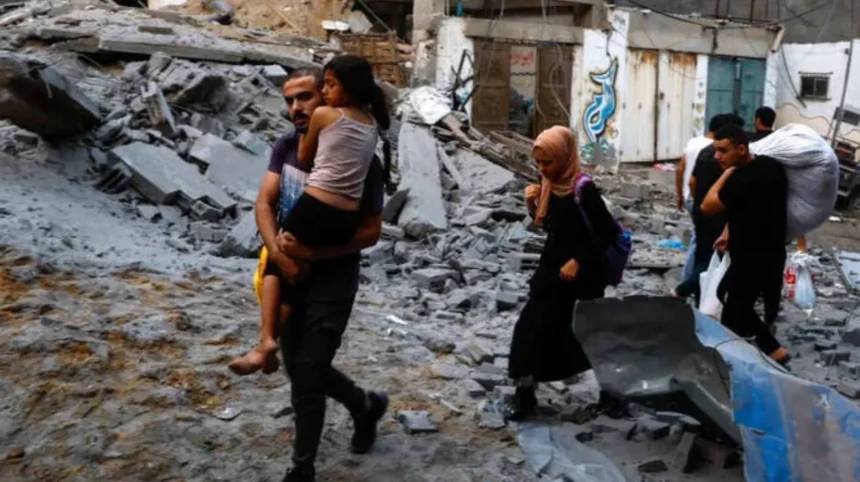
As reported by Daoud Kuttab of Arab News, five months after a US-sponsored ceasefire backed by UN Security Council Resolution 2803, Israel continues to control Gaza and the truce has not taken root. According to the article, Israel’s military presence has effectively expanded, while restrictions on aid, fuel and movement remain in place, leaving Palestinians in what the UN human rights office described as “conditions of precarity and dehumanization.” Ramadan ended amid rising humanitarian needs, with limited and irregular aid convoys, inadequate fuel deliveries and critical infrastructure such as hospitals, water and sanitation systems operating on the brink of collapse. The article notes that electricity is only available for a few hours a day, forcing hospitals to rely heavily on generators that could fail without sufficient fuel.
The toll on civilians is described as severe, with Palestinian health authorities reporting hundreds of people killed since the ceasefire was announced. According to Gazan authorities and local media cited in the piece, there have been thousands of alleged ceasefire breaches since October 2025, including direct strikes, aid restrictions and continued territorial pressure. The humanitarian corridor remains narrower than initially promised, and the flow of essential supplies such as food, medicine and spare parts for vital infrastructure falls far short of demand.
How are people and institutions reacting?
In Gaza’s streets, violence persists in the form of airstrikes, shelling and gunfire, disrupting daily life and reinforcing a sense of insecurity. The Palestinian Ministry of Health, supported by international monitors, is reported to have recorded dozens of fatalities in the months following the ceasefire, with damage to civilian infrastructure, clinics, homes and widespread displacement of families.
The article notes that Gaza’s already fragile economy has worsened, with basic food technically available but priced beyond the reach of many households. Trade is said to be limited to a small number of Israeli and Egyptian sellers, some accused of corruption and charging high “coordination fees,” contributing to soaring prices such as tomatoes reportedly costing between 6.40 and 9.60 US dollars per kilogram. Donor support reportedly surged during Ramadan through Islamic institutions and private donors, many linked to UAE-backed Palestinian exile leader Mohammed Dahlan, but declined afterward, leaving unemployment estimates in some sectors near or above 85 percent, according to Gazan officials cited by Kuttab.
Public sentiment is described as wary and fearful, with concerns that the so-called Yellow Line could move further into Gaza, potentially displacing more communities and undermining any chance of a stable future. Drones and checkpoints have reportedly turned movement into a high-risk activity, with even relatively safe corridors tightly controlled in terms of hours and distance from central areas.
Supporting details and governance challenges
According to the article, Gaza’s internal governance remains heavily constrained, with a proposed 15-person technocratic committee intended to oversee governance and reconstruction still unable to enter Gaza due to Israeli restrictions. In the interim, Palestinian security services are described as trying to maintain public order, police neighborhoods and curb price gouging, while facing repeated killings of local police officers in Israeli operations.
Washington has appointed Nickolay Mladenov as high representative for Gaza on the Board of Peace, and he has proposed an eight-month, three-phase plan aimed at reconstruction and a return to normal life, Kuttab reports. Phase one focuses on a broad cessation of hostilities and restoration of humanitarian norms; phase two prioritizes disarmament and the dismantling of tunnels; and phase three envisions a gradual withdrawal of Israeli forces from Gaza’s perimeters, contingent on verified disarmament and a stable security framework. The article argues that while the plan could in theory support recovery and governance, its success depends on effective enforcement, sustained international engagement and consistent protection of civilians.
Kuttab writes that the Mladenov plan effectively offers Israel the disarmament of Hamas in exchange for measures that Israel was already expected to deliver under the second phase of the US initiative, following the return of all hostages. According to the commentary, Israel has secured what it wanted while neglecting reciprocal commitments, including facilitating entry of the civilian committee and enabling movement through the Rafah crossing, which are reportedly being tied to further concessions on decommissioning.
What are the implications and next steps?
As reported in the article, Palestinians are demanding that Israel withdraw its troops from Gaza and fully open border crossings for humanitarian and civilian movement in both directions. Kuttab contends that Gaza does not need another abstract plan but a concrete path to relief and accountability, including unimpeded humanitarian access, reliable supplies of fuel and medicine, and a neutral reconstruction mechanism centered on civilian needs.
The analysis emphasizes the need for a durable agreement that protects civilians, upholds international law and establishes a governance framework resilient to future escalations. It calls for political will from regional and global leaders to avoid using Gaza as a bargaining tool or a testing ground for military strategies.
The article concludes that the people of Gaza require protection, opportunity and a genuine path to dignity, not just expressions of sympathy. It warns that the credibility of the international community in safeguarding civilians and pursuing lasting peace depends on turning urgent rhetoric into verifiable action, stating that Gaza cannot withstand another cycle of temporary truces followed by renewed destruction.

