


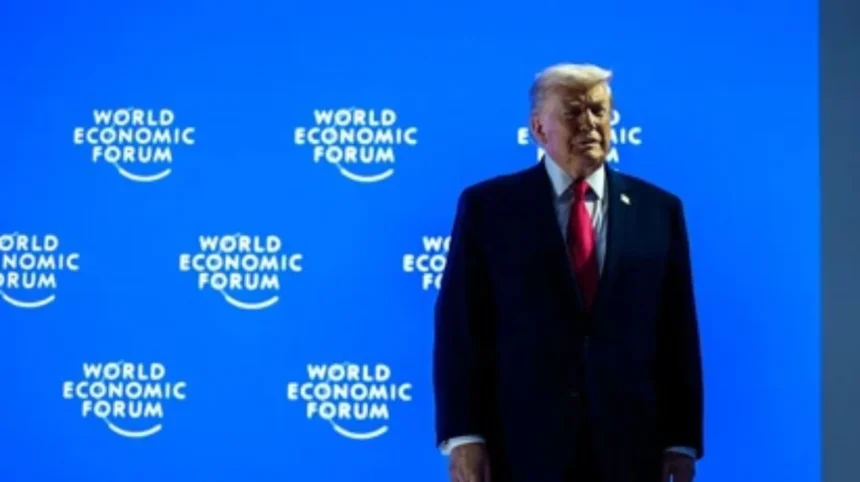
As reported by Mediaite, President Donald Trump told reporters that “peace is so destructive for everyone” while speaking aboard Air Force One on his way back to Washington from the World Economic Forum in Davos, Switzerland. According to Mediaite, the remarks came just hours after he signed the charter for a newly created Board of Peace, designed to oversee his administration’s plan for Gaza’s post-war reconstruction. The outlet notes that Trump made the comment during an answer about how a required 1 billion dollar fee from countries seeking permanent membership in the board would be used and then immediately attempted to correct himself. In the same exchange, he went on to say that “it’s so destructive for everybody when you have wars,” appearing to clarify that he meant war rather than peace was destructive.
According to Mediaite, Trump framed the hefty contribution requirement by saying that some countries had already pledged 1 billion dollars or more and that this was “nothing compared to the value of peace.” It was at this point, the outlet reports, that he delivered the “peace is so destructive” line that triggered widespread online criticism and headline coverage. Mediaite describes the remark as a “shocking gaffe” at odds with Trump’s self-description as a “president of peace.”
How did politicians and the public react?
As reported by Mediaite, a clip of Trump’s “peace is so destructive for everyone” comment quickly circulated on social media, where users highlighted the apparent contradiction between the phrase and his stated goal of promoting peace. According to the same outlet, left-leaning commentary account Patriot Takes posted the line “Man who begged for peace prize: ‘Peace is so destructive’,” capturing the tone of many critical responses. Mediaite notes that online reactions focused not only on the wording itself but also on the broader symbolism of such a remark being made while Trump was launching an initiative explicitly branded around peace.
Mediaite also reports that the gaffe landed at a sensitive moment, as the Board of Peace proposal had already drawn concern or resistance from several governments. According to Mediaite’s account, some critics argued that the remark undercut Trump’s messaging around Gaza reconstruction and raised doubts about his handling of high‑stakes diplomacy. The outlet’s reporting indicates that the episode intensified an already contentious debate over Trump’s leadership style in foreign policy and his reliance on off‑the‑cuff rhetoric in formal settings.
Supporting details: Board of Peace and international response
According to Mediaite, Trump’s Board of Peace is structured around a 1 billion dollar fee for nations that wish to secure a permanent seat, a sum some governments see as excessive or politically sensitive. The outlet reports that French President Emmanuel Macron declined to join, arguing that the board’s charter “goes beyond the framework of Gaza and raises serious questions” about its relationship to United Nations principles and structures. As reported by Mediaite, Norway and Sweden also turned down invitations to participate.
Mediaite states that Canadian Prime Minister Mark Carney agreed to join the Board of Peace but only on the condition that Canada would not pay the 1 billion dollar fee. According to the same report, former British Prime Minister Tony Blair accepted a position but reportedly hesitated over the cost, though he still intends to take part. Mediaite further notes that leaders from Egypt, Indonesia, Jordan, Pakistan, Qatar, Saudi Arabia, the United Arab Emirates, and Israel’s Prime Minister Benjamin Netanyahu have said they will join the board, while Russian President Vladimir Putin is still considering his invitation. These mixed responses underline how the structure and aims of the board, as described in Mediaite’s reporting, are already a subject of diplomatic contention.
What are the implications and what comes next?
According to Mediaite, the backlash to Trump’s “peace is so destructive” remark has become intertwined with wider questions over whether the Board of Peace will complement or compete with existing international institutions such as the United Nations. The outlet’s report indicates that Macron’s rejection and the conditions or refusals from other European states reflect concern that the new body could challenge established multilateral frameworks. Mediaite’s coverage suggests that the episode may complicate Trump’s effort to position the board as a central vehicle for Gaza’s reconstruction, particularly among skeptical allies.
As reported by Mediaite, Trump’s quick verbal correction—shifting from “peace” to “wars” being destructive—did not prevent the original phrasing from dominating online discussion of his Davos trip. According to the same report, the gaffe has fueled criticism of his communication style at a moment when he is seeking broad international support for a complex and costly reconstruction plan. Mediaite’s account underscores that future developments around the Board of Peace, including which countries ultimately join and how the 1 billion dollar fee is handled, will likely determine whether this initiative gains lasting diplomatic traction or remains a flashpoint in debates over Trump’s foreign policy direction.
In sum, Mediaite’s reporting shows that Trump’s “peace is so destructive” remark, made en route from Davos after launching a high‑profile peace initiative, has intensified scrutiny of both his rhetoric and his newly proposed Board of Peace, even as governments continue to decide whether to align themselves with the project.

