


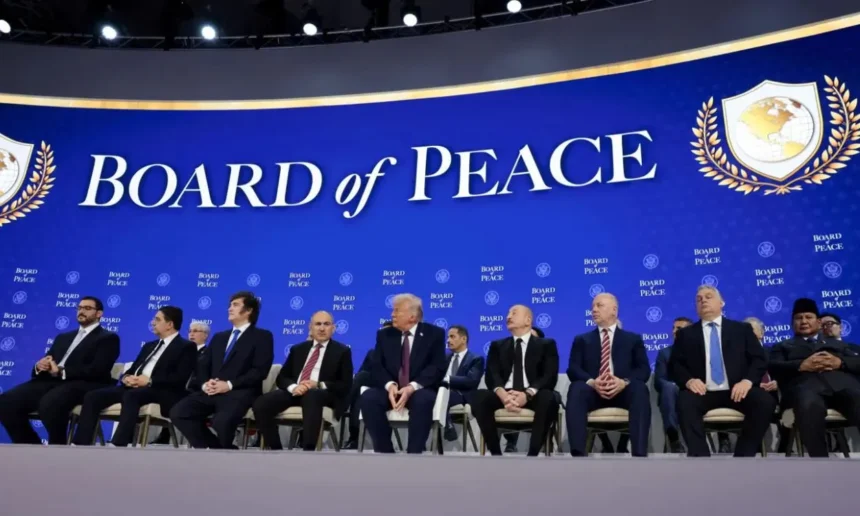
Trump’s Board of Peace and Its Impact on GazaAs reported by Neri Zilber of The Economist, President Donald Trump has launched a new international body called the “Board of Peace,” presented as the central vehicle for implementing his comprehensive post-war plan for the Gaza Strip and beyond. According to Reuters, the Board of Peace is framed by the White House as a structure that will not only guide Gaza’s reconstruction and governance but also address broader global security and diplomatic challenges. The initiative follows United Nations Security Council Resolution 2803 (2025), which welcomed Trump’s Gaza plan and endorsed the creation of the Board of Peace as part of an international framework to transition the territory from active conflict to a managed post-war order.
According to the White House, the Board of Peace is designed with several tiers and subsidiary entities focused on Gaza’s stabilization, reconstruction, and long-term development. Board members, drawn from selected states invited by the chair, are expected to oversee portfolios such as governance capacity-building, regional relations, reconstruction, investment attraction, and large-scale funding and capital mobilization. As reported by Al Jazeera, an Executive Board and a dedicated “Gaza Executive Board” sit beneath the main body, coordinating with Arab states and other partners to shape Gaza’s future political and economic landscape.
According to the White House statement, Trump’s plan links the Board of Peace to an “International Stabilization Force” and a transitional local governing structure in Gaza, embedding security, political, and economic oversight under a single US-backed architecture. Al Jazeera reports that the Board’s Gaza-focused arms are intended to supervise governance arrangements, reconstruction projects, and security-sector changes as part of a multi-year transition. The European Council on Foreign Relations (ECFR) notes that Trump alone retains authority to create, modify, or dissolve the Board’s subsidiary entities, underscoring the central role of the US presidency in shaping the framework.
Context and Reactions: How Is the Board Being Received?
According to Reuters, Trump has promoted the Board of Peace as proof that the ceasefire and subsequent arrangements in Gaza amount to “peace in the Middle East,” arguing that the new structure can help resolve long-standing security and governance issues. Reuters reports that Israeli Prime Minister Benjamin Netanyahu has accepted Trump’s invitation to join the Board, aligning Israel with the US-led design for Gaza’s future. Al Jazeera adds that Netanyahu’s participation comes despite an International Criminal Court arrest warrant issued in 2023 over alleged crimes against humanity in Gaza, raising questions among critics about the legitimacy and impartiality of the board’s composition.
As reported by The Economist, some diplomatic and policy observers view the Board of Peace as a distraction from urgent humanitarian and political work on the ground in Gaza, warning that high-level structures and branding risk overshadowing immediate reconstruction and accountability needs. ECFR analysts argue that the Board’s Gaza-focused subsidiaries could entrench a heavily externalized governance model, in which strategic decisions are shaped largely by Washington and its closest partners rather than by Palestinian political actors. According to reporting by Al Jazeera, membership in the Board is limited to states formally invited by the chair and represented by heads of state or senior officials, further fueling criticism that the framework sidelines local representation and wider international consensus mechanisms such as the United Nations.
Al Jazeera notes that Palestinian factions have backed the idea of a transitional Palestinian committee tasked with governing Gaza under the supervision of the Board of Peace, though they remain wary about the scope of external control and the conditions attached to international support. According to ECFR, critics in Europe and the broader diplomatic community worry that the new body could evolve into a rival or alternative to the UN system, especially if it claims broad authority over peace and security beyond Gaza. The Economist reports that some officials inside traditional multilateral institutions fear that the Board’s emergence may dilute established mechanisms for conflict resolution, humanitarian coordination, and international law.
Supporting Details and Expert Commentary
According to the White House, the Board of Peace is mandated to implement a “20-point” comprehensive plan for Gaza that integrates security arrangements, governance reforms, and economic development initiatives. The statement specifies that members of the Executive Board will each oversee key sectors, including governance, regional diplomacy, reconstruction, investment, and capital mobilization, with dedicated senior advisors tasked with translating the Board’s strategic priorities into day-to-day operations. Al Jazeera reports that Nickolay Mladenov, a former United Nations envoy, has been designated as an Executive Board member and “High Representative for Gaza,” serving as a primary liaison between the Board and local governance structures.
ECFR notes that the BoP structure includes a “National Council for the Administration of Gaza” (NCAG), led by Ali Shaath, a former deputy minister in the Palestinian Authority, as the lowest-tier administrative body responsible for Gaza’s on-the-ground governance. Al Jazeera reports that this council is intended to work with the Board’s Gaza executive and with representatives from Arab states to coordinate civil administration, reconstruction priorities, and service delivery. In parallel, ECFR and Al Jazeera both describe a dedicated military component led by US General Jasper Jeffers, who would command an international stabilization force tasked with enforcing permanent disarmament and broader security provisions in Gaza.
According to reporting by Al Jazeera, membership rules grant three‑year terms to most participating states but allow countries contributing more than 1 billion dollars in the first year to secure permanent seats on the Board. ECFR analysts suggest that this funding-linked membership model could concentrate decision-making power among a small group of wealthy states, particularly the United States and select regional allies. The Economist further highlights concerns that such an arrangement may weaken incentives for inclusive diplomacy and accountability, as those financing the Board’s work would also shape its priorities and oversight mechanisms.
Implications and Future Developments: What Could the Board Mean for Gaza and Beyond?
According to The Economist, the Board of Peace could significantly reshape the geopolitical landscape of the Israel–Palestine conflict by placing an American-led structure at the center of Gaza’s reconstruction, security, and governance decisions. ECFR argues that, if fully implemented, the Board and its Gaza-focused subsidiaries may institutionalize a long-term, externally managed transition that delays or complicates Palestinian efforts toward self-determination and a negotiated political settlement. Al Jazeera notes that Israel’s confirmed participation, alongside the US and selected Arab states, positions the Board as a critical arena for regional bargaining over Gaza’s future and over broader security arrangements involving Hamas and other armed groups.
According to Reuters, the Board will have to navigate unresolved issues that have historically derailed peace efforts, including disarmament, security guarantees, and timelines for Israeli military withdrawal. ECFR analysts suggest that the stabilization force and security-tier architecture could become flashpoints if local actors perceive them as instruments of occupation rather than neutral guarantors of order. The Economist notes that the Board’s global ambitions—extending beyond Gaza to other crises—may further complicate relations with the United Nations, regional organizations, and existing peacekeeping frameworks.
Al Jazeera and ECFR both report that additional Executive Board and Gaza Executive Board members are expected to be announced in the coming weeks, a process likely to reveal more about the political balance and priorities within the new structure. According to the White House, the United States intends to work “in close partnership with Israel, key Arab nations, and the international community” to implement the Gaza plan, while calling on all parties to cooperate with the NCAG, the Board of Peace, and the international stabilization force. Analysts quoted by The Economist and ECFR suggest that how Palestinian factions, regional powers, and multilateral bodies respond to these next steps will determine whether the Board of Peace becomes a durable framework or a contested experiment in post-war governance.
In summary, verified reporting from outlets including Reuters, Al Jazeera, The Economist, ECFR, and official White House statements indicates that Trump’s Board of Peace is an expansive, US-driven mechanism intended to manage Gaza’s transition from war to a new political and economic order, while also positioning itself as a broader global peace and security platform.

