

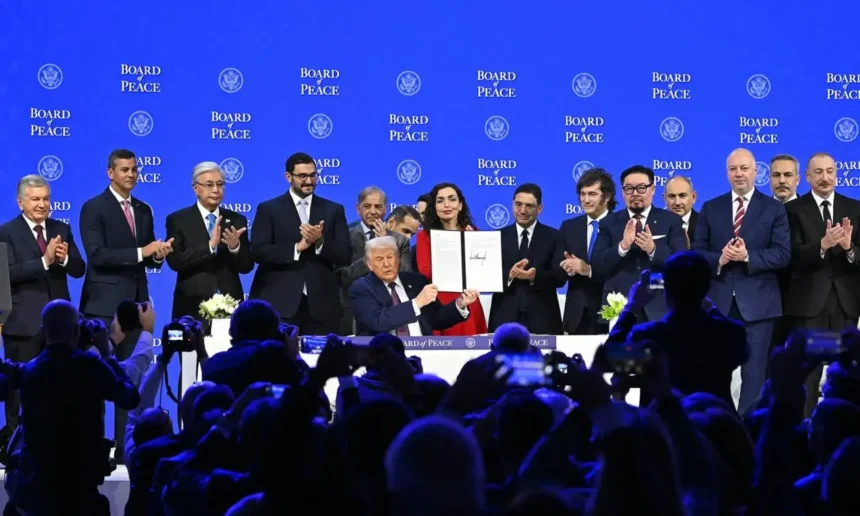
According to The Observer, the “Board of Peace” is a new international body championed by United States President Donald Trump and formally linked to the United Nations through a Security Council resolution focused on a ceasefire and reconstruction process in Gaza. As reported by international outlets including CBC News and Reuters, the board was initially framed as a mechanism to oversee the implementation of the Gaza ceasefire and support reconstruction efforts, but Trump has presented it as having a broader mandate to address global security challenges. Foreign Policy and other analysis-focused publications report that critics and diplomats see the initiative as part of a wider shift in Washington’s approach to multilateralism and the existing rules‑based order.
- How the Board of Peace works and who is involved
- Context and reactions: Alternative UN or parallel body?
- How are governments and experts responding?
- What are critics and supporters saying?
- Supporting details and expert commentary
- Implications and future developments: How might the world order shift?
- What does this mean for the United Nations?
- What are the next steps for the Board of Peace?
As reported by Reuters, Trump will serve as chairman of the Board of Peace and has invited a range of world leaders to participate, making clear that permanent membership requires a contribution of 1 billion dollars, while other states can join for limited three‑year terms. CBC News notes that about 30 countries have accepted invitations so far, including Bulgaria and Belarus, with a small number of European Union states such as Bulgaria and Hungary on board while key allies like France and the United Kingdom have so far declined. Policy analysis published by Foreign Policy and the Better World Campaign describes the board as a highly centralized, U.S.-led structure in which Trump wields sweeping authority, including de facto veto power over its decisions.
How the Board of Peace works and who is involved
According to reporting cited by The Observer and detailed by CBC News, the Board of Peace derives its formal mandate from a UN Security Council resolution tied to a Gaza ceasefire, which authorizes the creation of a body to supervise implementation and coordinate reconstruction. The Better World Campaign explains that, unlike the United Nations, the board is not a universal organization; it is designed as a stand‑alone structure limited to invited members and does not rely on broad multilateral consensus to act. Foreign Policy reports that Trump has been appointed chairman in his personal capacity, with authority to invite or exclude members, break ties, and approve or veto all board resolutions.
CBC News and Reuters add that the board’s initial mission is centered on Gaza, including monitoring the ceasefire and overseeing reconstruction funds, but Trump and some close advisers have publicly suggested that its remit could expand to other conflicts. According to CBC News, Israeli Prime Minister Benjamin Netanyahu has accepted a position on the board, although he did not attend its debut events due to an International Criminal Court arrest warrant, while Russian President Vladimir Putin is reported to be considering an invitation despite facing his own ICC warrant. CBC News further reports that Palestinians will not sit on the board or its executive committee; instead, they are represented through a subordinate body, the National Committee for the Administration of Gaza, made up of technocrats under the board’s supervision.
Context and reactions: Alternative UN or parallel body?
How are governments and experts responding?
As reported by CBC News and Reuters, several traditional U.S. allies in Europe and beyond have reacted cautiously or critically to the Board of Peace, questioning whether it is intended to rival or undermine the UN. Reuters notes that Trump has denied that the board is designed to replace the UN, insisting it is meant to complement existing institutions while “moving faster” on pressing crises. However, an analysis by Foreign Policy argues that the structure gives Trump near‑total veto power and risks creating a competing forum to the UN Security Council, especially if key U.S. partners choose to work through it instead of New York.
CBC News reports that France has declined to join, stating that the board’s charter is incompatible with the UN’s founding principles, even after facing threats of steep tariffs on French wine from Trump. The British foreign secretary has also voiced reservations, with CBC News citing UK concerns about the presence or potential inclusion of Vladimir Putin and the implications for international criminal justice. Policy analysis from the Centre for Eastern Studies and other think tanks, summarized by international media, suggests that the board is perceived by some European officials as an attempt to reshape multilateral decision‑making in ways that concentrate power in Washington and weaken the role of universal institutions.
What are critics and supporters saying?
According to CBC News, critics argue that the Board of Peace amounts to an exclusive club of states willing to pay for access and influence, with the 1‑billion‑dollar permanent membership fee seen as both a funding model and a political filter. Foreign Policy and other commentators cited by The Observer describe the concept as a “top‑down project” that centralizes authority in the hands of the U.S. president and a limited group of allies, raising concerns that it could sideline smaller or less aligned countries. Analysis quoted by CBC News also notes that the board’s Gaza‑focused composition and expertise make it less relevant to crises outside the Middle East, despite rhetoric about a wider global remit.
At the same time, some governments that have joined or considered joining present the board as an opportunity to accelerate reconstruction in Gaza and to participate in a new forum where Washington is fully engaged. CBC News reports that Trump has argued the board will work “in conjunction” with the UN and could “expand into other domains,” while insisting that it offers a more action‑oriented alternative to what he has long criticized as UN bureaucracy. According to coverage in international outlets, supporters in participating capitals emphasize the practical benefits of securing reconstruction funds and influence over Gaza policy, even as they acknowledge uncertainty about the board’s long‑term role.
Supporting details and expert commentary
The Better World Campaign explains that the governance model of the Board of Peace is explicitly centralized around the office of the chair, giving Trump broad discretion over membership, agenda‑setting, and the adoption or blocking of board decisions. Foreign Policy’s analysis notes that the board’s charter allows states to buy permanent executive seats for at least 1 billion dollars, contrasting this with the UN Security Council’s fixed permanent membership and one‑state‑one‑vote General Assembly framework. Experts cited by these outlets warn that such a funding and membership model risks entrenching inequality among states and tying decision‑making directly to financial contributions.
CBC News reports that the board currently includes around 30 countries, ranging from Eastern European states like Bulgaria and Belarus to a small number of EU members, while others remain on the sidelines. Policy analysts quoted by international media argue that the UN resolution underpinning the Gaza ceasefire gives the board a degree of international legitimacy, even as Trump continues to criticize UN multilateralism. Commentators in Foreign Policy and other outlets suggest that, whether or not the board becomes an effective operational body, its existence signals a shift in U.S. attitudes toward the post‑1945 institutional order the United States helped create.
Implications and future developments: How might the world order shift?
What does this mean for the United Nations?
Foreign Policy’s analysis, referenced by The Observer, argues that even if the Board of Peace never becomes a fully credible alternative to the UN, its creation alone could weaken the UN by encouraging states to look elsewhere for security and reconstruction decisions. Experts quoted in that analysis say the board’s very existence confirms that the United States is less committed to the UN system it once championed, making it harder for U.S. diplomats to persuade other powers to invest political capital in New York‑based negotiations. CBC News adds that the UN Security Council resolution establishing the board’s mandate for Gaza reconstruction has, paradoxically, both empowered Trump’s initiative and highlighted the UN’s reliance on U.S. leadership.
According to think‑tank commentary cited by international outlets, there is concern that parallel structures like the Board of Peace could further fragment global governance if more states or leaders attempt to create selective coalitions aligned around narrow interests. Analysts suggest that, while the board is formally tied to a specific mission in Gaza, its centralized structure and financial model could be used as a template for future U.S.-led initiatives that bypass traditional multilateral forums. For now, major powers that have not joined—such as France and the United Kingdom—are watching to see whether the board gains operational credibility or remains largely symbolic.
What are the next steps for the Board of Peace?
According to CBC News and Reuters, the Board of Peace’s immediate tasks involve monitoring the ceasefire in Gaza, coordinating reconstruction planning, and managing relations with the subordinate Palestinian committee responsible for local administration. International coverage notes that the composition of the board, the level of participation from key regional actors, and the pace of reconstruction funding will be important tests of its effectiveness. Analysts quoted by Foreign Policy indicate that the board’s long‑term relevance will depend on whether it is called upon to address other crises, such as in Ukraine or the Sahel, and whether states perceive it as a serious venue for security decision‑making.
Foreign Policy and other expert sources emphasize that many governments remain cautious, wary of being seen as endorsing a structure that appears to concentrate unprecedented power in the hands of a single state and leader. The Observer and CBC News highlight that decisions by influential non‑participants—especially in Europe, Latin America, and the Global South—will shape whether the board evolves into a durable feature of the international system or remains a controversial experiment. While its future trajectory is uncertain, reporting across multiple outlets indicates that Trump’s Board of Peace has already intensified debate over the future of the UN and the broader architecture of global governance.
In summary, international reporting describes the Board of Peace as a UN‑linked but U.S.-dominated body, created under Donald Trump’s chairmanship to oversee Gaza’s ceasefire and reconstruction while potentially expanding into a wider security role, prompting sharp debate over whether it will serve as a complement to or a challenge against the existing multilateral order.

