


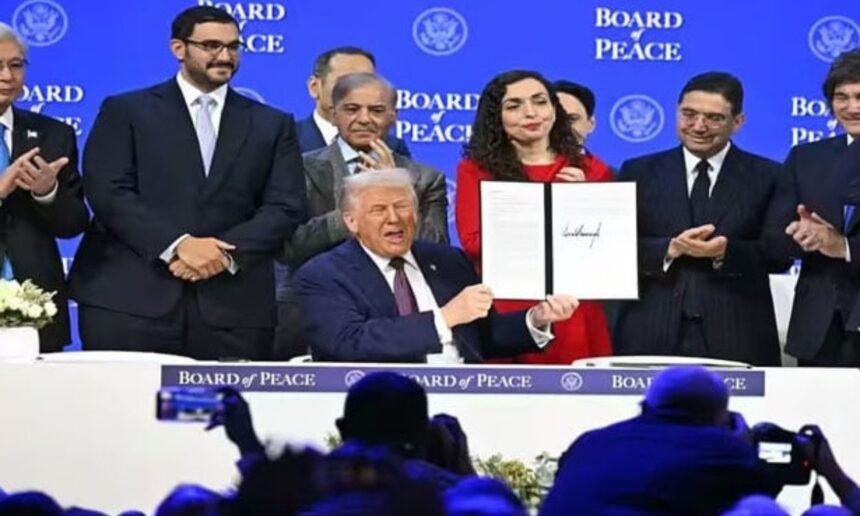
According to Minute Mirror, the launch of United States President Donald Trump’s “Board of Peace” has triggered concern in New Delhi that the new body could become a platform for renewed international focus on the Kashmir dispute. The outlet reports that British media coverage has underlined India’s discomfort with Pakistan’s early and enthusiastic decision to join the board, while India has chosen to stay out. Minute Mirror says British reporting frames India’s calculation as an attempt to avoid giving fresh multilateral traction to an issue it insists is strictly bilateral.
As cited by Minute Mirror, British media note that Pakistan’s ruling and opposition figures have portrayed the Board of Peace as an additional arena—alongside the United Nations—where they can raise the question of Jammu and Kashmir. The reports say this prospect has revived long-standing Indian concerns about third‑party involvement in the dispute. According to Minute Mirror, the British coverage suggests that, while the board is formally focused on Gaza and broader peace efforts, its composition and agenda‑setting could allow participating states to bring in other security flashpoints, including Kashmir.
Context and reactions: How is India responding to the Board of Peace?
What is reported about New Delhi’s stance?
Minute Mirror, summarizing British media accounts, states that India has so far declined to sign up to Trump’s Board of Peace, even as regional rival Pakistan and several other Muslim‑majority countries have opted in. The reports say New Delhi is wary of any new international forum where Pakistan might seek to internationalize the Kashmir issue beyond existing UN mechanisms. British outlets quoted by Minute Mirror suggest that Indian policymakers view the board as unpredictable in scope and heavily shaped by Washington’s priorities.
The British coverage, as relayed by Minute Mirror, also notes that India has historically resisted external mediation on Kashmir, arguing that all outstanding issues with Pakistan must be settled bilaterally under the Simla Agreement and subsequent understandings. In this context, analysts cited in the British reports say India is likely to keep its distance from any body that could blur that red line. Minute Mirror adds that this helps explain why New Delhi has not publicly engaged with invitations or signals linked to the Board of Peace.
How is Pakistan portrayed in British reporting?
According to Minute Mirror’s review, British media emphasize that Pakistan has welcomed the Board of Peace as an opportunity to deepen its diplomatic engagement with the United States and like‑minded states on Palestine and other conflicts. At the same time, Pakistani commentators cited in those reports see the board as a venue where Islamabad can highlight unresolved disputes, including Kashmir, to a high‑profile international audience.
Minute Mirror notes that British coverage points to a contrast: while Pakistan seeks to leverage new forums to raise Kashmir, India aims to avoid any setting that could be interpreted as accepting multilateral oversight of its internal and territorial questions. This dynamic, the reports suggest, has contributed to Indian unease about the potential evolution of the Board of Peace’s mandate and discussions.
Supporting details and media analysis
Minute Mirror reports that British commentary links India’s caution over the Board of Peace to its broader strategic posture in the region. Analysts in UK media outlets, as paraphrased by Minute Mirror, argue that India fears precedents that might embolden international actors to press for greater involvement in Kashmir under the banner of conflict resolution or human rights. They suggest New Delhi is especially sensitive to moves that could weaken its narrative that Kashmir is an internal matter.
The British media analysis, according to Minute Mirror, also places the issue in a wider geopolitical frame. Commentators note that India is balancing closer ties with the United States against its own red lines on sovereignty and territorial integrity. They argue that Trump’s creation of a new, highly personalized peace structure adds complexity for India, which must weigh the diplomatic costs of staying out against the risks of joining a forum where Pakistan is already active and vocal.
Implications and future developments: What could this mean for Kashmir?
Could the Board of Peace become another arena for the Kashmir dispute?
Minute Mirror says British media stop short of predicting that the Board of Peace will formally take up Kashmir, but they underline that Indian officials are concerned about even informal or political discussions. Analysts quoted in those reports suggest that if Pakistan and other allies use their positions on the board to repeatedly reference Kashmir in speeches or side meetings, it could contribute to renewed international attention on the dispute.
At the same time, the British coverage, as summarized by Minute Mirror, recognizes that the Board of Peace was initially framed around Gaza and broader Middle East peace efforts. Whether it evolves into a wider conflict‑resolution platform will depend on how the US and other key members choose to shape its agenda. For now, the possibility that Kashmir could enter the conversation—directly or indirectly—is enough to fuel Indian anxieties, the reports indicate.
How might India and Pakistan adjust their strategies?
According to Minute Mirror’s account of British analysis, India is likely to continue avoiding association with the Board of Peace while reinforcing its stance that Kashmir is a bilateral matter. Commentators suggest New Delhi may instead focus on more traditional diplomatic channels and strategic partnerships where it feels it has greater control over the agenda.
For Pakistan, British media reports cited by Minute Mirror indicate that participation in the board could complement its existing efforts at the UN and other forums to keep Kashmir on the international radar. Analysts note that Islamabad may use any opportunity within or around the Board of Peace to frame Kashmir alongside Palestine as unresolved questions of self‑determination. How much practical impact this has will depend on the board’s trajectory and the willingness of major powers to entertain such linkages.
In summary, Minute Mirror reports that British media see Trump’s Board of Peace as adding a new layer of complexity to South Asian diplomacy, with Pakistan viewing it as a potential platform to raise Kashmir and India staying away amid fears that the initiative could erode its long‑held insistence on strictly bilateral handling of the dispute.

