


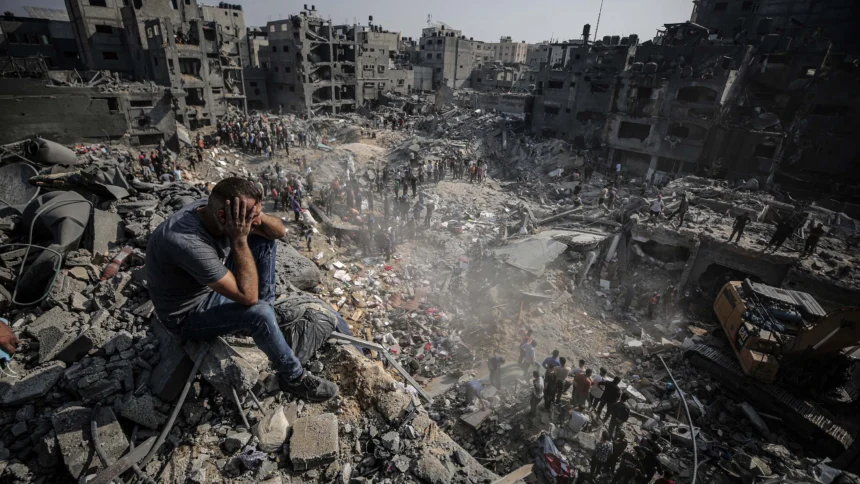
Israel’s months-long military campaign in the Gaza Strip has drawn renewed scrutiny after an in‑depth investigation alleged that thousands of Palestinians were effectively “vaporized” by high‑temperature weapons supplied by the United States and used by Israeli forces. The findings center on thermal and thermobaric munitions that experts say can produce extreme heat inside confined areas, leaving many victims with no recoverable remains.
- A forensic count of the “disappeared”
- What kinds of weapons are alleged to have been used?
- How do thermal and thermobaric bombs work?
- Documented strike sites and patterns of destruction
- What have experts and officials said?
- How have human rights and legal concerns been framed?
- What is known about US involvement in arms supplies?
- What future developments are being discussed?
A forensic count of the “disappeared”
According to a detailed feature by Al Jazeera, Gaza’s Civil Defense teams have documented at least 2,842 Palestinians whose bodies effectively “evaporated” in the course of Israeli air and ground operations that began in October 2023. These figures were compiled by cross‑referencing the number of people believed to be at specific strike locations with the number of bodies or body parts that rescuers were able to recover.
As reported by Zeteo, civil defense workers and medical officials described arriving at bombed sites to find only blood spray, scattered tissue fragments, or small pieces of bone where entire families had been sheltering. The absence of intact corpses in hundreds of documented cases prompted investigators to examine whether particular categories of munitions were responsible for the unusually severe destruction of human tissue.
The New Arab notes that this process of elimination, based on missing persons lists, eyewitness accounts, and the physical traces left behind, underpins the estimate that thousands of people were killed in blasts so intense that their bodies were largely or completely destroyed. The investigation stresses that the figure does not include the far larger number of Palestinians who were killed and whose bodies were recovered and identified.
What kinds of weapons are alleged to have been used?
According to Al Jazeera’s investigation and subsequent coverage by outlets including TRT World and Middle East Eye, experts and eyewitnesses have linked the phenomenon to thermal and thermobaric weapons, also known as vacuum or aerosol bombs. These munitions disperse a fuel or explosive aerosol that is then ignited, creating a powerful blast wave and temperatures that can exceed 3,500 degrees Celsius.
As summarized by The New Arab, such temperatures are high enough to burn, disintegrate, or vaporize human tissue, particularly in enclosed or semi‑enclosed spaces where heat and pressure are trapped. Experts cited in these reports say that victims close to the epicenter of the blast may leave little more than traces of blood or tiny fragments, complicating efforts to identify the dead.
Media summaries of the Al Jazeera program name several US‑manufactured munitions as being linked to incidents under investigation, including the MK‑84 general‑purpose bomb, the BLU‑109 bunker‑buster, and the GBU‑39 small‑diameter bomb. According to these reports, weapon remnants recovered in Gaza and analyzed by researchers suggest that these bombs were used in strikes where entire groups of people vanished with almost no recoverable remains.
How do thermal and thermobaric bombs work?
According to technical explanations cited by Al Jazeera and The New Arab, thermobaric or high‑temperature weapons operate differently from conventional blast munitions. They first disperse a cloud of fuel or explosive particles, which then mixes with oxygen in the surrounding air before ignition.
When detonated, this fuel‑air mixture produces a prolonged blast wave and intense heat that can penetrate deep into buildings, tunnels, and other confined spaces. Experts say this combination of pressure and temperature can rupture internal organs, collapse lungs, and incinerate bodies, particularly when people are sheltering indoors.
The MK‑84, often described as a 900‑kilogram bomb filled with a high‑energy explosive mixture, is reported to generate extreme heat capable of flattening multi‑story structures. TRT World notes that the BLU‑109, which has a hardened steel casing and delayed fuse, is designed to pierce through concrete or earth before exploding, creating a fireball inside the structure and destroying everything within.
According to Al Jazeera’s feature, the GBU‑39 is engineered to keep much of a building’s outer shell intact while devastating its interior through pressure and heat, a design characteristic that investigators say is consistent with some Gaza strike sites where victims disappeared inside relatively standing structures.
Documented strike sites and patterns of destruction
Media summaries of the Al Jazeera investigation highlight specific incidents in which these weapons were allegedly used, leading to a high number of missing persons. TRT World reports that a BLU‑109 bunker‑buster was linked to an attack on the al‑Mawasi area, which Israel had previously designated as a “safe zone” for displaced civilians, and where the blast reportedly “evaporated” 22 people.
Al Jazeera describes other strikes on residential buildings, schools, and shelters in which rescuers arrived to find only partial remains, a strong chemical smell, and signs of extreme heat damage such as melted metal and charred concrete. Civil defense teams told investigators that in numerous cases they were able to identify victims only through trace DNA or by matching missing family members to those known to have been in the building.
Middle East Eye notes that this pattern—structures partially standing, interiors heavily scorched, and occupants effectively gone—was documented at multiple sites across the Gaza Strip, suggesting the repeated use of similar high‑temperature munitions. The outlet reports that experts who reviewed photographic and video evidence, along with weapon fragments, concluded that the described effects were consistent with thermobaric or high‑temperature US‑supplied bombs.
What have experts and officials said?
The New Arab reports that legal and weapons experts interviewed about the investigation described the findings as “forensically significant” because they tie a documented category of missing people to identifiable classes of munitions. These specialists argue that the high temperatures involved make it plausible that people closest to the blast would leave minimal physical remains, particularly in closed rooms or underground shelters.
According to Zeteo’s summary of the Al Jazeera report, medical professionals in Gaza, including senior health officials, told investigators that they had seen cases where victims appeared to have been subjected to extreme heat and pressure far beyond what is typical of standard high‑explosive bombs. These accounts describe bodies that were severely charred, partially disintegrated, or reduced to scattered tissue, often alongside widespread structural damage.
Middle East Eye notes that independent analysts who reviewed the evidence stressed the importance of further on‑the‑ground documentation, including collecting more weapon remnants and conducting metallurgical and chemical tests to confirm the types of explosives used. However, they also said that the emerging pattern, combined with known export records of US‑made bombs to Israel, strongly indicates the deployment of thermal or thermobaric weapons in densely populated areas.
How have human rights and legal concerns been framed?
According to The New Arab, legal experts say that while international law does not categorically ban all thermobaric weapons, their use is constrained by core principles of distinction, proportionality, and precaution. Weapons that cannot be directed at a specific military target or whose effects cannot be limited in a way that distinguishes between combatants and civilians may be considered indiscriminate.
Several analysts quoted in reporting on the investigation argue that deploying high‑temperature bombs in crowded urban neighborhoods, refugee camps, or designated “safe zones” raises serious questions under international humanitarian law. They note that thermal and thermobaric munitions, by design, are particularly devastating in confined spaces where civilians are likely to shelter during bombardments.
The New Arab adds that the findings appear against the backdrop of existing war‑crimes allegations related to the Gaza offensive, including repeated strikes on residential blocks, restrictions on food and aid, and attacks on medical infrastructure. The investigation’s focus on specific munitions, their suppliers, and their effects on civilians could potentially contribute to future legal proceedings in international courts.
What is known about US involvement in arms supplies?
As reported by Zeteo, both the Trump and Biden administrations approved the transfer of thousands of US‑manufactured bombs to Israel, including 2,000‑pound MK‑84-class munitions and other high‑yield weapons. These shipments formed part of broader military support packages that continued after the onset of the Gaza offensive.
Middle East Eye notes that the Al Jazeera investigation directly links the disappearance of thousands of Palestinians to weapons that are explicitly identified as US‑made, naming the MK‑84, BLU‑109, and GBU‑39 among others. The outlet reports that this connection has intensified calls from rights groups and some lawmakers for greater scrutiny of US arms exports and for conditions to be imposed on future transfers.
According to The New Arab, legal commentators say that if it is demonstrated that US‑supplied weapons were used in ways that violate international law, questions could arise about the responsibility of supplier states. These discussions encompass not only the legality of specific transfers but also whether continuing to supply such munitions in the face of mounting civilian harm could constitute complicity in potential violations.
What future developments are being discussed?
Media coverage of the Al Jazeera investigation suggests that its findings may feed into ongoing efforts to document alleged war crimes in Gaza for potential use by international bodies, including United Nations mechanisms and the International Criminal Court. The New Arab notes that the report comes amid broader legal proceedings and accusations already directed at Israeli officials over the conduct of the war.
Middle East Eye and other outlets report that human rights organizations are urging independent, on‑site investigations to verify the types of munitions used and to identify the chain of custody from manufacturers to end‑users. Such inquiries could involve ballistic analysis, forensic pathology, and examination of military procurement records.
In policy circles, analysts cited in coverage of the report say the revelations are likely to increase pressure on Washington and other supplier states to review export licenses and consider restrictions on weapons that cause extreme and hard‑to‑control harm in civilian areas. They also warn that, given the scale of destruction in Gaza and the number of people still unaccounted for, the true long‑term humanitarian and legal consequences of the alleged use of high‑temperature bombs may only become fully apparent over many years.
As the conflict continues and efforts to account for the dead and missing proceed, the investigation’s central claim—that thousands of Palestinians were effectively “vaporized” by US‑made thermal and thermobaric bombs—has become a focal point in global debates over arms transfers, accountability, and the laws governing warfare in densely populated civilian environments.

