


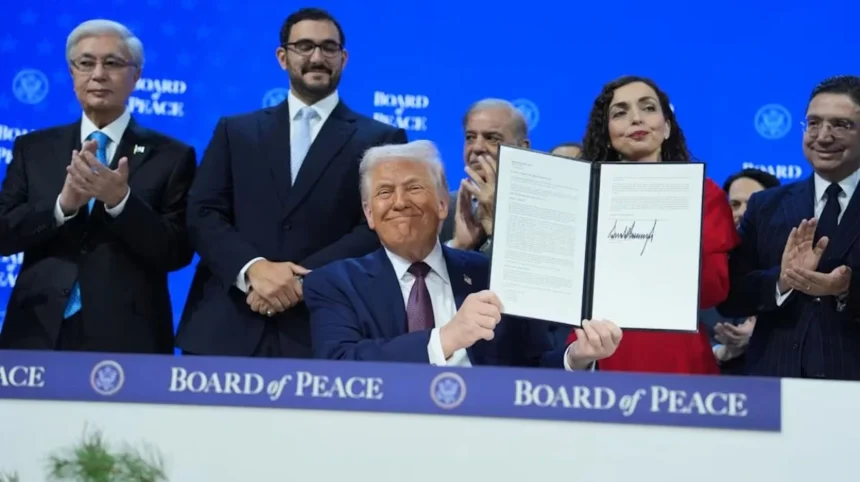
According to Channel News Asia, US President Donald Trump unveiled a new international body called the Board of Peace at the World Economic Forum in Davos, Switzerland, positioning it as a vehicle to oversee postwar Gaza and a broader range of global conflicts. CNA reports that the board’s charter, signed by leaders and officials from 19 countries, was originally conceived to manage the Gaza truce and reconstruction after the war between Israel and Hamas. The outlet notes that Trump used the launch to cast himself as a global peacemaker while facing widespread skepticism over both the scope of the initiative and its implications for the existing multilateral system.
As reported by Channel News Asia, Trump’s team also presented ambitious redevelopment plans branded as “New Gaza,” featuring maps of new settlements and images of luxury seafront hotels and apartments in the devastated Palestinian territory. CNA states that Jared Kushner, Trump’s son‑in‑law, described the reconstruction concept as a “master plan” and said Gaza “could be a hope” and “a destination,” emphasizing large‑scale investment and real estate‑driven recovery. According to Channel News Asia, Trump at the same event described Gaza as “great real estate” and linked reconstruction to strict conditions on Hamas.
Channel News Asia reports that Trump told Hamas it must disarm under the next phase of the Gaza ceasefire accord or face “the end of them,” tying demilitarization directly to reconstruction and the broader peace framework. CNA adds that Gaza’s newly appointed administrator, in a video message played at Davos, announced plans to reopen the Rafah border crossing between Egypt and Gaza in both directions the following week. According to Channel News Asia, Trump also signaled a willingness to “talk” with Iran, indicating that the Gaza initiative sits within a wider regional security agenda.
Context and reactions: how is the Board of Peace viewed?
According to Channel News Asia, the Board of Peace is chaired by Trump, requires countries to pay about US$1 billion for permanent membership, and is formally presented as working “in conjunction” with the United Nations. CNA notes, however, that the broad mandate to “resolve all sorts of international conflicts” and the scale of the financial buy‑in have fueled concerns that the board could evolve into a rival power center to the UN rather than a complementary forum. The outlet reports that Trump has repeatedly criticized the UN over what he views as its failure to resolve long‑running crises, and that frustration is described as one driver behind the board’s creation.
Channel News Asia reports that key US allies, including France and Britain, have expressed doubts about the Davos launch, with London saying it would not attend the ceremony. CNA notes that the guest list on stage skewed toward leaders more closely aligned with Trump, including Hungary’s Viktor Orban and Argentina’s Javier Milei, alongside officials from several Middle Eastern monarchies. According to Channel News Asia, Trump joked that those present were “in most cases very popular leaders, some cases not so popular,” a remark that underscored the political profile of the early backers.
As reported by Channel News Asia, the invitation extended to Russian President Vladimir Putin, whose country invaded Ukraine in 2022, has been particularly controversial. CNA states that Trump told the Davos audience Putin had agreed to join the Board of Peace, while Russian officials said the invitation was still under study. According to the same report, Ukrainian President Volodymyr Zelenskyy has been invited but has publicly questioned how he could work alongside Putin within such a framework, highlighting tensions around the board’s potential membership.
Supporting details and expert commentary
According to Channel News Asia, the Board of Peace charter was signed in Davos by representatives of 19 countries, although Trump said he expected around 50 states to eventually join, leaving the final membership map unclear. CNA reports that Egypt announced President Abdel Fattah al‑Sisi had accepted Trump’s invitation to join the board, but Sisi did not appear on stage at the ceremony. The outlet also notes that Israeli Prime Minister Benjamin Netanyahu, who faces an International Criminal Court arrest warrant over the Gaza war, had indicated he would attend but was ultimately absent.
Channel News Asia reports that much of the Davos event focused on the Gaza “master plan,” with Kushner presenting slides of “New Gaza” that emphasized real‑estate‑led reconstruction and new settlements. CNA notes that Trump framed Gaza’s reconstruction as an opportunity once Hamas disarms, while stressing that the Board of Peace would also address a range of other conflicts beyond Gaza. According to Channel News Asia, Trump simultaneously spoke of being “hopeful of a deal soon” to end Russia’s invasion of Ukraine and said he believed that conflict would be the easiest to resolve, though it had proven the hardest.
As reported by Channel News Asia, Zelenskyy has voiced concern that Trump’s attention to other high‑profile issues, including his push to acquire Greenland and disputes over tariffs, could distract from Ukraine’s war with Russia. CNA states that Trump told European allies in Davos he had reached a “framework of a future deal” and would waive certain tariffs as part of that understanding, linking economic concessions to broader diplomatic aims. According to the outlet, these overlapping agendas—Gaza, Ukraine, and wider geopolitical disputes—are part of the context in which the Board of Peace and the “New Gaza” proposal are being assessed by foreign governments.
Implications and future developments: what comes next?
According to Channel News Asia, the Board of Peace’s stated evolution from a Gaza‑focused oversight body to a mechanism intended to tackle “all sorts” of conflicts raises questions about how it will interact with existing institutions and whether it will gain broad international legitimacy. CNA indicates that doubts from key Western allies, the billion‑dollar membership requirement, and the invitation to Russia are likely to shape debates over whether the board becomes a major diplomatic forum or remains a more limited coalition of sympathetic states. The outlet reports that Trump has argued the board will work with the UN, but critics fear a parallel structure that could undercut established multilateral processes.
Channel News Asia notes that on the ground in Gaza, the reopening of the Rafah border crossing, the appointment of a new administrator, and the conditional nature of reconstruction funding all suggest that implementation of the “New Gaza” blueprint will hinge on security arrangements and Hamas’s response to demilitarization demands. CNA reports that demilitarization is framed by Trump and his team as a prerequisite for rebuilding, meaning progress on the peace plan will depend on negotiations with actors that have not publicly endorsed the Davos framework. According to the same reporting, Trump has also linked decisions on potential air strikes against Iran and efforts to end the Ukraine war to the broader role he envisions for the Board of Peace, signaling that its trajectory will be tied to developments across multiple conflict zones.
In sum, Channel News Asia’s reporting from Davos describes a far‑reaching initiative in which Trump’s Board of Peace and the “New Gaza” concept are presented as cornerstones of a new approach to conflict resolution and reconstruction, but one that faces skepticism over its cost, membership, and relationship with the United Nations. The future of the plan will depend on how many countries ultimately join the board, whether key stakeholders in Gaza and other conflict areas accept its terms, and how it navigates tensions with existing international institutions and rival powers.

