


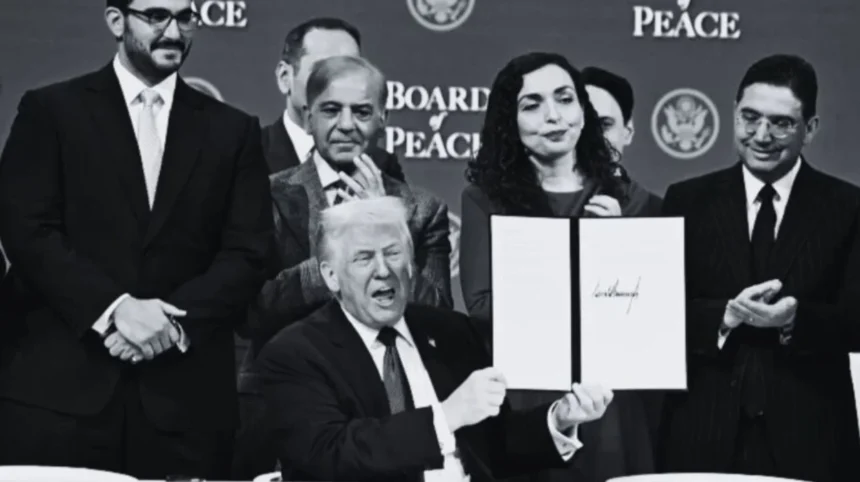
The Kremlin has indicated that the US-led “Peace Council” or “Board of Peace” initiative for Gaza championed by US President Donald Trump no longer carries the same weight it once did in Moscow’s calculations, suggesting the project has “lost relevance” amid shifting diplomatic priorities and on-the-ground realities in the Middle East. According to reporting on earlier stages of the initiative, Trump’s Gaza framework is built around a 20‑point plan endorsed in a United Nations Security Council resolution and designed to transition the enclave from active conflict to a period of demilitarization, technocratic governance and reconstruction overseen by an international body. As described by multiple outlets, this structure includes a Board or Council of Peace chaired by Trump, a National Committee for the Administration of Gaza and a Gaza Executive Board, with responsibilities ranging from supervising security arrangements to channeling reconstruction funds.
Earlier this year, Kremlin spokesperson Dmitry Peskov confirmed that Russian President Vladimir Putin had received an invitation through diplomatic channels to join Trump’s proposed Gaza peace council, and said Moscow was studying the details and seeking clarification from Washington. At that stage, Russian officials publicly characterized any discussion of formal participation as “premature,” stressing that they did not yet know whether the initiative would be confined strictly to Gaza or embedded in a broader regional architecture. Analysts have noted that the Kremlin has tried to use such invitations to signal that Russia remains a consequential actor in Middle Eastern diplomacy, even as it faces economic strain and battlefield challenges elsewhere.
How has Moscow framed its position?
Russian officials have framed their cooling stance toward Trump’s Gaza peace council against the backdrop of their long‑standing emphasis on the centrality of the United Nations Security Council and established multilateral channels. Commentators following the Kremlin’s messaging say Moscow is particularly sensitive to any format that appears to “look over” the UN system or dilute Russia’s status as a permanent Security Council member, and this concern has informed its rhetoric around alternative peace mechanisms, including those related to Gaza. As reported in regional and European media, the Kremlin has also highlighted the lack of visible progress on the ground in Gaza despite successive diplomatic announcements, pointing to continuing humanitarian needs and unresolved security issues as evidence that the political momentum behind the council has faded.
Public reactions from Moscow have been measured rather than confrontational, with Peskov previously emphasizing that Russia was “studying all the details” of Trump’s offer and hoped to clarify its nuances through further contact with the US side. However, Russia has simultaneously maintained its own lines of communication with regional actors and has signaled that it prefers arrangements in which it can act in parallel with, rather than subordinate to, US‑led frameworks. This combination of formal openness and practical distance has led analysts to interpret the Kremlin’s latest description of the council as having “lost relevance” as a way of downplaying expectations about any Russian role without a dramatic public break.
Supporting details and international reactions
International coverage of Trump’s Gaza initiative has underlined both its ambitious scope and its political fragility. As described by Euractiv‑linked and European commentary outlets, the Board of Peace was envisaged as a 15‑member body under UN Security Council auspices, tasked with supervising Gaza’s transition, coordinating an international stabilization force and overseeing the disarmament of armed groups and dismantling of military infrastructure. The plan has attracted financial and political endorsements from some governments, including pledges from countries such as Kazakhstan and Uzbekistan to route reconstruction funds for Gaza through international financial institutions in support of the US‑backed framework.
At the same time, experts cited in regional analysis pieces have warned that the mission of the Gaza peace council and associated stabilization forces remains ambiguous and potentially risky. Critics argue that enforcing demilitarization while major actors on the ground remain heavily armed could pull international personnel into direct confrontation with local factions, complicating rather than easing the path to lasting stability. Opinion writers in Israeli and international outlets have also questioned whether the Board of Peace can meaningfully change realities in Gaza if key armed actors refuse to disarm and if regional power rivalries, including tensions between Washington and Moscow, limit unified backing for the mechanism.
What are the implications and what comes next?
The Kremlin’s assessment that Trump’s Gaza peace council has “lost relevance” points to the risk that the initiative could gradually slip down the agenda of major powers, even as conditions in Gaza remain fragile. If Russia, a permanent Security Council member with historic ties across the region, distances itself politically from the US‑led framework, it could complicate efforts to present the council as a broadly backed international instrument and may encourage other actors to hedge or seek alternative diplomatic tracks. Analysts suggest that Moscow’s stance is also shaped by its desire to avoid endorsing any process that might be perceived domestically as aligning too closely with Washington’s strategic designs in the Middle East, particularly at a time when Russia is under pressure in other theaters.
Looking ahead, diplomats and observers will be watching whether the White House adjusts the structure, membership or mandate of the Gaza peace council to sustain engagement from key states and keep the plan viable. Future UN Security Council deliberations on Gaza and broader Middle East issues may offer further indications of whether the Board of Peace and related mechanisms retain practical significance or evolve into largely symbolic structures. For Gaza’s population and regional stakeholders, the effectiveness of any peace council will ultimately be judged less by its composition and more by whether it delivers tangible improvements in security, governance and reconstruction on the ground.
In summary, the Kremlin’s latest characterization of Trump’s Gaza peace council underscores how quickly diplomatic initiatives can lose traction when they are perceived as detached from both multilateral norms and shifting regional dynamics. While the underlying need for a sustainable political and reconstruction framework for Gaza remains acute, Russia’s cool language signals that the US‑led council, at least from Moscow’s perspective, is no longer a central vehicle for addressing that challenge.

