


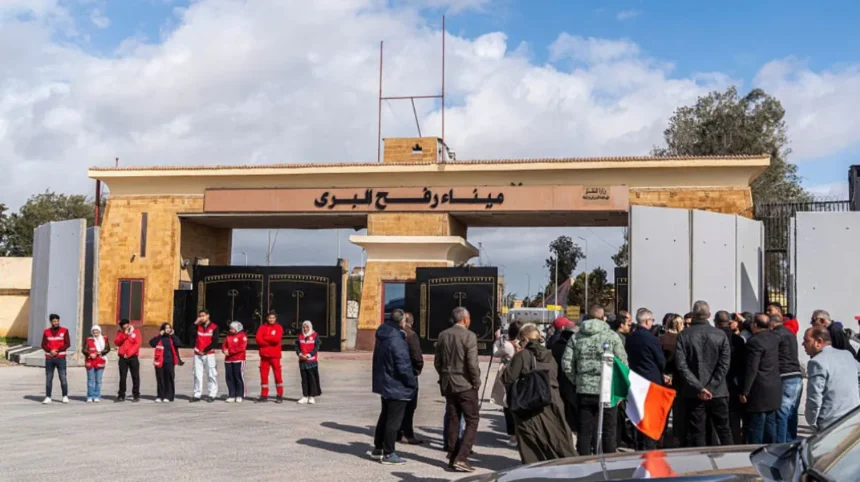
Israel’s announcement that it would reopen the Rafah crossing after more than two years of devastating war in Gaza followed the recovery of the remains of the last Israeli hostage held in the territory, rather than any comprehensive political settlement for Palestinians. As reported by The New Arab, the crossing has long been described as Gaza’s “lifeline,” the only route to the outside world not directly linked to Israel before the latest phase of the conflict. According to The New Arab, Israel seized the Gaza-side of Rafah in May 2024 during its southern offensive, leading to the crossing’s full closure except for sporadic medical evacuations. The outlet reports that the new reopening has been framed by Israeli authorities as limited and conditional, raising questions over whether it will ease Palestinian isolation or entrench Israeli oversight.
As reported by The New Arab, Israeli officials have indicated that Rafah will initially reopen only for pedestrian traffic and under a “full Israeli inspection mechanism,” with all Palestinian movement subject to Israeli and Egyptian security approval. According to The New Arab, Egypt closed its side of the crossing after Israel’s military takeover of Rafah in 2024 and has since demanded that any reopening allow movement in both directions, resisting any arrangement that would turn Sinai into a long-term refuge for displaced Gazans. The outlet notes that humanitarian agencies view the crossing as central to the delivery of badly needed fuel, food, medical supplies, and shelter materials to more than two million Palestinians in Gaza, much of whose infrastructure has been destroyed. As reported by The New Arab, the detailed modalities of who will operate the Palestinian side of Rafah, and under what authority, remain unresolved under current ceasefire and governance proposals.
Context and reactions: Freedom corridor or control point?
As reported by The New Arab, Palestinian residents and activists have expressed cautious hope that reopening Rafah could finally allow some families to reunite, students and patients to travel, and emergency cases to reach treatment abroad after years of near-total closure. According to The New Arab, many Palestinians simultaneously fear that an Israeli-run inspection regime could transform Rafah into another tool of restriction, where only tightly vetted categories of people are allowed to leave and returns are heavily controlled. The outlet notes that Hamas has publicly called for Rafah to be opened “in both directions without restrictions,” framing Israel’s announced conditions as an extension of the broader blockade.
According to The New Arab, Egyptian officials have voiced concern that an arrangement dominated by Israel could effectively sideline Palestinian authorities and international monitors, and Cairo has insisted that Rafah must not become a one-way exit that facilitates de facto population transfer from Gaza into Egypt. As reported by The New Arab, humanitarian organizations warn that if the crossing remains restricted to pedestrians or subjected to cumbersome inspection procedures, it will not meet the enormous scale of Gaza’s humanitarian needs. The outlet further reports that some regional diplomats view the reopening as a potential bargaining chip in wider negotiations over Gaza’s postwar governance, security arrangements, and reconstruction, rather than a clear step toward Palestinian freedom of movement.
Supporting details and expert commentary
As reported by The New Arab, before the 2023–2024 war the Rafah crossing was jointly managed by Egypt and Palestinian authorities and operated as Gaza’s primary civilian gateway, with thousands of people crossing annually despite intermittent closures. According to The New Arab, that system collapsed once Israel advanced into Rafah in 2024, forcing Egypt to shut its side and leaving aid convoys stranded for months on the Egyptian border. The outlet notes that aid agencies have described scenes of long lines of trucks waiting for approval while needs inside Gaza soared, underscoring Rafah’s role as a critical humanitarian corridor.
According to The New Arab, analysts say the form of control over Rafah is a key indicator of the broader balance of power in Gaza: a crossing overseen by Palestinians and international monitors would symbolically and practically expand Palestinian agency, while one effectively run by Israel would extend its grip over Gaza’s borders even if Egyptian officers are present on the other side. As reported by The New Arab, Israeli Prime Minister Benjamin Netanyahu has repeatedly emphasized that any postwar arrangement must ensure Hamas is disarmed and Gaza “demilitarized,” language experts interpret as signaling continued, and possibly long-term, Israeli security dominance over crossings including Rafah. The outlet adds that discussions about international or Arab-led forces to administer border points, including the participation of the Palestinian Authority, remain inconclusive and politically contentious among all parties.
Implications and future developments: What comes next?
According to The New Arab, the precise date and scope of Rafah’s reopening remain uncertain, with officials offering no clear timeline for when large-scale entry of goods and aid might resume. As reported by The New Arab, the current ceasefire framework envisions Gaza without a role for Hamas in governance, but does not yet resolve who will formally operate the Rafah terminal, inspect travelers, or issue permits, leaving space for competing Israeli, Egyptian, Palestinian, and international proposals. The outlet notes that these unresolved questions will determine whether the crossing functions as a genuine route for Palestinian mobility or as a narrowly controlled valve within a wider regime of restrictions.
As reported by The New Arab, humanitarian agencies and regional governments are expected to push for mechanisms that prioritize rapid aid delivery and respect for Palestinian freedom of movement, including potential international monitoring to limit unilateral control by any single party. According to The New Arab, Israel’s emphasis on security vetting and demilitarization suggests that any expanded opening could be phased, contingent on political and security developments, and vulnerable to renewed closure if tensions escalate. The outlet reports that for Palestinians in Gaza and abroad, the stakes are immediate and personal: the way Rafah is eventually managed could shape not only the flow of goods and aid, but the prospects for family reunification, study, work, and medical treatment beyond the enclave.
The situation at Rafah remains fluid, with the reopening framed by Israel as a security measure, by Egypt as a sovereignty and refugee question, and by Palestinians and aid agencies as a test of whether Gaza’s only non-Israeli border will serve as a corridor toward greater freedom of movement or reinforce a system of external control.

