


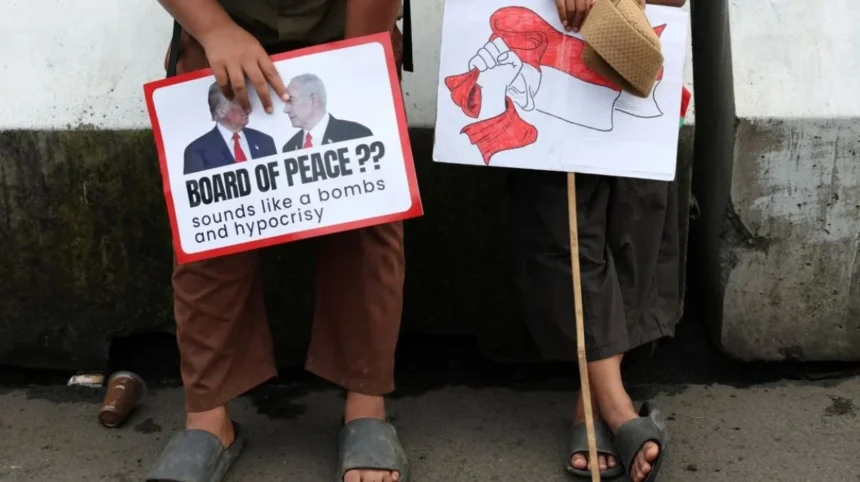
As reported by Resty Woro Yuniar of the South China Morning Post, Indonesia’s participation in the United States-led “Board of Peace” – an administrative body created to oversee post-conflict reconstruction in Gaza – has come under renewed scrutiny as the US-Israel war with Iran escalates. According to the South China Morning Post, critics in Indonesia argue that joining the initiative has undermined Jakarta’s traditional non-aligned posture and its longstanding support for Palestinian self-determination.
According to Channel NewsAsia, the Board of Peace was initially presented as a mechanism to coordinate reconstruction and stabilization efforts in Gaza following months of Israeli military operations. Indonesia, the world’s largest Muslim-majority country, became a key partner after President Prabowo Subianto signed the charter at the World Economic Forum in Davos and pledged financial and personnel support.
As reported by Anadolu Agency, Indonesian Foreign Minister Sugiono said the government had suspended all discussions on the Board of Peace initiative after a sharp escalation in the Middle East, citing the widening conflict involving Iran. He said the shift in regional dynamics and the focus on Iran had directly affected the foreign policy priorities of participating countries, including Indonesia.
Domestic pressure and diplomatic balancing
As reported by The Jakarta Post, pressure has grown at home for Indonesia to withdraw from the Board of Peace amid the US-Israel campaign against Iran, with Islamic organizations and lawmakers questioning whether the body can credibly claim to promote peace. Critics have warned that continued participation could erode Indonesia’s “strategic autonomy” and damage its reputation as a neutral mediator in Muslim-majority conflicts.
According to Channel NewsAsia, Indonesia’s Foreign Minister Sugiono said all Board of Peace discussions were “on hold” because attention had shifted to the crisis in Iran. He also said Jakarta would consult Gulf partners that are directly affected by the conflict, signaling Indonesia’s effort to align its diplomatic posture with regional concerns.
As reported by the South China Morning Post, President Prabowo has simultaneously sought to position Indonesia as a mediator between Washington and Tehran, offering to travel personally to Iran for talks if all sides agreed. According to the South China Morning Post, this mediation bid has been complicated by the perception in Tehran and among some Indonesian observers that Jakarta compromised its neutrality by joining a US-led structure closely associated with Israel’s ongoing control over Gaza.
Context and reactions: How are Indonesian stakeholders responding?
According to Channel NewsAsia, Indonesia’s participation in the Board of Peace has drawn criticism from experts and Muslim groups who argue that it clashes with Jakarta’s long-stated support for a two-state solution and Palestinian independence. The Indonesian Ulema Council, a leading clerical body, has publicly urged the government to leave the board, saying the initiative has become ineffective in light of US and Israeli attacks on Iran.
As reported by Arab News, the Indonesian Ulema Council argued that continued involvement in the Board of Peace risked legitimizing a process that does not stop ongoing military operations in the region. Meanwhile, Nahdlatul Ulama, Indonesia’s largest Muslim organization, called on the government to use any remaining leverage inside the board to press the United States and Israel to halt the violence.
According to The Jakarta Post, some lawmakers have questioned whether Indonesia’s commitments to the Board of Peace, including pledged funding and security contributions, align with domestic public opinion that remains strongly supportive of the Palestinian cause. They have also raised concerns that close association with a US-designed framework could limit Jakarta’s room to maneuver in relations with Iran and other non-Western partners in the Muslim world.
Supporting details and expert commentary
As reported by the South China Morning Post, analysts note that Indonesia’s foreign policy has long been built around non-alignment and support for decolonization, including vocal backing for Palestinian statehood. According to the South China Morning Post, joining the Board of Peace has therefore been seen by critics as a departure from this tradition, potentially tying Indonesia more closely to US regional strategy at a time of war.
According to Channel NewsAsia, Indonesian officials have emphasized that the Board of Peace was meant to focus on reconstruction in Gaza, not on military issues, and that Jakarta still backs a two-state solution as the only viable path to lasting peace. Foreign Minister Sugiono has said Indonesia will consult regional partners and evaluate its participation in light of both the Iran conflict and the state of the peace process for Palestinians.
As reported by Anadolu Agency, domestic opposition has not only focused on geopolitics but also on the perception that participation could dilute Indonesia’s moral authority in the Muslim world. According to Anadolu Agency, critics argue that if the Board of Peace cannot prevent further escalation or protect civilians, its credibility – and by extension that of member states such as Indonesia – will come under deeper question.
Implications and future developments: What could Indonesia do next?
According to Channel NewsAsia, Indonesian officials have indicated that leaving the Board of Peace is an option if the initiative does not meet key expectations, including progress toward Palestinian independence. With discussions officially placed “on hold,” Jakarta has signaled that its continued engagement will depend on how the Iran crisis evolves and whether the board can demonstrate tangible peace-building results.
As reported by the South China Morning Post, Indonesia’s attempt to mediate between Washington and Tehran could offer an alternative diplomatic path, but it may also be constrained by perceptions that Jakarta has aligned too closely with the United States through the Board of Peace. Analysts cited by the South China Morning Post suggest that Indonesia will need to carefully balance domestic expectations, regional sensitivities, and its own strategic ambitions as a middle-power mediator.
According to The Jakarta Post, further parliamentary debate and public pressure are expected as the Iran war continues and civilian casualties mount, potentially forcing the government to clarify or revise its commitments under the Board of Peace framework. Any decision to withdraw, stay, or reframe its role will likely shape Indonesia’s broader positioning in Middle Eastern diplomacy and its standing among Muslim-majority nations.
Indonesia has therefore moved to pause active participation in the US-led Board of Peace while facing intensified domestic criticism and navigating a rapidly escalating Iran crisis, according to multiple regional and international media reports. Officials in Jakarta continue to stress support for Palestinian statehood and signal openness to mediation roles, but they have yet to announce a final decision on whether Indonesia will remain in, reshape, or exit the Board of Peace initiative.

