


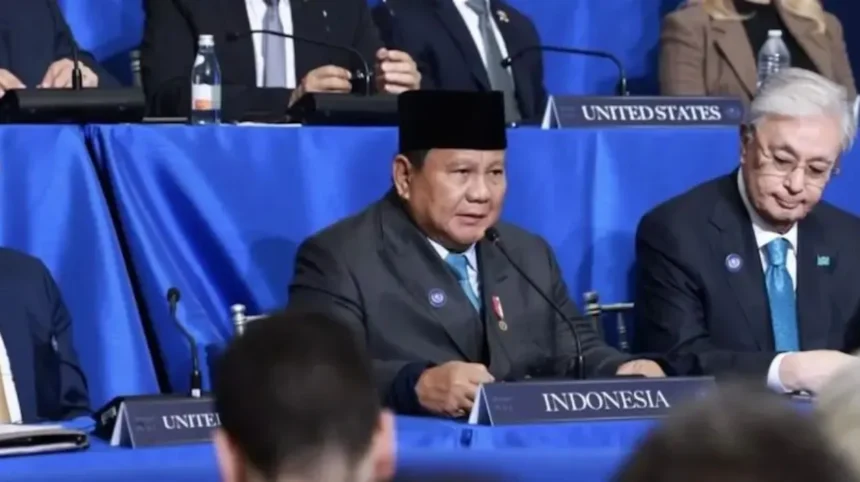
According to the Government of Indonesia’s Cabinet Secretariat, President Prabowo Subianto was among world leaders who signed the Board of Peace Charter in Davos, Switzerland, on January 22, 2026. The charter established the Board of Peace as a new international body mandated to oversee transition, stabilization, and reconstruction in post-conflict Gaza.
The Cabinet Secretariat states that Indonesia views participation in the Board of Peace as strategically important for ensuring that Gaza’s transition remains aligned with a two-state solution and does not become a permanent arrangement that sidelines Palestinian rights. Indonesian officials have framed this role as consistent with the country’s longstanding support for Palestinian self-determination and international law.
Minister for Foreign Affairs Sugiono said Indonesia’s decision followed intensive consultations with states in the “Group of New York,” noting that countries including Saudi Arabia, the United Arab Emirates, Qatar, Jordan, Türkiye, Pakistan, Egypt, and Indonesia agreed to join the Board of Peace shortly before the Davos signing. The minister emphasized that Indonesia has historically placed “great importance on peace and international stability, particularly with the situation in Palestine.”
Eurasia Review has published multiple opinion pieces examining Indonesia’s evolving role, including commentary on the political and diplomatic implications of Jakarta’s Gaza policy. These analyses highlight the tension between Indonesia’s moral commitment to Palestine and the practical constraints of joining a new U.S.-backed multilateral structure focused on Gaza.
How has Indonesia’s role in the Board of Peace been received?
The Cabinet Secretariat reports that Indonesian officials present Board of Peace participation as a concrete expression of the country’s “independent and active” foreign policy doctrine, rooted in the 1945 Constitution and a commitment to global peace. The government argues that joining the board enables Indonesia to advocate directly for a cease-fire, civilian protection, humanitarian access, and the restoration of Palestinian civil governance.
At the same time, outside analyses suggest that Indonesia’s decision has generated critical scrutiny at home and in regional expert circles. A February 2026 article by Modern Diplomacy notes that academics, international relations specialists, and civil society figures have raised questions over whether membership in the Board of Peace is a “realistic choice or subtle coercion,” given U.S. leadership of the initiative and the political sensitivities surrounding Palestine.
Modern Diplomacy reports that critics worry Indonesia could become entangled in a structure whose legitimacy and long-term commitment to Palestinian independence remain contested. Commentators cited by the outlet argue that Jakarta must ensure any new role aligns with national interests and long-standing principles of global justice that underpin its pro-Palestine stance.
Foreign Policy magazine describes Indonesia as “all-in” on the Board of Peace, noting that President Prabowo plans to leverage peacekeeping commitments in Gaza to enhance Indonesia’s international profile. The outlet reports that Prabowo has previously promoted Indonesian peace initiatives in other conflicts, including Ukraine, as part of a broader push to position the country as a regional and global security contributor.
Supporting details on military and financial commitments
As reported by Al Bawaba and republished by Eurasia Review, President Prabowo has pledged up to 8,000 Indonesian troops to support an International Stabilization Force in Gaza, with at least 1,000 personnel reportedly readied for deployment by April 2026 and additional contingents to follow. Foreign Policy notes that this deployment would significantly expand Indonesia’s peacekeeping footprint compared with its existing contributions under UN mandates.
The Indonesian government has framed the troop pledge as part of its commitment to ensuring that Gaza’s stabilization and reconstruction adhere to international law and United Nations resolutions. Officials say Indonesia’s presence is intended to provide a “moral and political balance” within the Board of Peace framework.
Modern Diplomacy reports that Indonesian analysts have raised concerns about the potential financial burden associated with Board of Peace membership, including possible contributions to reconstruction funds and operational costs. Commentators cited by the outlet argue that large financial obligations, coupled with uncertain governance structures, could strain Indonesia’s resources and complicate its domestic political debate over Palestine.
In related commentary, Eurasia Review has highlighted the broader regional context, noting that Indonesia’s decision-making intersects with shifting alignments in the Middle East and growing U.S. efforts to enlist Asian partners in postwar Gaza arrangements. These discussions frame Indonesia’s commitments as part of a larger recalibration of its role in global security and diplomacy.
What are the political implications and future challenges for Indonesia?
The Cabinet Secretariat emphasizes that Indonesia joined the Board of Peace to prevent Palestinian issues from being “sidelined in the global peace architecture,” positioning Jakarta as an active advocate within a new forum rather than a passive observer. Officials say participation is designed to uphold a two-state solution and maintain focus on Palestinian rights during the reconstruction process in Gaza.
Modern Diplomacy notes that, despite these assurances, domestic debate is likely to continue if the board’s work is perceived as diverging from Indonesia’s long-standing foreign policy principles. Analysts cited in the article warn that questions about the board’s legitimacy, financial demands, and effectiveness in promoting Palestinian independence could fuel public skepticism.
Foreign Policy reports that Prabowo views Gaza peacekeeping as part of a broader strategy to elevate Indonesia’s international status and demonstrate leadership in conflict resolution. The outlet indicates that such ambitions could bring both diplomatic opportunities and political risks if developments in Gaza do not align with public expectations at home.
Eurasia Review’s commentary underscores that Indonesia’s engagement with the Board of Peace will be judged against its historic posture as a strong supporter of Palestinian statehood. Analysts writing in that outlet argue that Jakarta must balance its new institutional role with a continued emphasis on inclusive, multilateral approaches grounded in international law.
Indonesia’s participation in the Board of Peace thus represents a significant evolution in its Palestine policy, combining charter signatures in Davos, pledges of troops for Gaza, and high-level diplomatic advocacy. How these commitments translate into outcomes on the ground in Gaza—and how they are perceived in Indonesian domestic politics—remains an open question that will shape the country’s foreign policy debate in the months ahead.

