


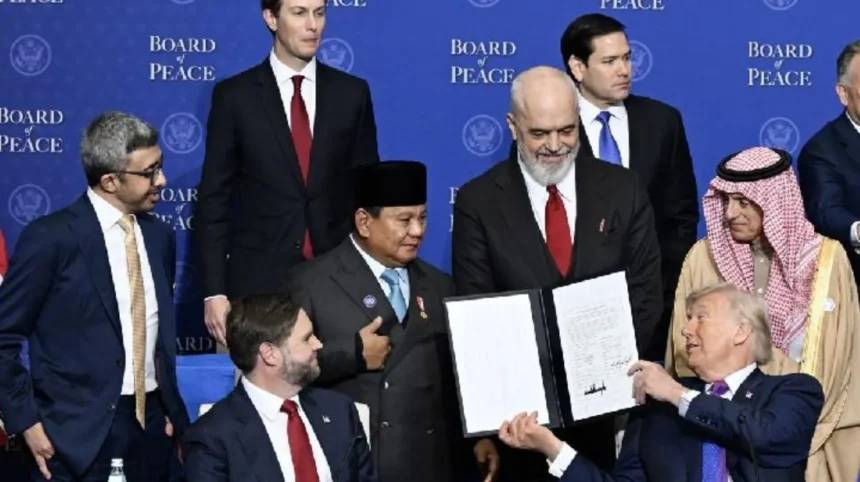
As reported by Meenakshi Ganguly and Andreas Harsono of Tempo, Indonesia’s participation in United States President Donald Trump’s “Board of Peace” has raised questions about the country’s foreign policy direction, financial commitments, and its long-held stance on the Palestinian cause. According to Tempo, the Board of Peace is a US-led initiative tied to efforts to stabilize Gaza and the wider Middle East, with member states expected to contribute politically, militarily, and financially.
According to Tempo, Indonesia recently agreed to join the Board of Peace and has been identified as one of several countries invited to support the body’s operations. Citing reporting summarized by Tempo from ABC News, a draft budget for the institution indicates that countries accepting the invitation will be granted three-year membership, with permanent membership reserved for those contributing more than 1 billion US dollars in the first year. Tempo notes that this proposed contribution level has sharpened domestic scrutiny of the initiative’s cost and benefits for Indonesia.
As reported by Tempo, critics inside Indonesia argue that participation in the Board of Peace must be assessed in light of the country’s constitutional principles and its traditional role as a supporter of Palestinian self-determination. Tempo’s opinion writers highlight concerns that the initiative’s structure and agenda are largely driven by Washington and may not align with Indonesia’s non-aligned foreign policy tradition.
Context and Reactions: Why Is Indonesia’s Role Being Questioned?
According to the South China Morning Post, Indonesia’s involvement in Donald Trump’s Board of Peace has come under increased scrutiny as conflict in the Middle East, including tensions involving Iran, has intensified. The outlet reports that critics in Indonesia have urged President Prabowo Subianto’s administration to reassess participation, warning that Jakarta could lose what they describe as “strategic autonomy” by moving too close to Washington’s security agenda.
As reported by the Times of Israel, President Prabowo Subianto has publicly stated that Indonesia will withdraw from the Board of Peace if the initiative does not deliver tangible benefits for Palestinians. The report notes that Prabowo conveyed this assurance to domestic Islamic groups, as critics questioned whether engagement with the US-led body might dilute Indonesia’s long-standing advocacy for Palestinian rights.
According to Dawn, a government statement in early March said Prabowo had reassured Islamic organizations that Indonesia’s role in the Board of Peace depended on the platform serving Palestinian interests. Dawn reports that Indonesia’s decision to join the board and commit troops to an international stabilization force in Gaza drew criticism from some experts and Muslim community representatives, who argued that it could be seen as weakening Indonesia’s traditional position in support of Palestinian aspirations.
As reported by Anadolu Agency, Indonesia has since paused or “suspended” active discussions related to the Board of Peace, with Foreign Minister Sugiono citing escalating tensions and military developments in the Middle East, including conflict with Iran, as key reasons. Anadolu notes that this move followed mounting debate at home about the risks associated with deeper security involvement under the US-led mechanism.
Supporting Details and Expert Concerns
According to Tempo, the Board of Peace proposal includes significant financial expectations that have raised domestic economic and political concerns. Tempo reports that the draft budget seen in international coverage foresees member states paying up to 1 billion US dollars in the first year to secure permanent membership, a sum that critics suggest could place substantial pressure on Indonesia’s public finances if it chose to make such a contribution.
As reported by Tempo and other outlets, Indonesia’s participation is also being debated alongside a separate United States–Indonesia trade arrangement, which some analysts say could be politically intertwined with security cooperation and Board of Peace membership. Academics at Gadjah Mada University, in commentary highlighted by local media, have warned that closer alignment with US economic and security frameworks could expose Indonesia to sovereignty risks and possible retaliation from other major powers.
According to the South China Morning Post, critics argue that sending Indonesian troops to Gaza under the Board of Peace umbrella could be interpreted as Jakarta endorsing a US-designed conflict-management model rather than pursuing an independent diplomatic role. The same report notes that while Prabowo has defended his approach as consistent with non-alignment, analysts interviewed by the outlet question whether the initiative’s design effectively allows Indonesia to maintain that position.
Tempo has also referenced earlier commentary characterizing Trump’s Board of Peace as carrying “ethical” and political risks for Indonesia. In that commentary, cited by Tempo, op-ed writers argue that joining a body framed as neutral peace-building could mask underlying power politics, and they call on Jakarta to carefully weigh the implications for its reputation among Muslim-majority countries and within the Non-Aligned Movement.
Implications and Future Developments: What Could Happen Next?
According to Anadolu Agency, the Indonesian government’s decision to suspend discussions on the Board of Peace suggests that Jakarta is reassessing the costs and strategic implications of deeper involvement while monitoring developments in the Middle East. The report indicates that the pause coincides with rising regional tensions, suggesting that Indonesia may seek clearer guarantees about the initiative’s impact on Gaza and Palestinian civilians before proceeding.
As reported by the South China Morning Post, Indonesia currently remains a member of the Board of Peace despite the suspension of some discussions. Analysts cited by the outlet say that future decisions could hinge on whether the initiative demonstrates progress toward protecting Palestinian rights and reducing violence, as well as how other major powers respond to the US-led framework.
According to the Times of Israel and Dawn, President Prabowo’s pledge to leave the Board of Peace if it fails to help Palestinians sets a clear political benchmark that domestic audiences and international observers are likely to use to judge Indonesia’s next steps. Media reports suggest that Jakarta will face continuing pressure from civil society groups, religious organizations, and foreign policy experts to ensure that any security or financial commitments under the Trump-led initiative do not compromise Indonesia’s long-standing support for Palestinian self-determination.
In sum, Indonesia’s engagement with Donald Trump’s Board of Peace remains under close scrutiny at home and abroad, with debates focusing on financial obligations, foreign policy alignment, and the real impact on Palestinians. The government’s decision to suspend discussions while keeping membership open underscores the balancing act Jakarta faces between maintaining strategic relations with Washington and preserving its traditional role as a vocal supporter of Palestinian rights.

