

Key Points
- Who is involved: Thai PBS Verify fact‑checking unit, Cambodian social media users, Cambodia’s Prime Minister Hun Manet, the Cambodian government, Thailand’s Ministry of Foreign Affairs, U.S. President Donald Trump and participants in the “Board of Peace” meeting.
- What happened: A claim circulated on social media alleging that Cambodia’s national flag was not displayed during the “Board of Peace” meeting in Washington, despite Cambodia’s attendance; Thai PBS Verify investigated and found the claim to be false.
- When it occurred: The inaugural “Board of Peace” meeting took place on 19 February 2026, while the misleading post appeared shortly afterwards and Thai PBS Verify published its fact‑check on 4 March 2026.
- Where it occurred: The meeting was held at the United States Institute of Peace in Washington, D.C., and the disinformation spread on Threads, a social media platform; the verification was carried out by Thai PBS Verify in Thailand.
- Why it matters: The claim targeted Cambodia’s international standing and Prime Minister Hun Manet’s diplomatic efforts, and illustrates how visual misinformation around high‑profile events can fuel political criticism and cross‑border tensions.
- How it is being addressed: Thai PBS Verify cross‑checked AFP news photographs and footage from the event, identified Cambodia’s flag on a large screen at the venue, and published a detailed debunk; Thailand’s Foreign Ministry also clarified Thailand’s observer status and position regarding the Board of Peace.
- Potential impact or implications: The episode highlights the growing role of fact‑checkers in countering diplomatic disinformation, underscores sensitivities around the U.S.‑backed Board of Peace and Gaza peace plan, and may influence how regional governments respond to future misleading narratives.
Thai PBS Verify has concluded that a viral social media claim alleging the absence of Cambodia’s national flag at U.S. President Donald Trump’s “Board of Peace” meeting in Washington is false, after analysing original news footage showing the flag clearly displayed on a screen at the venue. The inaugural meeting, held on 19 February 2026 at the United States Institute of Peace, formed part of the White House’s wider initiative to advance a 20‑point plan on Gaza under the newly created Board of Peace. The debunk comes amid heightened scrutiny of the board, which is presented by the Trump administration as a future international organisation for peace and security but remains politically sensitive in Southeast Asia and beyond.
- Key Points
- Social media claim targeting Cambodian flag
- Verification using AFP footage and wide‑angle images
- Board of Peace: background to the Washington meeting
- Thailand’s observer status and official explanation
- Cambodia’s image and regional sensitivities
- Role of Thai PBS Verify and fact‑checking practice
- Disinformation around the ‘Board of Peace’
- Lessons on visual evidence and online platforms
- What Happens Next
Social media claim targeting Cambodian flag
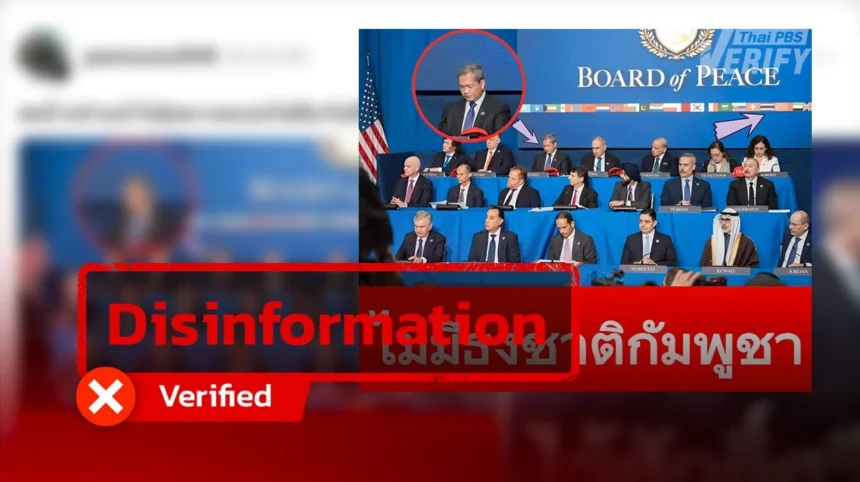
The fact‑check was triggered by a post on Threads claiming that the Cambodian flag was missing from the Board of Peace meeting, despite Cambodia’s participation in the event. The post, which drew more than 3,400 views and over 260 likes, mocked Prime Minister Hun Manet and suggested that the absence of the flag showed other leaders’ lack of interest in engaging with him.
According to Thai PBS Verify, the message read in part: “Serves you right, Hun Manet. No flag, and nobody wants to talk to you,” framing the purported omission as a diplomatic slight. The post did not provide independent evidence beyond cropped or limited‑angle images from the event, illustrating how incomplete visuals can feed misleading narratives.
Verification using AFP footage and wide‑angle images
In response, Thai PBS Verify conducted a keyword search to locate original visual material from the meeting, focusing on images and footage distributed by international news agency AFP. The team examined wide‑angle photographs showing the stage at the United States Institute of Peace, where two large screens flanked the podium.
The analysis found that the screen on the left clearly displayed the national flag of Cambodia, alongside other national symbols associated with participating states. When the AFP image was magnified, the Cambodian flag remained visible and identifiable, contradicting the social media claim that it was absent from the meeting. Thai PBS Verify concluded that the assertion that the Cambodian flag had been excluded was “entirely unfounded” and categorised the claim as false.
The fact‑check noted the original AFP caption, which stated that Trump delivered a speech during the inaugural Board of Peace meeting at the United States Institute of Peace on 19 February 2026, underlining that the images were contemporaneous and directly related to the contested event. This information could not be independently verified.
Board of Peace: background to the Washington meeting
The Washington gathering formed part of the first high‑level meeting of the Board of Peace, a body established under the White House’s Comprehensive Plan to End the Gaza Conflict. The board’s stated objective is to oversee a 20‑point peace proposal put forward by Trump, covering ceasefire arrangements, reconstruction financing and longer‑term governance in Gaza.
Thai PBS Verify reports that the board’s mandate includes strategic oversight, mobilising international resources and managing a transition towards peace and development in Gaza. Over time, the Board of Peace is intended, according to its promoters, to evolve into an international organisation dedicated to peace and security in conflict zones worldwide, extending beyond the specific context of Gaza.
Other media outlets have noted that the initiative follows a UN Security Council resolution authorising cooperative efforts in Gaza, and that rights experts have raised questions about the board’s composition and the absence of Palestinian representation. Critics cited by these reports argue that the structure risks resembling a form of external control over a foreign territory, although the Trump administration frames it as a multilateral stabilisation mechanism.
Thailand’s observer status and official explanation
The fact‑check also sets out Thailand’s position in relation to the Board of Peace, as clarified in a statement from the Thai Ministry of Foreign Affairs dated 20 February 2026. The ministry said Thailand attended the inaugural meeting in Washington as an observer, rather than as a full participating member.
According to the ministry’s statement, Ambassador Suriya Chindawongse, Thailand’s envoy to the United States, was designated to represent the country at the meeting “to observe and follow developments of the Board of Peace,” while the Thai government continues to “consider and review” the initiative. The statement added that attending as an observer would help Bangkok stay informed about the board’s direction and activities, informing any subsequent decision on whether to participate more fully.
Thai PBS Verify uses this official explanation to contextualise Thailand’s involvement, noting that the country has not yet made a final determination about joining the board. The clarification seeks to pre‑empt speculation that Thailand’s presence signified a binding commitment, instead framing it as part of an ongoing evaluation of the new peace architecture.
Cambodia’s image and regional sensitivities
Although the false claim centred on the alleged absence of Cambodia’s flag, the fact‑check indicates that the narrative was closely tied to domestic and regional political sensitivities. By suggesting that the flag had been excluded, the post implicitly questioned Cambodia’s international standing and attempted to portray the country’s leadership as marginalised during a high‑profile global event.
The focus on Hun Manet in the caption underlines how visual misinformation can be directed at specific political figures, potentially influencing public perceptions at home and abroad. The episode occurred in a region where disputes over sovereignty, borders and military incidents have previously been accompanied by competing information campaigns, as highlighted by other Thai PBS Verify investigations into Cambodia‑Thailand issues.
Fact‑checking in this case therefore has implications beyond a single image, touching on broader questions of diplomatic respect, national prestige and regional relations. It also underscores the importance for governments of responding swiftly and transparently to viral content that may affect their international reputation.
Role of Thai PBS Verify and fact‑checking practice
Thai PBS Verify describes itself as a unit dedicated to filtering news, reducing the spread of false information and promoting accurate understanding in society. The organisation publishes investigations across topics including regional conflicts, domestic politics and international events, often triggered by high‑engagement posts on social media.
In the Cambodian flag case, the unit followed a methodical process that included identifying the claim, tracing original visual sources, cross‑checking captions and contextual information, and presenting clear evidence to support its conclusion. The fact‑check clearly separates what the social media user claimed from what the images show, and it labels the final finding under a “What is the truth?” section to distinguish verified facts from allegations.
This structured approach aligns with international fact‑checking standards that emphasise transparency of sources, reliance on primary material where possible and clear communication of verdicts such as “false” or “unsupported”. Thai PBS Verify’s intervention demonstrates how national media outlets can contribute to media literacy and counter disinformation linked to international diplomacy.
Disinformation around the ‘Board of Peace’
The Cambodian flag claim is one example of the wider swirl of narratives, endorsements and criticisms surrounding Trump’s Board of Peace. Other coverage has focused on the board’s financial pledges, projected troop deployments and its potential role alongside or in competition with existing international institutions.
Al Jazeera, for instance, has reported that the board is associated with a multibillion‑dollar reconstruction pledge for Gaza, backed by the deployment of foreign personnel, while raising questions about whether promised measures are sufficient to address the humanitarian situation. The BBC has noted that member states have announced sizeable relief commitments linked to the board, though full details of implementation remain unclear. This information could not be independently verified.
Against this backdrop, the visual symbolism of flags and seating positions at the inaugural meeting has taken on outsized significance for domestic audiences in participating countries. As states weigh the diplomatic costs and benefits of associating with the board, misinterpretations of images can feed narratives about favour, exclusion or status that may not reflect the underlying reality.
Lessons on visual evidence and online platforms
The fact‑check underscores how images from large‑scale events can be selectively cropped or framed online to support pointed commentary, especially on fast‑growing platforms such as Threads. Users who encounter a limited view of a stage or a moment in a live broadcast may draw conclusions that do not hold when the full visual field is examined.
Thai PBS Verify’s use of wide‑angle shots and zoomed‑in views to prove the presence of Cambodia’s flag illustrates why context is crucial when assessing visual claims. It also shows the value of consulting professional wire‑service images, which often capture events from multiple vantage points and are accompanied by editorial captions.
For audiences, a key lesson is the importance of caution before sharing content that makes strong political claims based on a single photograph or short clip. For media organisations and governments, the case highlights the need to respond proactively when such claims circulate, both by providing authoritative information and by supporting independent verification efforts.
What Happens Next
Thai PBS Verify’s ruling that the Cambodian flag claim is false may dampen the immediate spread of that specific piece of misinformation, but similar narratives could re‑emerge around future Board of Peace events or other international summits. Fact‑checking organisations in the region are likely to continue monitoring social media platforms for misleading posts connected to high‑profile diplomacy, particularly where they touch on sensitive bilateral relationships.
Thailand’s government is still considering whether to deepen its engagement with the Board of Peace beyond observer status, and its decision may shape domestic debate about the initiative and associated narratives. Cambodia, for its part, may use the clarification over the flag to reinforce its message that it is fully recognised at international forums, while remaining alert to further online commentary about its role.
More broadly, as the Board of Peace advances its 20‑point Gaza plan and seeks to position itself as a lasting international organisation, scrutiny from media, fact‑checkers and rights groups is likely to intensify. The way visual and textual claims around such meetings are challenged or corrected will play a significant part in shaping public understanding of both the board’s activities and the diplomacy surrounding it.

