


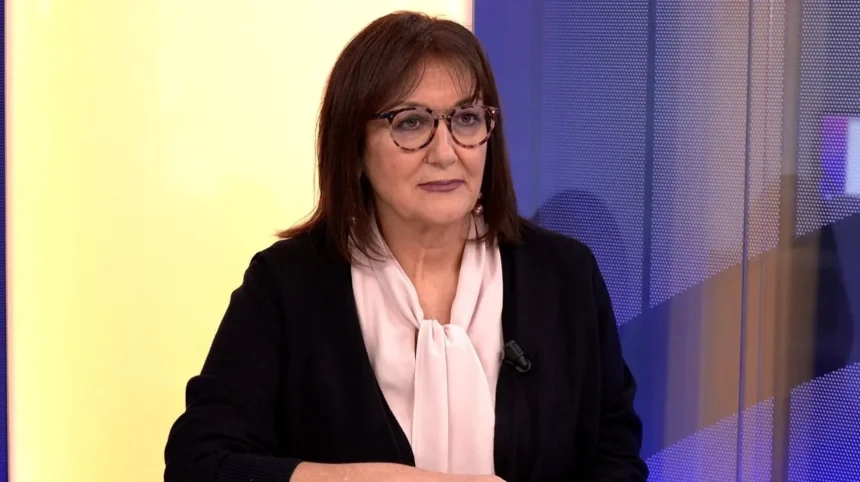
European Commissioner for the Mediterranean Dubravka Šuica has rejected claims that the European Union has conferred legitimacy on US President Donald Trump’s new Board of Peace following her participation in its inaugural meeting in Washington in February. According to Euronews, Šuica attended the 19 February session as an observer, a move that provoked criticism from several EU governments who argue the European Commission has no mandate to engage in foreign policy initiatives of this kind. France and Spain in particular contended that her presence breached EU treaties by overstepping the Commission’s competences on external action.
As reported by Euronews, Šuica said the EU “has not legitimised” the Board of Peace and stressed that the Commission is not a member of the body. She explained that the invitation was addressed to Commission President Ursula von der Leyen and that she had attended on von der Leyen’s behalf, framing her role as one of observation rather than endorsement. Euronews notes that the Board of Peace, launched by Trump and chaired by him for life, has drawn scrutiny within Europe for its broad remit and perceived challenge to the United Nations system.
How did criticism and reactions emerge?
EU member states and lawmakers reacted sharply to Šuica’s attendance, questioning both the institutional and political signals it sent. According to Euronews, France’s foreign minister argued that the Commission lacked a mandate from member states to participate in the Board, and Spain raised similar concerns about compliance with the EU treaties. A joint statement from three major political groups in the European Parliament – Socialists and Democrats, Renew Europe, and the Greens/European Free Alliance – later described her participation as a “grave error of judgement” from an institutional, legal and political perspective.
Euronews reports that these parliamentary groups warned that even observer status risked sending a powerful signal of endorsement for Trump’s initiative. They urged the Commission to disengage from the Board of Peace, refrain from sending observers and cease any form of participation. In a separate parliamentary question, MEPs argued that Šuica’s presence at an event organised by the Board could be seen as ambiguous in light of the EU’s commitment to a multilateral system centred on the UN.
In her interview with Euronews, Šuica sought to distance the EU from the Board’s design and objectives while defending her decision to attend. She said it was “a good occasion” in her role overseeing cooperation with North African and Middle Eastern countries to meet regional counterparts on the sidelines of the meeting. At the same time, she underlined that the Commission “is not in line” with parts of the Board’s rules of procedure and scope, reiterating that the EU remains outside the initiative.
Supporting details and mandate concerns
The Board of Peace was initially presented by Trump as a mechanism to support reconstruction in Gaza following the devastation of the recent conflict. In her remarks to Euronews, Šuica said that, at the time of the February meeting, the initiative was meant to focus on Gaza and that the EU should not lose sight of the dire humanitarian situation there. However, Euronews and other outlets have noted that the Board’s charter, published before the first working session, does not explicitly mention Gaza or the Palestinian territories.
According to a document cited by Reuters, the EU’s foreign policy arm has raised concerns that the Board “significantly deviates” from a United Nations Security Council mandate that was previously concentrated solely on Gaza. The same document warns about a “concentration of powers” in Trump’s hands as lifelong chair, as well as the conditions under which member states can obtain permanent seats by contributing substantial financial resources. European Council President Antonio Costa has publicly flagged “serious reservations” among EU leaders about the Board’s scope, governance and alignment with the UN charter.
Euronews also reported that several EU capitals, including France, have rejected invitations to join the Board due to fears that the initiative could undermine the UN and reshape global governance in ways that sideline multilateral diplomacy. Hungary, by contrast, has accepted a seat, highlighting divisions among member states over how to engage with Trump’s foreign policy agenda. Legal scholars have argued that the controversy around Šuica’s attendance illustrates broader challenges in defining who represents the EU externally and under what mandate.
What are the implications and possible next steps?
The immediate political consequence for the European Commission is sustained pressure from member states and the European Parliament to clarify its stance on Trump’s Board of Peace and to avoid any perception of participation beyond observation. Euronews reports that Šuica is expected to brief foreign ministers on her visit and defend the Commission’s approach at the Foreign Affairs Council, where ministers can question whether institutional boundaries were respected. Calls from parliamentary groups to “clearly disengage” suggest that any future Commission presence at Board meetings will face heightened scrutiny.
For EU foreign policy, the episode underscores tensions over how far the bloc should go in engaging with US-led initiatives that touch on global security architecture. According to Euronews and Reuters, many EU governments fear that aligning too closely with the Board could be interpreted as shifting away from the UN-based multilateral order that underpins the Union’s external action. The debate comes as EU leaders prepare to discuss regional security and economic stability, including the impact of the Gaza conflict and the broader Middle East situation, at upcoming informal talks in Cyprus.
Šuica told Euronews she remains focused on advancing the EU’s Mediterranean agenda, including the New Agenda for the Mediterranean and related pacts, despite the escalation of conflict in the region. She expressed optimism that an action plan for the Mediterranean Pact could be endorsed by EU leaders in the coming months, indicating that the Commission aims to channel its efforts through established EU frameworks rather than new external bodies. How the Commission responds to demands for distance from Trump’s Board of Peace may influence future debates over EU representation and coordination in matters of global governance.
In sum, Šuica’s message is that the EU does not consider itself a member of the Board of Peace and does not see its observer presence as conferring legitimacy on Trump’s project, even as internal criticism continues. The controversy has opened a wider discussion inside the Union about institutional mandates, loyalty to the UN-centred multilateral system, and the political symbolism of engaging with new power structures in international conflict resolution.

