


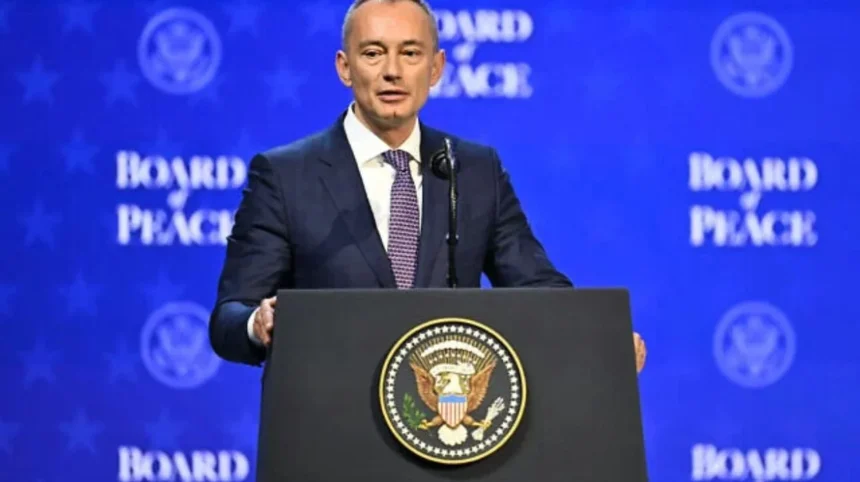
According to The Times of Israel, a senior envoy to the international Board of Peace overseeing post‑war Gaza says mediators have agreed on a general framework intended to unlock large‑scale reconstruction of the enclave, but insist the plan hinges on Hamas disarming. The Board of Peace was created under the broader Gaza peace plan championed by US President Donald Trump, which links reconstruction and an Israeli withdrawal to the demilitarization of Hamas and other armed factions in the territory. As reported by NPR, mediators recently presented Hamas with a proposal in Cairo for the “complete handover” and “full decommissioning” of its weapons and those of other groups in Gaza in exchange for extensive rebuilding and an international stabilization force. According to background reporting on the Gaza peace plan, reconstruction is supposed to be overseen by a technocratic Palestinian committee under international supervision by the Board of Peace.
As outlined by analysts examining the security track, international mediators have pushed a middle‑ground formula that secures Hamas agreement in principle to disarm, while delaying detailed implementation mechanisms such as sequencing, benchmarks and verification to later talks. The aim, according to these assessments, is to anchor reconstruction decisions in international guarantees, limit Israeli interference in internal Gaza governance, and keep donors engaged despite unresolved security questions. Reporting by CNN and others on Trump’s 20‑point Gaza proposal notes that Hamas disarmament and the transfer of governance to a Palestinian technocratic body are central conditions for a full Israeli military withdrawal and the start of major rebuilding.
What reactions and positions have emerged?
According to material posted on social media and cited by regional outlets, Board of Peace envoy Nikolay Mladenov has described an agreed framework among mediators that he says could “unlock reconstruction” and “breathe life back into communities” in Gaza if implemented. NPR reports that Hamas officials say they are prepared to discuss their weapons but had been waiting for a formal proposal from mediators before committing to any specific disarmament arrangement. A senior Hamas figure interviewed by Reuters previously declined to give a definitive commitment to disarm, saying any decision would depend on the nature of the proposal and stressing that broader Palestinian factions would need to be involved.
Regional commentary cited by Al Jazeera and other media indicates that some Palestinian officials view the new technocratic committee for Gaza as a potential alternative authority to Hamas, while warning that reconstruction and basic service delivery could stall if armed groups on the ground prevent it from operating. According to Al Jazeera, US officials and mediators have framed the emerging governance structure as a way to encourage calm and a “return to normalcy,” while creating space to negotiate Hamas’s demilitarization and an eventual international peacekeeping presence. In Israeli media and policy debates summarized by think‑tank analyses, officials have repeatedly said Hamas must disarm and that Israel will not accept a reconstruction process that allows the group to rearm or retain effective security control over Gaza.
Supporting details and expert commentary
According to NPR’s reporting, the demilitarization proposal delivered in Cairo is described by people briefed on it as a comprehensive framework for the “complete handover” and “full decommissioning” of Hamas’s arsenal and that of other armed organizations. The same reporting notes that Trump’s Board of Peace was tasked with overseeing Hamas’s demilitarization, establishing a multinational stabilization force and managing the conditions for an Israeli withdrawal from Gaza. Background analysis on the Gaza peace plan explains that day‑to‑day governance and reconstruction would be run by a National Committee for the Administration of Gaza made up of Palestinian technocrats, operating under the oversight of the Board of Peace and international partners.
Policy experts cited by the New Lines Institute and other research bodies say mediators are trying to square competing priorities: Israel’s insistence on clear progress toward Hamas disarmament, Hamas’s reluctance to surrender weapons while Israeli forces remain, and donors’ demand for a credible reconstruction track. These assessments suggest that the current framework focuses on principle‑level commitments, leaving sensitive questions such as verification regimes, security force composition, amnesty provisions and timelines to later negotiations. One analyst quoted in Al Jazeera coverage stressed that any interim administration will require “clear political and legal authorization” from Palestinian institutions and broad international backing to function effectively amid pressure from armed groups.
What are the implications and possible next steps?
According to NPR and other outlets, if Hamas accepts the proposal to relinquish its weapons under the emerging framework, mediators believe it could trigger large‑scale reconstruction funding, deployment of a multinational security force and a phased Israeli withdrawal from Gaza. However, Reuters and regional media underscore that Hamas has not publicly committed to disarm and continues to link any discussion of its arsenal to broader political conditions, leaving the central condition in the Board of Peace framework unresolved. Analysts cited by the New Lines Institute warn that without a workable disarmament mechanism and agreed security architecture, international donors may hesitate to fully back reconstruction despite the mediators’ framework.
Future steps described in reporting and expert commentary include further negotiations between mediators and Hamas on the scope and sequencing of disarmament, talks with Israel on possible amnesty or incentives for Hamas members who comply, and efforts to stand up the technocratic Gaza administration and an international stabilization force. Israeli participation in the Board of Peace framework, which has already required adjustments to its scope and mandate, will likely remain a key factor in determining how quickly any reconstruction deal can be implemented. For now, mediators appear focused on solidifying the agreed framework and testing whether Hamas and Israel are prepared to move from principle‑level understandings toward concrete, verifiable steps on the ground.
In sum, the Board of Peace envoy’s remarks highlight that international mediators see a viable framework in place to begin rebuilding Gaza, but they also underline that the plan’s central condition — Hamas’s disarmament — remains the decisive unresolved issue that will determine whether large‑scale reconstruction and a new governance and security order for the territory can move ahead.

