


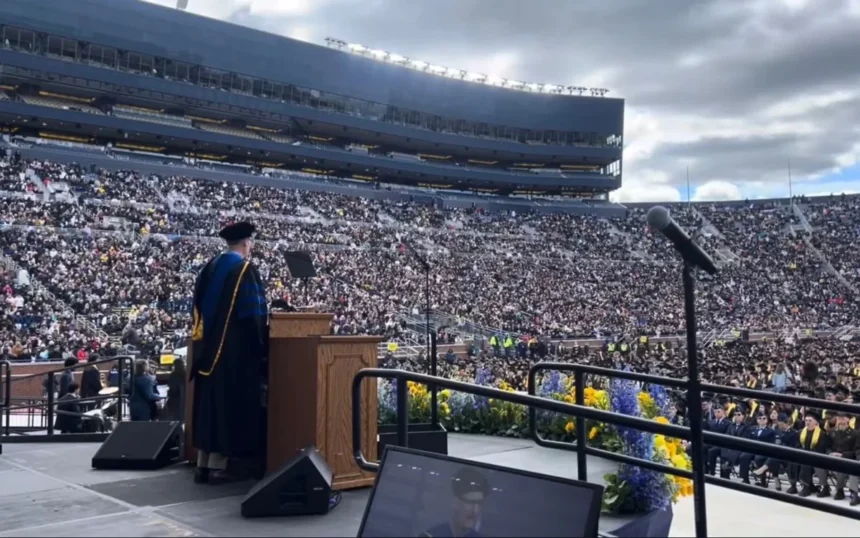
The University of Michigan issued a formal apology following remarks made by a professor during its spring commencement ceremony. Derek R. Peterson, the outgoing Faculty Senate chair and a history professor, praised pro-Palestinian student activists in his address. This incident occurred on May 2, 2026, at the university’s football field in Ann Arbor.
As reported by JTA staff of the Times of Israel, Peterson structured his speech around historical pioneers at the university. He highlighted Moritz Levi, the first Jewish professor appointed in 1896, who opened doors for Jewish students facing East Coast antisemitism. Peterson then linked this to current events, saying the pro-Palestinian activists had “opened our hearts to the injustice and inhumanity of Israel’s war in Gaza.”
According to the Times of Israel, Peterson’s comments received applause from the crowd. The university has seen extensive pro-Palestinian protests, including encampments, over the past two years. Incidents such as peony destruction at the arboretum and vandalism at a Jewish regent’s home have also occurred on campus.
Interim President Domenico Grasso responded the same day with a public statement. Grasso described the remarks as “hurtful and insensitive to many members of our community.” He noted that Peterson deviated from pre-submitted comments, calling the statements inappropriate for a celebratory event.
What Were the Key Reactions?
Michigan Hillel condemned the speech on Instagram the following day. “Commencement is a celebration of every graduate. It is not a stage for political statements that alienate the Jewish community,” the organization stated. Hillel expressed hope for productive conversations with administrators.
Ted Deutch, CEO of the American Jewish Committee and a Michigan alumnus, criticized Peterson for hijacking a unifying moment. As reported by the Times of Israel, Deutch accused him of injecting anti-Israel politics into the event. Florida GOP Senator Rick Scott called for federal funding cuts, stating on social media that such content does not justify taxpayer support.
Over 1,100 faculty, staff, and students signed an open letter defending Peterson within 24 hours. The letter argued his comments connected to historical student activism against injustice, similar to Levi’s era. It claimed Grasso’s apology violated the university’s institutional neutrality policy.
Karla Goldman, a Judaic Studies professor at Michigan, told the Jewish Telegraphic Agency that reactions were predictable. She questioned the purpose of the remarks, asking, “Why throw a grenade?” Goldman understood the link between historical and current activism but noted the foreseeable backlash.
Additional Verified Details
Peterson also teaches African-American studies and was finishing his term as Faculty Senate chair. The university announced a review of future commencement programming. Grasso emphasized institutional neutrality, a stance many universities have adopted amid Israel-related tensions.
Pro-Palestinian activism at Michigan included sustained encampments since the early stages of the Gaza conflict. Amir Makled, an attorney who defended encampment participants, recently received the Democratic nomination for the university’s board of regents. These events provide context for Peterson’s reference to student efforts.
The speech video was removed from public university channels. Commencement ceremonies nationwide have faced disruptions over Israel-Gaza issues since October 7, 2023. In 2024, Michigan graduations saw pro-Palestinian demonstrations, leading some schools to limit student speeches.
Previous incidents involved disciplining students for similar comments. Universities have navigated these tensions by reinforcing policies against political expression at ceremonies. Peterson’s faculty role distinguished this case from typical student-led actions.
What Are the Broader Implications?
Grasso’s apology reaffirmed the university’s commitment to unity at commencements. The review of programming aims to prevent future deviations from approved scripts. Institutional neutrality remains a guiding principle amid polarized debates.
The faculty letter highlighted free speech values, noting many community members have family affected by the Gaza war. Protests were seen as central to some students’ experiences. This underscores ongoing campus divisions over the conflict.
Senator Scott’s threat of defunding raises questions about federal oversight of public universities. Hillel’s call for dialogue suggests potential administrative discussions. The rapid faculty mobilization shows strong internal support for Peterson’s perspective.
Goldman’s analysis points to predictable outcomes in such high-profile settings. Linking historical Jewish inclusion to current activism drew both praise and criticism. These reactions reflect broader national tensions on campuses.
Future commencements may feature stricter guidelines. Peterson’s speech set a precedent for faculty involvement in sensitive topics. The university’s response balances celebration with free expression concerns.
The incident amplifies Michigan’s history of activism. From early Jewish integration to recent protests, the campus has been a site of social change efforts. Grasso’s statement regretted pain caused on a day of accomplishment.
Over 1,100 signatures on the rebuttal letter indicate significant campus sentiment. This contrasts with external criticisms from Jewish organizations. The university faces pressure from multiple sides.
Programming refinements could include pre-approvals or faculty training. Removal of the speech video limits public access to the full remarks. These steps aim to maintain focus on graduates.
The apology and backlash highlight challenges in diverse communities. Peterson’s praise of protesters tied into a narrative of opening hearts to injustice. Reactions varied by viewpoint on the Gaza conflict.
Michigan’s interim leadership navigates these issues amid ongoing protests. The board of regents nomination adds political layers. Faculty senate transitions may influence future stances.
This event contributes to national discourse on campus speech. Universities continue adapting policies post-2024 disruptions. Peterson’s role as outgoing chair marks the end of his leadership tenure.
The University of Michigan’s apology followed Professor Derek Peterson’s praise of pro-Palestinian activists at the May 2 commencement. Interim President Domenico Grasso cited deviation from approved remarks and insensitivity. Reactions ranged from Hillel’s condemnation and funding cut calls to over 1,100 faculty signatures defending free speech. The university plans to review future programming while upholding institutional neutrality.
Super easy to register and start playing. No complicated steps, just pure fun and excitement. Join no1jililogin
Finally found a platform that doesn’t make it complicated to withdraw winnings. The customer support was also very helpful with my initial deposit. Visit 77bbcombet
I was a bit skeptical at first but this site is legit. The customer support team helped me out with my account in minutes. lucky91onlinelogin is a gem.
I was looking for a spot that mixes classic charm with modern excitement and this place hits the mark perfectly. It feels like stepping into a cozy lounge where the hosts know your name. The games flow beautifully and every round brings a little spark of joy. Visit pefarfancasino and enjoy a truly pleasant ride. pefarfancasino