


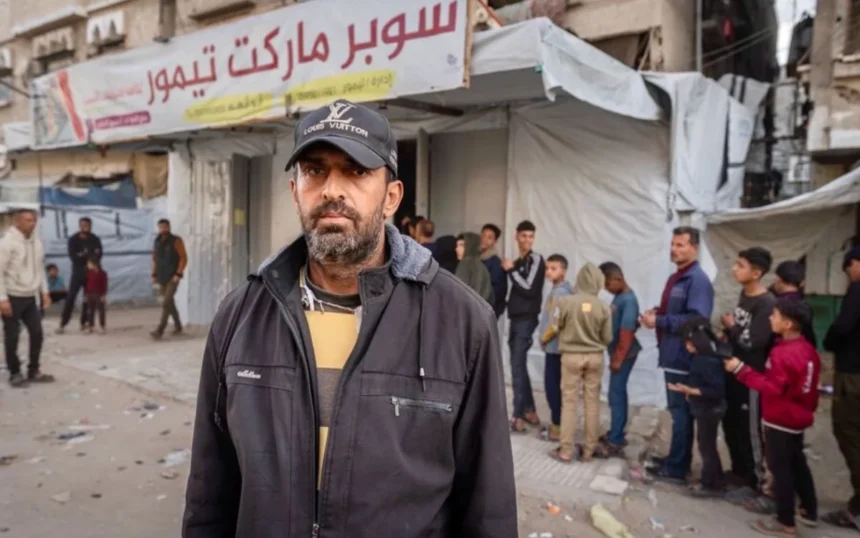
A deepening bread shortage is tightening grip on Gaza as the wider Middle East conflict, restrictions on supplies, and damaged infrastructure converge to limit production of the Strip’s most basic staple. According to the World Food Programme (WFP), bakeries that once supplied nearly all of Gaza’s bread are now struggling to meet even part of daily demand, forcing families to queue for hours at shops and distribution points. The crisis comes amid sharply higher prices for flour and fuel, as well as ongoing security and economic instability stemming from the regional conflagration that has roiled the area since late 2023.
In Khan Younis, Mohammad Abu Tair arrives at his local shop by 6 a.m. each day, joining a long line of men, women, and children waiting for bundles of flatbread. As reported by WFP staff writer Maxime Le Lijour, Abu Tair explains that his family of nine now relies on a single subsidized bundle per day, far less than they need. “One bundle is not enough,” he says, noting that the cost of flour and cooking gas has made homemade bread unaffordable for his unemployed household. The situation is emblematic of a broader pattern in which roller‑coaster prices for key staples have piled fresh hardship on a population already exhausted by war and displacement.
What is driving the bread crisis?
The bread shortage in Gaza is the result of several interlocking factors. According to the WFP story, the eruption of the Middle East crisis initially halted the entry of commercial wheat flour into Gaza for over a month, causing prices to spike and pushing many families out of the market. Even after commercial flour started to trickle back in, many households could no longer afford full‑sized loaves, forcing them to shift to smaller, subsidised options sold at WFP‑supported shops. The organisation notes that nearly seven months into a US‑brokered ceasefire, the region’s economy remains fragile, with roughly 80 percent of Gaza’s workforce unemployed and large segments of the population teetering on the edge of severe hunger.
WFP support has kept some bakeries afloat, supplying flour and fuel to 26 bakeries that together provide about one‑third of Gaza’s bread needs. As Le Lijour reports, for every 10 bundles produced by WFP‑supported bakeries, eight are sold to retailers at a capped price of three shekels (about $1), while two are distributed for free at hot‑meal kitchens. The arrangement has been a critical lifeline, but it depends on the continued arrival of flour and fuel through restricted crossings and along disrupted supply lines. When those inputs falter, both bakeries and the families relying on cheap bread feel the strain.
How damaged bakeries are holding back production
The physical state of Gaza’s bakeries is another major constraint. Before the war that began in October 2023, there were almost 100 registered bakeries in the enclave and dozens more informal ones, many of which produced flatbread that serves as a staple at nearly every meal. During the conflict, many of these establishments were destroyed or heavily damaged by airstrikes and shelling, and entire production lines remain buried under rubble or in ruins. As WFP explains, bakeries such as Haifa, in Khan Younis, had to be rebuilt from the wreckage, with owners relying on salvaged and heavily repaired equipment because importing new machinery and spare parts remains extremely difficult under current border restrictions.
Tariq Ewaida, owner of Haifa bakery, recounts that an air strike in July 2025 reduced his establishment to rubble and killed his father and his nephew as they went to inspect the damage. Since then, he and his team have worked around the clock to clear debris and reassemble what remains. “Nothing you see here is new,” Ewaida tells WFP. “It’s all been repaired.” Next door, the Al‑Heloo bakery is still a pile of rubble, reflecting the sheer scale of destruction that bakeries across Gaza face. With little infrastructure material allowed into the Strip and no real access to foreign‑currency financing, rebuilding to pre‑war capacity is all but out of reach for many owners.
Why bakeries are struggling to keep up
Bakery owners who have managed to reopen confront a daily grind of breakdowns, overstretched machinery, and high‑margin alternatives for traders. Mohammed Zidan, owner of Castle bakery in Deir al‑Balah, describes how age‑worn equipment and scarce spare parts strain production. “It’s been three years since my machines had proper servicing,” he says. “They are getting very tired.” Zidan also notes that prices for critical spare parts have skyrocketed, with some items that once cost 5,000 shekels now running over 40,000 shekels on the local market, often as second‑hand or refurbished stock. Raw materials and fuel are no easier to obtain, he adds, since crossing restrictions limit what can enter and when.
To cope, WFP has launched a market‑based pilot programme under which bakeries source much of their own inputs while receiving only diesel and flour from the agency. According to WFP, this model aims to sustain local businesses, maintain employment, and give customers more choice in a constrained environment. “Every bakery in Gaza can support around 100 people and their families,” Zidan tells WFP, referring to jobs in supply, transport, production, and sales. “It helps keep the local economy going.” At the same time, he warns that the Middle East crisis continues to undermine the stability of local supply chains, leaving bakeries vulnerable to future shutdowns if fuel or flour deliveries slacken again.
What life looks like for families without enough bread
For ordinary Gazans, the shortage translates into queuing, rationing, and uneasy trade‑offs at the family table. WFP reports that shopkeeper Alabadsawi Safi, who runs a WFP‑contracted store in Khan Younis, has seen prices for cooking gas and other essentials rise sharply since early March. “Cooking gas and life in general are expensive right now,” Safi says, underscoring the tension between keeping bread prices low and covering the rising costs of running a business. The WFP story highlights that many families now substitute smaller, subsized loaves for the full‑sized bread they once baked at home, simply because they cannot afford anything more.
The United Nations and the European Union have estimated that Gaza will require around $71.4 billion over the next decade for recovery and reconstruction, a figure that underscores the depth of the crisis even as the guns have largely fallen silent. In the meantime, the bread shortage serves as a daily reminder of how fragile the ceasefire gains are. As the WFP article notes, although the Middle East conflict has shifted in intensity, its effects continue to ripple through Gaza’s food systems, displacing families, disrupting supply lines, and pushing key staples like flour and fuel out of reach for many households that have already lost their livelihoods and homes.
What comes next for Gaza’s bread supply?
The path ahead for Gaza’s bread supply depends largely on the security, political, and economic environment in the wider region. As WFP documents, the bakery‑support model and targeted food‑parcels distribution are only partial solutions, contingent on the sustained opening of border crossings, the consistent flow of flour and fuel, and the ability of local businesses to operate without constant disruption. If the Middle East conflict escalates again or additional restrictions are imposed on Gaza’s crossings, bakery owners warn they may be forced to slow production once more, compounding the risk of severe food insecurity.
International agencies and Gazan officials alike stress that lasting recovery will require not only humanitarian aid but also large‑scale investment in infrastructure, industry, and employment. Until then, figures such as Abu Tair, Safi, and Zidan illustrate the day‑to‑day reality of a population trying to rebuild its economy and food security on the fragile foundation of a few dozen bakeries operating with patched‑together machinery and shrinking supplies. The bread shortage in Gaza is, in this sense, both a symptom and a visible consequence of the Middle East conflict’s broader impact on one of the world’s most densely populated and aid‑dependent territories.
A very professional platform with a great atmosphere. I feel safe playing here and the bonuses are actually useful. Great job idlisboa77
The app is lightweight and doesn’t lag even on my old phone. Really impressed with pkwinpkrapk and their customer support.
The app is incredibly stable and the localization for Korea is spot on. It makes the whole experience much more convenient for us. betwinnerkoreaapp
Login is always fast and secure. I don’t have to worry about my account getting locked out. jiliflogin makes the whole process stress free.