


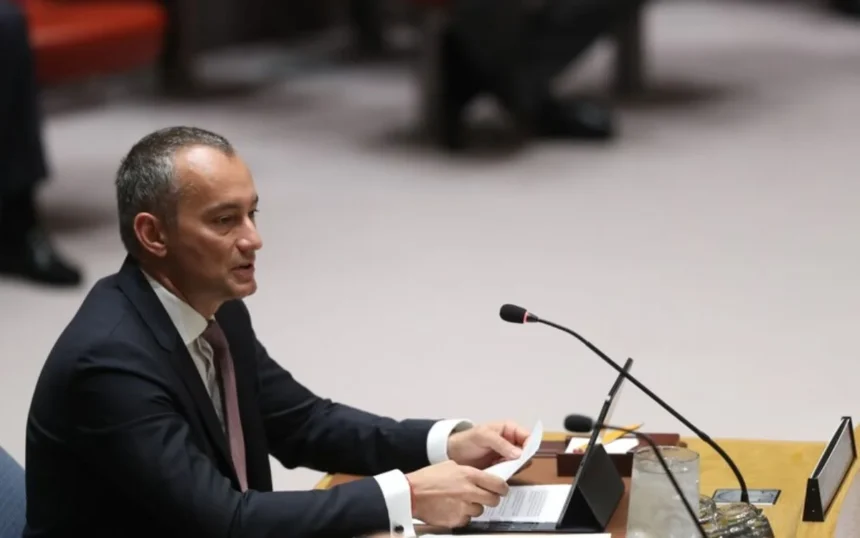
President Donald Trump’s envoy for the Board of Peace, Nickolay Mladenov, is scheduled to meet Israeli officials in Jerusalem to discuss easing restrictions on humanitarian aid entering the Gaza Strip. As reported by Anadolu Agency’s correspondent Lina Altawell, the talks are expected to focus on reducing bureaucratic and security barriers that have limited the volume and speed of supplies entering the enclave. The meeting is part of a broader push by the Trump‑backed Board of Peace to implement its Gaza reconstruction and stabilization agenda amid ongoing criticism over the pace and conditions of relief.
The Board of Peace, an international body announced by President Trump last year, is tasked with coordinating donor funding and overseeing the post‑war future of Gaza. According to Anadolu Agency, the initiative brings together representatives from several dozen countries and aims to channel billions of dollars toward reconstruction, security, and economic development in the strip. The Board has also pledged to support the creation of an international stabilization force and a technocratic administration in Gaza, though Israel has repeatedly conditioned significant reconstruction on the demilitarization of the territory and the dismantling of Hamas.
In the context of aid, Israeli restrictions have been a major point of contention. As reported by Anadolu Agency, Israeli authorities have limited the number of trucks allowed into Gaza, imposed security checks on convoys, and at times suspended or reduced the flow of supplies over concerns about diversion to Hamas or security risks. The outlet notes that humanitarian agencies and UN officials have repeatedly warned that these restrictions have contributed to food shortages, medical supply gaps, and the deepening of what the UN has described as the worst humanitarian crisis in Gaza’s history.
What will the envoy seek from Israel?
During the talks, Mladenov is expected to urge Israel to relax entry requirements and streamline inspection procedures for humanitarian convoys, according to Anadolu Agency. The article notes that the envoy may ask Israel to increase the number of trucks allowed into Gaza each day and to shorten delays at crossings such as Kerem Shalom and Erez, where supplies have often been held for hours or days. The outlet also reports that Mladenov is likely to emphasize the linkage between improved aid access and the credibility of the Trump‑sponsored reconstruction plan, which relies on visible humanitarian progress to attract further donor commitments.
Anadolu Agency quotes Israeli media reports saying that Mladenov may also press Israel to limit military operations in and around Gaza’s main crossings, arguing that repeated strikes and security disruptions have made it difficult for aid organizations to operate safely. The outlet notes that Israeli officials have previously tied the level of humanitarian activity to security assessments, including the perceived threat from Hamas‑affiliated armed groups. The meeting is therefore expected to involve a delicate balancing act between the envoy’s push for more open access and Israel’s insistence on maintaining what it describes as necessary security controls.
The Board of Peace envoy is also expected to raise concerns about the conditions under which international staff are allowed to operate in Gaza. According to Anadolu Agency, several UN agencies and NGOs have reported that bureaucratic hurdles, visa restrictions, and insecurity have reduced the number of foreign humanitarian workers in the territory. The article says that Mladenov may seek assurances that Israel will facilitate the entry of aid workers, including engineers, medical personnel, and logistics experts, whose presence is critical to the reconstruction agenda Trump has promoted.
Context of the Board of Peace and Gaza policy
The meeting with Israeli officials comes as the Trump‑led Board of Peace moves from pledges to on‑the‑ground implementation. As reported by Anadolu Agency, the Board’s inaugural meeting in Washington secured financial commitments from several countries, with Trump announcing that participating nations had pledged billions of dollars toward Gaza reconstruction and stabilization. The article notes that the Board’s architecture is designed to bypass traditional UN mechanisms and place the United States at the center of post‑war planning, an approach that has drawn skepticism from some Western allies and regional actors.
Anadolu Agency also highlights that the Board of Peace plan envisages a heavily securitized Gaza, with international security forces and a technocratic local administration replacing the Hamas‑ruled government. The outlet reports that Israeli Prime Minister Benjamin Netanyahu has publicly welcomed the idea that there should be no reconstruction in Gaza until it is demilitarized, reflecting a shared emphasis between the Israeli government and the Trump‑backed initiative on security‑first sequencing. However, the article notes that critics argue this sequencing risks prolonging the humanitarian crisis and delaying the return of displaced Palestinians to their homes.
In that context, the discussions over easing aid restrictions are seen as a test of whether the Board of Peace can deliver tangible improvements in living conditions, or whether the initiative will remain largely aspirational. Anadolu Agency notes that UN officials and some donor governments have warned that without a clear and sustained easing of access, the billions of dollars pledged may have limited impact on the ground. The article adds that humanitarian groups have called for the immediate lifting of what they describe as counterproductive restrictions that do not correspond to the stated goal of preventing Hamas from rearming.
Supporting perspectives and expert commentary
Humanitarian and Middle‑East policy analysts quoted or cited by Anadolu Agency have stressed that the core challenge in Gaza is not only the amount of aid available but the conditions under which it can be delivered. The outlet reports that UN officials have repeatedly said Gaza needs a much higher volume of trucks and a more predictable clearance process to address widespread malnutrition, disease, and the collapse of basic services. Analysts quoted in the article argue that every additional day of delay or tightening of restrictions erodes the legitimacy of both the Israeli blockade and the Trump‑backed reconstruction framework.
Some regional actors have also expressed concern that the Board of Peace could be used to sideline established multilateral institutions. As reported by Anadolu Agency, Middle‑East‑based commentators have warned that concentrating reconstruction authority in a US‑led body may reduce the role of the UN and regional powers, potentially deepening divisions rather than building consensus. The article notes that Turkey and other countries that have joined the Board have signaled support for the initiative but have also cautioned that any plan must be transparent and accountable to the affected population.
Within Israel, the media coverage summarized by Anadolu Agency reflects a divided view. Some Israeli outlets have described the envoy’s visit as a welcome step toward aligning Washington’s expectations with on‑the‑ground security realities, while others have warned that pressure to ease restrictions could be exploited by Hamas or other armed groups. The article states that Israeli security officials have told local media that they remain committed to preventing weapons and dual‑use items from reaching Gaza, a point Mladenov is expected to hear directly during his meetings.
Implications for the Gaza aid and reconstruction agenda
The outcome of Mladenov’s talks with Israeli officials is likely to shape the practical feasibility of the Trump‑backed Gaza reconstruction plan. As reported by Anadolu Agency, if Israel agrees to significantly ease restrictions, aid organizations could increase the scale and speed of food, medicine, and shelter distributions, creating visible improvements in living conditions. The outlet notes that such improvements would, in turn, bolster political support in the United States and among donor countries for the Board of Peace and its longer‑term vision for Gaza.
Conversely, if restrictions remain largely unchanged or are tightened further, the article warns that the humanitarian situation could continue to deteriorate despite the billions of dollars pledged. Anadolu Agency reports that UN officials have already warned that some areas of Gaza may face famine‑level conditions if supply flows are not stabilized. The article adds that prolonged suffering could fuel resentment among Palestinians and undermine the stated goal of creating a stable, post‑Hamas environment amenable to reconstruction and investment.
The meeting also carries symbolic weight amid broader debates over US influence in the Israeli‑Palestinian arena. As described by Anadolu Agency, the Board of Peace is widely seen as an attempt by President Trump to assert American leadership over peace and reconstruction efforts, even as traditional UN‑led processes remain stalled. The article notes that the envoy’s visit to Jerusalem is one of several upcoming diplomatic engagements, including planned meetings with regional actors and representatives from Gaza‑based civil‑society groups, that could determine whether the Board is treated as a genuinely operational body or as a forum for high‑level declarations.
In practical terms, the talks are expected to produce a set of working‑level agreements on truck‑entry quotas, inspection protocols, and security coordination around the crossings. Anadolu Agency reports that Israeli officials have indicated they are willing to review procedures if they are convinced that additional safeguards are in place to prevent diversion of aid. The outlet also notes that Mladenov is expected to stress that the United States will continue to view the openness of Gaza’s crossings as a key metric of Israel’s commitment to the broader peace and reconstruction framework led by the Trump administration.
Saw an ad for inbetmx and got curious. It gives some reasonable choices and options to choose from and play. Try inbetmx and see how you like it.
Alright, so I checked out r168bet recently. Pretty straightforward to use, and they seem to have a decent selection of games. Nothing too fancy, but it gets the job done. You can find it here: r168bet
R777Casino is my lucky charm! I’ve had some amazing luck here, maybe you will too. Go see for yourself r777casino.
Really impressed with the game selection and the overall vibe of the site. It feels like a community for real players. Everything is just right. Explore bdrana88.
Honestly the best selection of games I have seen in a while. Everything loads fast and the bonuses are legit. Give inyouknowallgame a try.
Everything about this site is professional. From the login process to the game selection, it is all top notch. Try jiligocasinologin
The bonuses on this platform are insane! I had a great time playing last night and the support team is very helpful. Great job vn88vv88!
Finally found a platform that doesn’t lag during peak hours. The game variety is impressive and the customer support is actually helpful. pk68vippk is definitely my new go-to.