


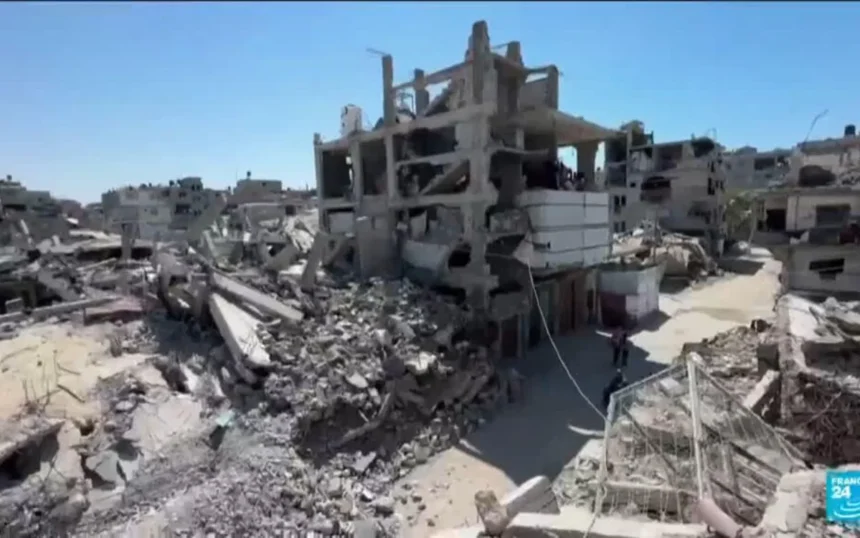
Seven months after the latest ceasefire ended two years of war, the Gaza Strip still resembles a city of ruins. In Khan Younis and other parts of the territory, men in boots and high‑visibility vests chip away at mountains of concrete and twisted metal, hauling debris into trucks that shuttle it to nearby crushing sites. As reported by Liza Kaminov in a France 24 report on the region, the work continues around the clock but pays only the equivalent of a few euros per day, barely enough to cover basic food costs for a single family.
According to France 24, the physical destruction across Gaza includes large sections of hospitals, schools, and entire residential neighborhoods reduced to rubble. The United Nations has estimated that war‑related damage could total around 70 billion dollars, with tens of millions of tons of debris to be cleared before reconstruction can begin in earnest. UN agencies and local crews have started rubble‑removal and road‑leveling operations, using crushed debris to restore access to bakeries, clinics, and temporary shelters, but the scale of the wreckage far outpaces the current pace of recovery.
How workers see Labour Day in Gaza
For many Gazans, the idea of celebrating International Labour Day feels distant or even alien. As reported by France 24, construction workers clearing rubble describe wages of about 8–9 euros a day, sums that one laborer says “don’t buy anything” in today’s Gaza. “Everything’s expensive,” he adds, noting that the same daily income cannot feed a parent, several siblings, and himself. In the video report, workers interviewed in Khan Younis state plainly that Labour Day is “a foreign concept” to them, explaining that the choice is not between work and holiday but between work and hunger.
A local organizer featured in the France 24 coverage says that collective bargaining and workplace protections have largely collapsed under the pressure of displacement and debris removal. “We only hear about Labour Day,” she explains. “There are no human rights, no rights, nothing.” Several workers emphasize that what they need is not a symbolic day off but stable employment, livable wages, and materials to rebuild homes and businesses that were erased by strikes and bombardments.
Conditions on the ground and humanitarian strain
The humanitarian situation further undercuts any notion of a normal Labor Day routine. In many parts of Gaza, families displaced from their homes still live in overcrowded shelters, makeshift tents, or undamaged but inadequate buildings. The combination of ruined infrastructure, contaminated water networks, and limited access to electricity has turned basic survival into a daily logistical challenge, leaving little room for workers to reflect on labor rights or to organize traditional May‑Day marches.
International organizations working on reconstruction say security and unexploded ordnance remain a major constraint. According to assessments cited by the BBC and other outlets, the Gaza Strip may contain over 60–70 million tons of rubble, including human remains and dangerous explosives, which must be cleared before any large‑scale rebuilding can proceed. In this context, the work crews clearing debris are themselves working in hazardous conditions, often without consistent safety equipment or formal employment contracts.
Who is leading the reconstruction effort?
Multiple actors are involved in shaping Gaza’s reconstruction, but a clear, unified authority has yet to emerge. As reported by the BBC and other outlets, several blueprints have been drafted, including the “Phoenix plan” by Palestinian engineers and architects, which calls for a locally driven, decade‑long reconstruction process. Another proposal, backed by Egypt and the Arab League, envisages a five‑year rebuilding period that would also seek to integrate Gaza more closely with the West Bank in a future Palestinian state.
However, on the ground, Hamas municipalities still administer many day‑to‑day services while the Palestinian Authority in the West Bank pushes its own rebuilding strategy. International donors and UN‑backed mechanisms, such as the Gaza Reconstruction Mechanism, continue to channel construction materials and funding, but previous reconstruction efforts after earlier conflicts have shown that political disagreements and access restrictions can slow progress for years.
What the future holds for workers
For Gaza’s laborers, any future rebuilding project depends first on ending the cycle of displacement and making rubble removal a long‑term job rather than a stopgap survival tactic. As described in the France 24 report, workers hope that large‑scale reconstruction will eventually create thousands of formal construction jobs, allowing them to earn wages that truly meet their families’ needs. Local planners and international partners have suggested that rubble‑crushing plants, recycling hubs, and modular‑building projects could generate both employment and infrastructure in parallel, but these ideas require stable funding and political agreement.
Until such a framework is in place, many workers say they will not treat May 1 as a holiday but as another day of toil. “We need work in Gaza,” one laborer says in the France 24 report. “We need work.” For now, the discourse of labor rights and worker dignity circulates mainly abroad, while on the ground in Gaza, the central question remains how to turn rubble into roofs, roads, and livelihoods that can outlast the next ceasefire.
Best experience I’ve had in a while. The bonuses are actually fair and the graphics are top notch. Love playing on phjili00
The app version is just fantastic. I can play on the go without any lag. It is way more convenient than using a mobile browser. brwin222apk
The jackpots here are insane! I love how easy it is to navigate the site on my phone. Big thanks to phjilihot777 for the awesome vibes.
Finally a site that doesn’t crash every five minutes. The winning streaks I’ve had here are legendary. Big thanks to phtaya789!