


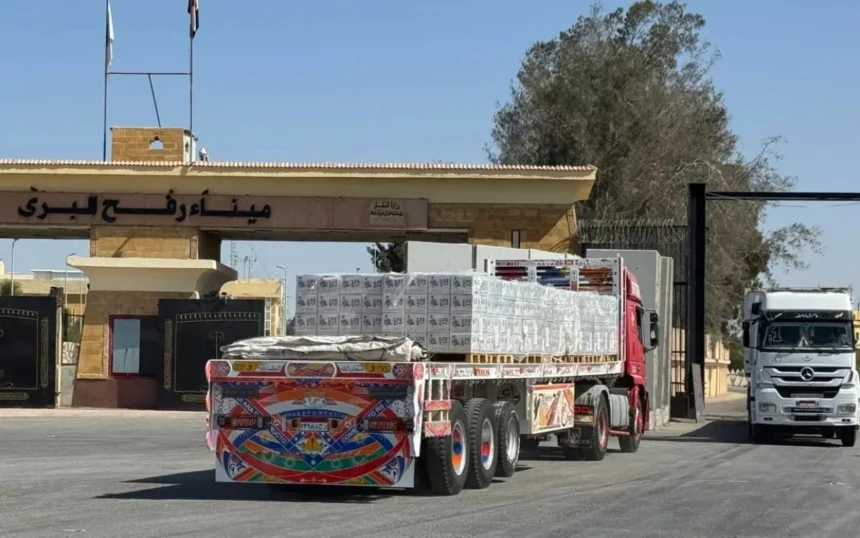
An IDF lieutenant has been indicted in Israel on charges of attempting to smuggle goods into the Gaza Strip via the Kerem Shalom Crossing, using his military position to facilitate the operation in exchange for a large financial payment. According to The Jerusalem Post, the officer planned to exploit his posting at the crossing, his familiarity with border procedures, and his operational authority to let a truck carrying prohibited merchandise enter Gaza. The indictment states that the alleged smuggling was to be rewarded with millions of shekels, along with a share of profits for all participants.
The case is part of a broader pattern of recent investigations into Gaza‑bound smuggling operations centered on Kerem Shalom. As reported by other Israeli outlets, prosecutors have filed multiple indictments in recent months against individuals accused of trafficking cigarettes, electronics, and other valuable goods into the enclave, often by piggybacking on aid convoys or using military‑linked drivers. In several of these cases, authorities have alleged that defendants understood the goods could reach Hamas or its operatives, heightening security concerns around the crossing.
How the alleged smuggling operation was run
According to the indictment cited by The Jerusalem Post, the accused officer worked with a group of civilians to orchestrate at least one attempt to smuggle a truckload of restricted or prohibited items into the Gaza Strip. The vehicle was reportedly loaded with goods that would normally be subject to tight controls or outright bans at the crossing, and the plan reportedly relied on the officer’s ability to influence or bypass standard inspection and authorization procedures. The prosecution alleges that the smuggling was intended to generate substantial profits, with clear division of roles among the defendants.
Investigators describe the scheme as part of a wider smuggling network, in which each participant performed a specific function—acquiring goods, arranging transport, coordinating with intermediaries inside Gaza, and securing passage at the crossing. As reported by other outlets, similar networks have previously used nearby routes and crossings, including Kissufim and Zikim, to move goods into Gaza even during periods of heightened conflict and tightened border restrictions. In this instance, authorities emphasize that Kerem Shalom remained a key artery for both tightly controlled humanitarian aid and, allegedly, illicit trade.
Security and legal implications of the case
The indictment highlights the sensitivity of military access at crossings that serve dual civilian‑humanitarian and security‑control functions. Israeli officials have repeatedly stressed that goods entering Gaza must go through rigorous checks to prevent weapons, dual‑use materials, or other restricted items from reaching militant groups. The fact that an active‑duty officer is accused of exploiting his position to undermine those controls has raised concerns about the integrity of the oversight system and the potential for further insider‑assisted smuggling.
Commentators and legal analysts quoted by Israeli media have noted that cases involving military personnel in smuggling or collaboration‑linked schemes can trigger charges that extend beyond simple economic offenses. Prosecutors have in other Gaza‑related cases invoked charges such as aiding the enemy or financing terrorism, which carry significantly heavier penalties under Israel’s Counter‑Terrorism Law. In the current indictment, authorities have yet to formally include those more severe charges, but the case is being closely watched for any expansion of the legal framework applied.
What comes next in the investigation and trial
The case is proceeding through Israel’s criminal‑court system, with the officer’s indictment underscoring the state’s stated intent to punish those who exploit their military roles for illicit gain. As reported by Israeli outlets, the State Attorney’s Office has previously described similar Gaza‑smuggling cases as part of a broader crackdown on networks that operate in the shadow of official aid and security channels. Officials have indicated that investigators are continuing to trace additional links, financial flows, and potential accomplices connected to the crossing.
Security and military officials have not publicly commented on the specific merits of this indictment, but other recent statements have reaffirmed that crossings such as Kerem Shalom remain under strict scrutiny during and after periods of active conflict in Gaza. The outcome of the trial may influence how the IDF and border authorities tighten internal oversight, vetting of personnel assigned to crossings, and the use of technology and audits to monitor cargo flows. For now, the case stands as one of several high‑profile instances in which Israeli authorities say they have uncovered attempts to turn humanitarian infrastructure into a conduit for lucrative smuggling.
I was skeptical at first, but after a few wins, I’m totally sold. vnzj88 offers a really fair gaming environment for everyone.
The login process is seamless and I never have any issues with my account access. It is refreshing to find a site that actually works properly. Visit phpcomelogin for a hassle-free experience.
Really impressed with the fast payouts and the overall interface. It makes everything so much easier. Highly recommend bdsky999 to everyone.
A very trustworthy platform with a fair gaming system. I feel safe depositing here knowing the security is tight. Cheers to tk444login.
Fast deposits and even faster withdrawals, which is exactly what I need. The customer support team is also very responsive. Great job by kcwin.
The graphics are stunning and the gameplay is very addictive. I had a blast playing here last night. Definitely check out citrabet777.
If you are looking for a place with a huge range of betting options, this is it. Very transparent and easy to navigate. Visit miliarbetlogin.
Downloading the app was the best decision. It is much more convenient than using a browser and the performance is top notch. Get the 850betappapk now.
Just what I was looking for. The stability of the app is impressive and everything runs just as it should. Keep it up bdck4444aps