


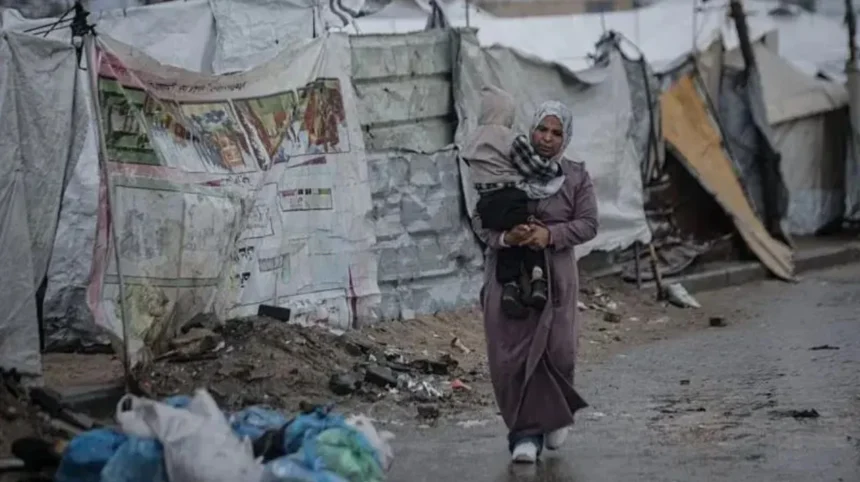
As reported by BBC News, international attention has shifted from Gaza to the escalating confrontation involving Iran, raising new doubts about the durability of a fragile ceasefire and the future of President Donald Trump’s 20‑point peace initiative for the territory. According to BBC News, the plan, which helped halt fighting in Gaza in October last year, is now stalling just as Iran’s conflict with Israel and the United States dominates diplomatic and military agendas. Nearly six months after the ceasefire, Palestinians in Gaza are contending with rising prices, slow aid deliveries and limited reconstruction, deepening concern that their situation is being overshadowed by events elsewhere in the region.
According to BBC News, Gaza residents report that basic supplies are arriving less consistently than before, while economic pressures intensify. Shopper Hassan Faqawi told BBC News that prices have “skyrocketed” and that “the global spotlight is on Iran, the U.S., and Israel, while Gaza is overlooked,” reflecting a widespread sense of abandonment among civilians.
In a statement to the BBC, COGAT, the Israeli military body overseeing crossings, rejected accusations of aid shortages and instead accused Hamas of mismanaging and diverting resources. According to BBC News, Israel maintains that its ongoing airstrikes since the Iran war began in late February are aimed at Hamas militants and infrastructure, though Palestinian officials say they have caused numerous civilian casualties, including children.
How are local actors and mediators responding?
As reported by BBC News, a key element of the U.S.-backed peace framework is a demilitarization proposal presented at the UN Security Council by Nickolay Mladenov, the High Representative for Gaza on the U.S.-led Board of Peace. According to BBC News, Mladenov outlined a plan linking disarmament by Palestinian armed factions, including Hamas, to the launch of large‑scale reconstruction financed by international donors.
However, a Palestinian official familiar with Hamas’s deliberations told BBC News that the group is likely to reject the disarmament terms, raising fears of a potential renewed Israeli military offensive if the process collapses. According to BBC News, Israel’s prime minister has insisted that Hamas must disarm “either peacefully or forcefully,” underscoring the high stakes of the negotiations.
On the ground, BBC News reports that Hamas is reasserting control in Gaza despite heavy losses in previous fighting, with masked men in military uniforms setting up frequent checkpoints, stopping cars and pedestrians after dark. Traders and shopkeepers told BBC News that new or increased taxes imposed by Hamas on goods and services are further driving up prices, adding to the economic strain on residents.
Many Gazans interviewed by BBC News voiced frustration over governance and the stalled peace process. Displaced woman Hanaa told BBC News that “no one is in charge of Gaza now except for Hamas” and expressed hope that a national committee might eventually take over administration, reflecting calls for broader Palestinian political representation in managing reconstruction.
Supporting details and expert assessments
According to BBC News, international donors pledged around 7 billion dollars for Gaza’s reconstruction at a meeting in Washington, following a high‑profile ceremony launching the Board of Peace at the World Economic Forum in Davos. Despite those commitments, analysts cited by BBC News say implementation has slowed sharply as diplomatic attention has shifted toward Iran, leaving key components of the 20‑point plan on hold.
Amjad Iraqi, a senior analyst at the International Crisis Group, told BBC News there is “significant skepticism” over whether the program can move forward in the current environment and noted that Hamas faces intense pressure to accept the deal even as mediators focus more on Iran. According to BBC News, Palestinian envoy Riyad Mansour has described recent steps as only the “beginning” and stressed that it will be crucial to keep Gaza on the international agenda “while other developments unfold” in the wider region.
Related reporting by Jewish Insider notes that some experts believe the war involving Iran may give Hamas temporary breathing room in Gaza, while also potentially leaving it more isolated if Tehran’s position weakens. According to Jewish Insider, analysts argue that Iran’s shifting capacity and priorities could affect Hamas’s political leverage and its willingness to compromise on disarmament and governance arrangements in Gaza.
Additional coverage by Streamline Feed highlights that the Board of Peace, the technocratic body tasked with overseeing Gaza’s transition, is struggling to maintain the attention of major powers now preoccupied with the Iranian crisis. According to Streamline Feed, negotiations over Hamas’s weapons have “slowed to a crawl,” while both Hamas and Israeli officials are recalibrating their positions in light of broader regional security concerns.
What are the broader implications and what comes next?
As reported by BBC News, the combination of a fragile ceasefire, incomplete reconstruction and stalled demilitarization talks has deepened public skepticism in Gaza about the Trump administration’s 20‑point peace plan. According to BBC News, many Palestinians fear that the initiative could quietly falter if international attention remains fixed on Iran, leaving Gaza stuck in a prolonged limbo of partial recovery and recurring insecurity.
Analysts quoted by BBC News and other outlets say that if the disarmament‑for‑reconstruction deal fails, the risk of renewed large‑scale hostilities between Israel and Hamas will increase, particularly if political pressure in Israel intensifies or if regional dynamics further destabilize the situation. According to Streamline Feed, the longer the peace plan remains unimplemented, the more entrenched Gaza’s deprivation and institutional fragility become, making any future settlement harder to achieve.
According to BBC News, some diplomats and Palestinian officials argue that sustained international engagement will be necessary to keep Gaza on the global agenda alongside the Iran crisis, including follow‑through on financial pledges and political support for governance reforms. Jewish Insider additionally reports that regional parties are watching how the Iran conflict reshapes alliances and power balances, developments that could in turn influence Hamas’s choices and the options available to mediators seeking a more durable arrangement for Gaza.
In Gaza, the current lull in large‑scale fighting offers residents a limited glimpse of what a more stable future might look like if peace efforts succeed, but the combination of economic hardship, slow reconstruction and uncertain diplomacy has left many doubtful that lasting change is imminent. According to BBC News, whether the Trump peace framework can survive amid the strategic distraction of the Iran conflict remains an open question, with lives and livelihoods in Gaza closely tied to decisions being made far beyond its borders.
I used to watch the local Liga BetPlay and now I can actually place smart wagers on those matches thanks to this academy. The coaches share realistic bankroll management tips that saved me from early mistakes. Highly recommend this platform for anyone looking to improve their game. academiadeapuestascolombia
I stumbled upon this place through a friend and it turned into my regular go to spot. The bonuses are actually reachable and the wagering requirements make total sense. Playing here feels like a proper escape after a long work day. insatbet
I have been playing here for a while and I absolutely love how smooth everything runs on my phone. The local payment options make deposits super easy and the bonuses keep my sessions going. I also appreciate the fair gameplay and quick payouts. This is hands down the best gaming spot for us players in Chile. clplayuzuchile