

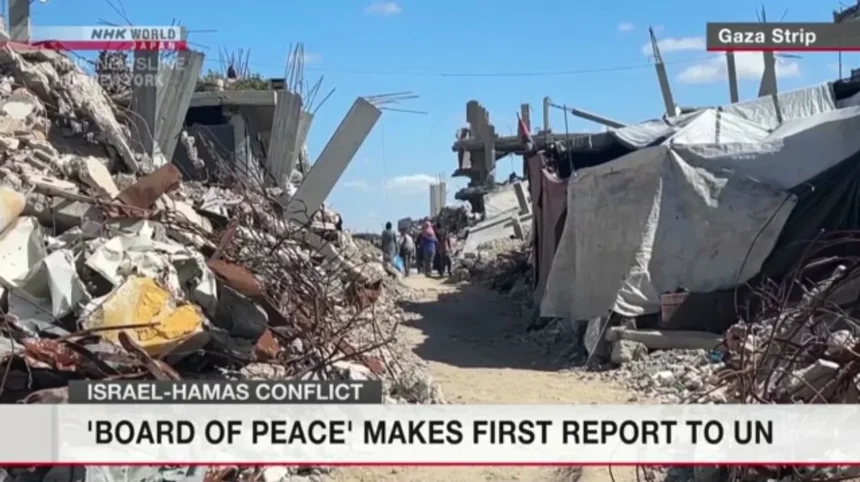
According to NHK World, a delegation from the United States‑backed “Board of Peace” has submitted its first formal report to the United Nations, detailing progress and next steps in the Gaza reconstruction and governance plan endorsed by the UN Security Council in late 2025. As reported by analysts at the Arab Center Washington DC, the Board of Peace is a central mechanism created under former US President Donald Trump’s 20‑point “Comprehensive Plan to End the Gaza Conflict,” which was approved by UN Security Council Resolution 2803 in November 2025. According to this reporting, the board is tasked with coordinating funding, overseeing reconstruction, and shaping transitional governance arrangements in Gaza until reformed Palestinian institutions can assume control.
As noted by European Union Institute for Security Studies commentary, the Board’s mandate is implemented through two additional bodies: the Gaza Executive Board, which includes an appointed High Representative for Gaza and an Israeli representative but no Palestinian members, and the National Committee for the Administration of Gaza, a technocratic Palestinian body formed in coordination with Arab partners and the United States. Time magazine has reported that the board’s inaugural meeting in Washington secured around 7 billion dollars in pledges from nine countries as part of wider commitments now summarized to the UN.
Context and reactions: How is the Gaza plan being received?
According to NHK World’s earlier reporting, the Board of Peace was launched as part of “phase two” of the Trump administration’s peace initiative following the October 2025 ceasefire between Israel and Hamas. NHK World noted that the United Nations has estimated reconstruction needs in Gaza at about 70 billion dollars, far exceeding current pledges and highlighting the scale of the challenge described in the board’s report to the UN.
In a video report, Al Jazeera said an envoy representing Trump’s Board of Peace briefed the UN Security Council on a strategy to disarm armed groups in Gaza as part of the broader ceasefire and reconstruction framework. The Carnegie Endowment for International Peace has reported that the Board of Peace has received about 17 billion dollars in pledges so far, including 10 billion from the United States and 7 billion from member states and other donors, a figure likely referenced in the board’s update to UN members.
UN human rights experts have issued public criticism of the Board of Peace, warning in a March 2026 statement that the current approach risks sidelining Palestinian rights and calling instead for a “reparative, rights‑based” reconstruction strategy in Gaza. The EU Institute for Security Studies likewise cautioned that, although branded as multilateral, the board centralizes power and excludes direct Palestinian representation in key decision‑making structures, a concern that frames some of the reactions to its first report at the UN.
Supporting details and expert commentary
As reported by Time, Trump used the board’s inaugural Washington meeting to present the mechanism as the centerpiece of Gaza’s reconstruction, emphasizing international fundraising and long‑term oversight of local governance and investment conditions. Time’s coverage indicated that nine countries, including Kazakhstan, Azerbaijan, the United Arab Emirates, Morocco, Bahrain, Qatar, Saudi Arabia, Uzbekistan and Kuwait, pledged more than 7 billion dollars toward Gaza relief under the board framework, which is now being channeled into the plan summarized for the UN.
Analysis by the Arab Center Washington DC describes the Board of Peace as both a funding platform and a governance tool that will “set the framework and handle the funding for the redevelopment of Gaza” until the Palestinian Authority completes reforms and can resume control. In its assessment of the financial dimension, Carnegie Endowment experts stressed that even the initial 17 billion dollars in commitments fall well short of UN and World Bank estimates, arguing that continued fundraising and tighter oversight of how money is managed will be central themes in any UN discussion of the board’s report.
European policy analysis further notes that Gaza has become a test of the board’s credibility, given that its charter does not explicitly mention Gaza and instead routes its role through intermediary bodies that currently lack Palestinian representation. This structure, experts argue, may be a key point for UN member states weighing the board’s first report against long‑standing UN principles on self‑determination and inclusive reconstruction.
Implications and future developments: What happens next?
According to NHK World, the ceasefire that underpins the Board of Peace’s work followed two years of conflict and has been accompanied by intermittent Israeli strikes and continued civilian casualties in Gaza, underscoring the fragile security environment in which any reconstruction plan must operate. A guide by the Council on Foreign Relations explains that the board’s activities form part of subsequent phases of Trump’s Gaza peace plan after an initial ceasefire phase that sought to freeze battle lines and halt large‑scale military operations.
Carnegie Endowment analysts say that a central task for the Board of Peace in the coming period will be securing additional funds and addressing widespread skepticism among some donors, especially in Europe, about its mandate and governance, issues likely to feature in ongoing UN deliberations following this first report. UN human rights experts have urged states and institutions engaging with Gaza reconstruction to press for a rights‑based framework, signaling that the UN’s human rights machinery will continue to scrutinize how the board’s decisions affect Palestinian civilians.
As reconstruction, governance reforms and disarmament efforts proceed under the Board of Peace framework, UN Security Council members are expected to monitor implementation of Resolution 2803 and the 20‑point Gaza plan, reviewing further reports from the board and associated bodies. The first report to the UN marks an early test of whether this new structure can translate pledged funds and political commitments into tangible improvements for Gaza’s population while meeting international legal and human rights standards.