


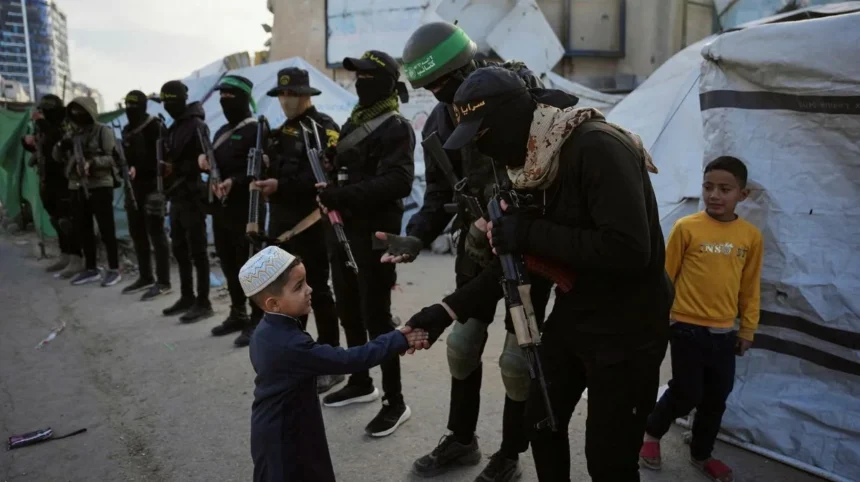
According to a Reuters exclusive report published by U.S. News & World Report, the U.S.-Israeli war with Iran has put on hold key talks over a Gaza disarmament proposal being advanced by former President Donald Trump’s Board of Peace. The plan centers on persuading Hamas and other armed factions in Gaza to lay down heavy weapons and eventually light arms in exchange for amnesty and large-scale reconstruction, as part of a broader effort to stabilize the enclave after years of conflict.
As reported by Reuters, one source with direct knowledge of the Board of Peace mission said the Iran war has caused at least a temporary pause in negotiations, mainly because flight disruptions and regional instability have hampered travel by mediators and delegations. Cairo has served as a frequent hub for these talks, which involve U.S. officials as well as Egyptian, Qatari and Turkish intermediaries. A Palestinian official close to the mediation effort told Reuters that Hamas had been expected to meet with those mediators on the day the Iran war erupted on February 28, but the meeting was canceled and no new date has been set.
According to Reuters and other outlets that have reviewed the Board of Peace framework, the disarmament concept is being promoted as a pathway to “one authority, one law, and one weapon” in Gaza, with a transitional Palestinian body charged with collecting arms from Hamas and other factions before reconstruction and further Israeli withdrawals proceed. U.S. officials and sources familiar with the talks have indicated that some form of amnesty could be offered to Hamas members if they agree to surrender heavy weaponry and, eventually, assault rifles, though Israel continues to demand complete disarmament.
Context and Reactions: How Has the Iran War Affected the Disarmament Push?
According to Reuters, multiple sources involved in or briefed on the mediation say the outbreak of full-scale hostilities with Iran has forced Trump’s team and regional partners to shift their immediate focus from Gaza’s internal security arrangements to managing the wider regional conflict. One insider described the pause in Gaza disarmament talks as a “brief, minor delay” driven more by logistical problems, such as canceled flights and security concerns for negotiators, than by any formal decision to abandon the effort.
A Palestinian official cited by Reuters said Hamas has not yet given a final answer on the Board of Peace proposal, and the movement’s leadership had planned to deliberate further with Egyptian, Qatari and Turkish mediators before the Iran war intervened. A Hamas official confirmed to Reuters that talks on Trump’s Gaza plan have been “frozen for now” but declined to provide details, underlining the uncertainty around when, or if, negotiations might resume.
Policy analysts have also begun weighing in on how the Iran conflict could reshape the viability of the disarmament track. Zaha Hassan, a fellow at the Carnegie Endowment for International Peace, told Reuters that Gulf states such as the United Arab Emirates and Qatar, which pledged funding for the Board of Peace initiative, may now question whether their financial commitments are “really money well spent” while they themselves face rocket or missile threats linked to the Iran confrontation.
Supporting Details and Background
According to reporting by The New York Times and The Times of Israel, the Board of Peace framework was presented in greater detail to the United Nations and regional actors in late March, setting out sequencing principles for how weapons would be collected and how governance would transition in Gaza. Nickolay Mladenov, described as a senior envoy on Gaza for the Board of Peace, told the U.N. Security Council that the plan envisions a phased disarmament beginning with the “most dangerous weapons,” with reconstruction and the reintegration of fighters into civilian life conditioned on verified compliance.
As reported by The New York Times, guarantor states including the United States, Egypt, Turkey and Qatar have broadly endorsed the principle that all armed groups in Gaza — notably Hamas and Palestinian Islamic Jihad — would eventually be required to place their weapons under the authority of a transitional Palestinian body. Mladenov said people in Gaza “want reconstruction, which necessitates the disarmament of weapons,” but he did not give a clear timeline or describe any parallel steps on a potential Israeli military pullback.
Further background on Hamas’s position suggests deep reservations about full disarmament. Sources close to Hamas told Asharq Al-Awsat that the group is especially reluctant to relinquish rifles and lighter arms, fearing attacks from rival militias in Gaza, some of which are believed to maintain ties with Israel. In a separate interview with Al Jazeera, Hamas leader Khaled Meshaal indicated that the movement is willing to discuss arrangements that could reduce or eventually end hostilities with Israel, but stressed that Hamas wants a say in any disarmament mechanism rather than simply surrendering its capabilities.
Implications and Future Developments: What Could Happen Next?
According to Reuters, officials involved in the Board of Peace mission believe that, over the longer term, the war with Iran could either complicate or ultimately accelerate efforts to resolve the Hamas disarmament issue. One source argued that if Iranian influence over Hamas is weakened by the conflict, the group might eventually feel less bound to Tehran’s stance and more open to an internationally backed arrangement in Gaza.
For now, there is no confirmed date for talks between Hamas and the mediators to resume, and neither the Israeli government nor the White House has publicly detailed any revised timetable. Reuters reports that Israel has shown no sign of withdrawing its forces from parts of Gaza it currently holds, while Hamas maintains control in other areas, leaving the enclave effectively divided even as outside powers debate a disarmament and reconstruction roadmap.
Diplomats and analysts quoted by major outlets say the next steps will depend on several variables: the trajectory of the Iran war, the willingness of donors to keep backing the Board of Peace process, and Hamas’s eventual response to any amnesty and disarmament formula. Until those conditions become clearer, the disarmament proposal shaped around Trump’s Gaza plan remains on hold, with key decisions by Hamas and regional actors delayed by the broader regional conflict.