


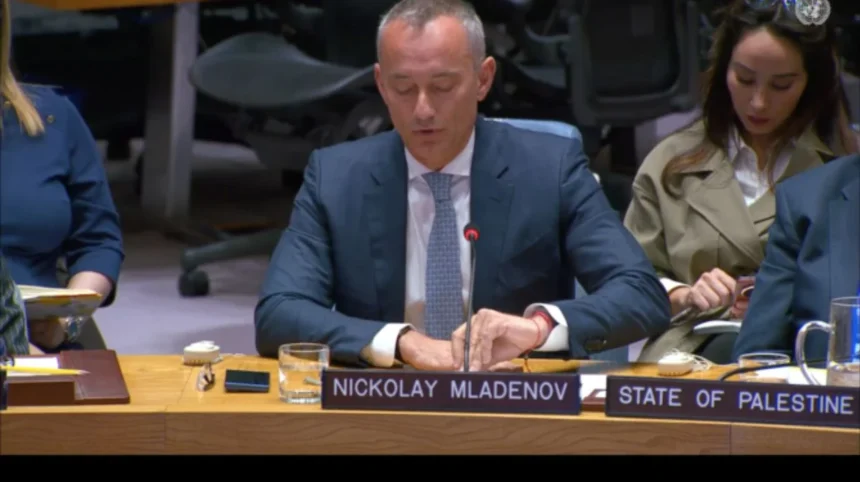
As reported by Arab News, Gaza Board of Peace Director-General Nickolay Mladenov told the UN Security Council that a comprehensive plan to disarm militant groups in the enclave is the only viable path to both Israeli security and Palestinian self-determination.
According to Arab News, he argued that “only verified decommissioning combined with a new professional police force and a civilian administration” can permanently eliminate the threat posed by armed factions.
The former UN Middle East peace envoy was appointed in January 2026 by the US to lead the Board of Peace, which was launched under US President Donald Trump to oversee Gaza’s reconstruction, governance and the disarmament of Hamas under a Security Council–mandated 20-point peace plan.
Mladenov told council members that past Israeli military operations in Gaza had failed to produce lasting security, noting that weapons stockpiles and militant infrastructure had repeatedly been rebuilt over the last two decades.
He said the “evidence of the last 20 years” undermines arguments that long-term Israeli military control of Gaza is necessary, insisting that verified decommissioning and accountable Palestinian governance do not “trade away” security.
According to Arab News, the Board of Peace is mandated to implement the ceasefire framework while guiding the establishment of a technocratic administration in Gaza.
What reactions and warnings did Mladenov deliver?
Mladenov warned the Security Council that despite progress under the initial phase of the ceasefire, conditions in Gaza remain dire, with essential services operating at a fraction of pre-war levels and the healthcare system in collapse.
As reported by Arab News, he said more than 2 million people in the enclave face severe shortages of housing, aid and basic services, and he called for the reopening of the Rafah crossing and a major scale-up of humanitarian deliveries and temporary housing.
He stressed that “all parties must fully respect the ceasefire,” warning that every violation risks unraveling what has been “painstakingly built” since the truce took effect.
According to Arab News, Mladenov urged Security Council members to press Hamas and other Palestinian factions to accept the disarmament framework without delay, describing it as a prerequisite for reconstruction and for an eventual withdrawal of Israeli forces.
He cautioned that if this process fails, the consequences will be “devastating,” warning of a potentially “divided Gaza” and the loss of any credible pathway to Palestinian statehood.
Mladenov framed the situation as a stark choice for all parties between “a renewed war or a new beginning,” adding that “there is no third option.”
Supporting details and governance vision
As reported by Arab News, the Board of Peace was created following a November 2025 UN Security Council resolution, giving it a formal international mandate to coordinate Gaza’s ceasefire, reconstruction and governance transition.
Under this framework, Mladenov outlined a vision in which Gaza is rebuilt under Palestinian governance, anchored in a civilian administration and a new professional police force, rather than long-term foreign military control.
He said this model aims to provide functioning infrastructure and economic opportunities that would reduce dependence on aid and help stabilize the enclave.
According to Arab News, Mladenov linked security guarantees to verified decommissioning of weapons and accountable local governance, arguing that this combination addresses both Israeli security concerns and Palestinian demands for self-determination.
He presented the Board of Peace’s mission as overseeing disarmament while supporting the emergence of technocratic, accountable Palestinian institutions capable of managing reconstruction and basic services.
The emphasis on a civilian governing structure places internal Palestinian administration at the center of Gaza’s future, rather than prolonged external military oversight.
What are the implications and next steps for Gaza?
As reported by Arab News, Mladenov’s briefing suggests that progress on Gaza’s reconstruction is directly tied to acceptance of the disarmament framework by Hamas and other Palestinian factions.
He indicated that without verified decommissioning and a functioning civilian administration, efforts to restore housing, infrastructure and services are unlikely to yield sustainable security or political stability.
The call to reopen Rafah, expand humanitarian aid and provide temporary housing outlines immediate operational priorities for the Board of Peace and international partners.
According to Arab News, failure to implement the plan risks entrenching Gaza’s humanitarian crisis, deepening political fragmentation and foreclosing prospects for a viable Palestinian state.
Mladenov’s warning that Gaza could become “divided” if the process collapses highlights concerns that rival authorities or fragmented control could emerge in the enclave.
His message to the Security Council frames upcoming decisions on disarmament, governance and reconstruction as critical to preventing renewed conflict and enabling a stable, Palestinian-led future for Gaza.
In sum, Mladenov used his Security Council appearance to argue that Gaza’s reconstruction must proceed under accountable Palestinian civilian governance, backed by verified disarmament and international support, if the enclave is to avoid another cycle of war and humanitarian collapse.