


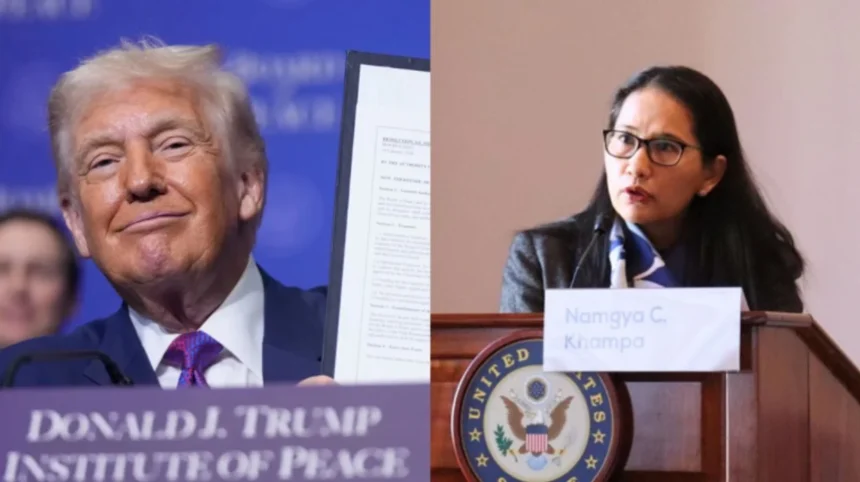
According to a report carried by the Times of India, India on Thursday attended the inaugural meeting of US President Donald Trump’s Board of Peace on Gaza as an “observer” country, without formally joining the initiative. The meeting was held at the Donald J. Trump Institute of Peace in Washington DC and focused on plans for the redevelopment of the Gaza Strip after two years of war between Hamas and Israel.
Times of India, citing the Press Trust of India (PTI), reported that India was represented by Namgya Khampa, Chargé d’affaires at the Indian Embassy in Washington. The gathering brought together a number of participating and prospective member states to discuss reconstruction financing, security conditions and the future political framework for Gaza under the new Board of Peace.
How did India and the US describe the meeting?
India’s Ministry of External Affairs spokesperson Randhir Jaiswal confirmed in a briefing, reported by ET Digital, that New Delhi had taken part in the Board of Peace meeting “as an Observer.” He said India has “welcomed the Gaza Peace Plan initiative of President Trump, as well as efforts underway as part of Resolution 2803 of the UNSC,” indicating support for diplomatic and reconstruction efforts while stopping short of a formal role.
As reported by the Times of India, Trump told participants that the United States would commit 10 billion dollars to fund the Board of Peace, intended to oversee Gaza’s rebuilding after what he described as destruction caused by two years of conflict. India Today noted that Trump did not specify the precise funding source or whether US congressional authorization would be required for the full amount.
India Today reported that Prime Minister Narendra Modi was among several global leaders invited to join the Board after Trump floated the body during the second phase of ceasefire talks between Israel and Hamas in Gaza. However, New Delhi has so far limited its engagement to observer status, with officials indicating that India is still assessing the structure and mandate of the new mechanism.
Supporting details: membership, funding and mandate of the Gaza Peace Board
Times of India, citing PTI, reported that Trump said the Board of Peace’s members include 27 nations, among them Argentina, Armenia, Azerbaijan, Hungary, Pakistan, Saudi Arabia and the United Arab Emirates. Countries seeking permanent membership, instead of a standard two‑year term, would be required to contribute 1 billion dollars, while others can hold time‑limited seats.
India Today noted that Trump unveiled the Board at a launch event in Davos on 22 January, presenting it as a platform not only for Gaza reconstruction but also for addressing other international “hotspots.” The report said Trump has suggested the Board “might” one day replace the United Nations, arguing that the UN has not lived up to its potential, although no formal plan to supplant the UN has been agreed.
Coverage from Mirror Now and other Indian outlets reported that at the Washington meeting Trump reiterated a 10‑billion‑dollar pledge from the United States, while officials and media accounts cited combined commitments of several billion dollars from countries including Qatar, Saudi Arabia and the UAE for Gaza’s redevelopment. India News Network described the forum as aimed at “fostering redevelopment and stability” in Gaza through coordinated international funding and oversight.
India Today added that estimates for full reconstruction of Gaza, devastated by extensive airstrikes and ground operations, run as high as 70 billion dollars. Among the key outstanding issues identified in that reporting are the disarmament of Hamas, the withdrawal of Israeli forces, the size and governance of the rebuilding fund and mechanisms to ensure that humanitarian aid reaches civilians on the ground.
What does India’s observer role mean and what could happen next?
According to the Economic Times and other Indian media, New Delhi framed its presence in Washington as a careful engagement with a high‑profile US initiative while retaining strategic flexibility. India has emphasized support for Gaza’s reconstruction and backing for a durable ceasefire, but has not yet committed to the financial and political obligations that would come with full membership of the Board of Peace.
India Today’s report suggested that India will continue to monitor how the Board develops, including its relationship with existing multilateral mechanisms such as the United Nations and the implementation of UN Security Council Resolution 2803. Future decisions on whether to join could hinge on governance rules, transparency over funding, and how the body balances reconstruction goals with broader regional security considerations.
Taken together, the accounts from Times of India, India Today and other outlets indicate that India’s attendance as an observer at the inaugural Gaza Peace Board meeting allows it to support discussions on Gaza’s rebuilding and peace efforts without formally entering a new US‑led structure. The move reflects both India’s interest in Middle East stability and its cautious approach to emerging multilateral formats whose scope and longevity are still taking shape.