

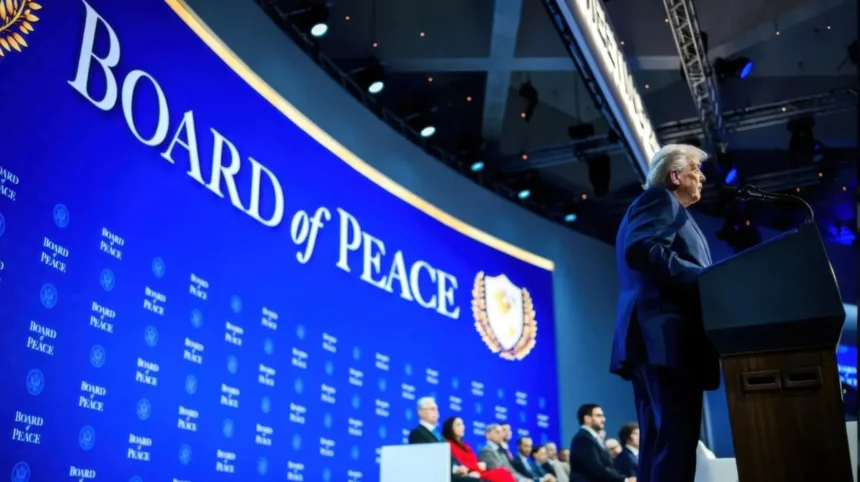
According to Foreign Policy, President Donald Trump created the Board of Peace as part of a broader 20-point plan aimed initially at stabilizing and rebuilding Gaza after the Israel-Hamas war, while gradually expanding its mandate to global conflict resolution. Foreign Policy reports that Trump convened the inaugural Board of Peace meeting in Washington, positioning it as a central instrument of his administration’s approach to postwar governance, reconstruction, and disarmament in Gaza. As reported by Foreign Policy, Trump appointed himself lifelong chair of the Board of Peace, with unilateral powers over its agenda, vetoes, and succession, prompting concerns among experts about concentration of control and the body’s independence.
Analysis by the French think tank IRIS notes that Trump unveiled the Board of Peace at the World Economic Forum in Davos as an extension of his Gaza plan, framing it as a structure devoted to peace and stability but raising questions about its legitimacy and its potential to compete with the United Nations. According to IRIS, the executive membership includes figures closely tied to Trump and to major financial and political interests, deepening scrutiny over transparency, governance, and possible conflicts of interest in how reconstruction and investment decisions are made for Gaza and other conflict zones. The Soufan Center adds that the Board of Peace initiative has emerged against the backdrop of a high-risk US strategy toward Iran, in which Trump has sought to avoid large-scale ground deployments while maintaining pressure on Tehran’s nuclear and regional activities.
How are experts viewing Trump’s peace strategy?
According to POLITICO, the Board of Peace was conceived as a follow-on mechanism to an October cease-fire between Israel and Hamas that the United States helped broker and that received backing from the UN Security Council, with a mandate to rebuild Gaza and more broadly “build peace in areas affected or threatened by conflict.” POLITICO reports that the eruption of the US–Israel military campaign against Iran has begun to undermine the body’s diplomatic momentum, with some states questioning whether it can still function as a credible peace-building platform while one of its main architects is engaged in a regional war. As reported by The Soufan Center, critics argue that the administration’s assumptions about quickly achieving strategic objectives in Iran have proven overly optimistic, complicating the political environment in which the Board of Peace must operate.
Foreign Policy notes that Trump repeatedly described the Board of Peace as an alternative or complement to existing multilateral bodies, prompting speculation that Washington may seek to leverage it as a rival to the UN system at a time of tense relations between the administration and key UN institutions. IRIS analysis underscores that this dual role—as both a Gaza-focused reconstruction mechanism and a broader geopolitical tool—has led foreign policy specialists to scrutinize whether the Board’s structure and appointments are designed more for effective conflict resolution or for advancing US and allied interests in contested regions. On Case Western Reserve University’s “Talking Foreign Policy” radio program, host Michael Scharf and expert guests regularly examine such initiatives as part of wider debates on the legal, diplomatic, and strategic implications of US foreign policy tools, including new institutions like the Board of Peace in contexts such as the Iran conflict.
Supporting details and expert commentary
According to Foreign Policy, Trump’s decision to grant himself lifelong control over the Board of Peace—along with veto power and control over its agenda—has led observers such as analyst Aaron David Miller to warn that the body is structurally tilted toward presidential preferences rather than multilateral consensus. IRIS reports that Trump named advisers Aryeh Lightstone and Josh Gruenbaum, both associated with economic diplomacy and mobilizing international investment in the Middle East, to help operationalize the Board’s mandate and diplomatic priorities. IRIS further notes that the overlap between the private financial interests of some Board-associated figures and the reconstruction and investment decisions in Gaza has fueled concerns among civil society and experts about potential conflicts of interest.
POLITICO states that Indonesia has publicly signaled its dissatisfaction with the Board’s trajectory amid the US–Iran war, with the country’s president threatening to withdraw support if Palestinians do not clearly benefit from the body’s work. According to POLITICO, Indonesia’s foreign minister has said that talks related to the Board of Peace have been halted because of the Iran conflict, potentially affecting Jakarta’s pledge of up to 8,000 troops to a proposed international stabilization force. The Soufan Center adds that the war with Iran has exposed “misplaced assumptions” within the US administration regarding the speed and scale of military success, reinforcing doubts about whether parallel peace initiatives like the Board can deliver durable stability in the region.
What are the implications and next steps?
POLITICO reports that the Iran war risks freezing or derailing early Board of Peace initiatives, from Gaza reconstruction frameworks to broader efforts to coordinate troop contributions and stabilization missions with key regional and Muslim-majority partners. According to POLITICO, if Indonesia or other states follow through on threats to suspend participation, the Board’s ability to function as a credible multilateral peace instrument could be significantly reduced. Foreign Policy suggests that as the Board’s scope widens and the US–Iran conflict continues, the tension between Washington’s military strategy and its peace-building rhetoric may intensify, shaping how allies, adversaries, and international organizations view the Board’s legitimacy.
IRIS notes that the way the Board of Peace evolves—whether as a complementary platform to the UN or as a perceived competitor—will likely influence broader debates about global governance and the role of US-led structures in post-conflict environments. The Soufan Center indicates that ongoing assessments of the war’s trajectory, including Trump’s stated reluctance to deploy ground forces and his efforts to manage relations with partners like Israel, will be critical to understanding how much political capital remains to support ambitious peace initiatives such as the Board. According to Case Western Reserve University, upcoming editions of “Talking Foreign Policy” will continue to bring legal and diplomatic experts together to analyze developments related to US use of force, new peace institutions, and their impact on international law and regional stability.
In sum, reporting from outlets including Foreign Policy, IRIS, POLITICO, The Soufan Center, and Case Western Reserve University’s “Talking Foreign Policy” program indicates that Trump’s Board of Peace, initially launched as a Gaza-focused reconstruction and peace mechanism, is now being tested by the political and strategic fallout from the US–Iran war, with questions mounting over its authority, composition, and capacity to deliver on its expansive mandate.