


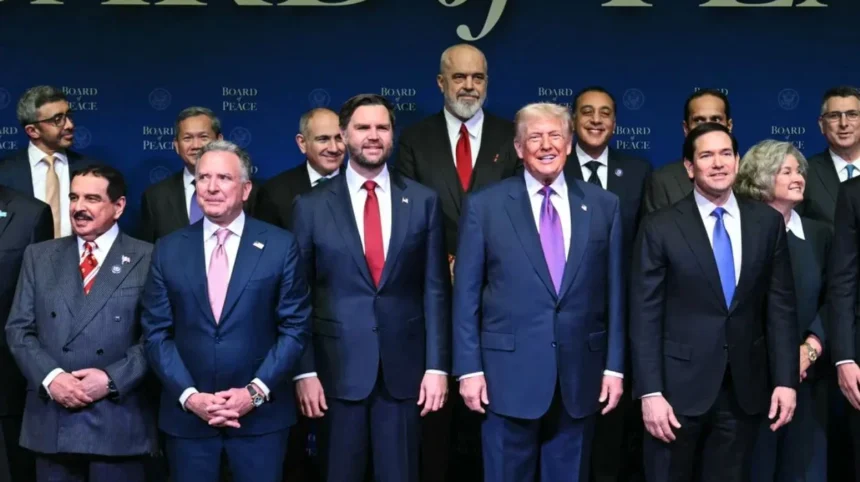
As reported by The Hill, President Donald Trump announced that the United States will commit 10 billion dollars to a new international forum called the Board of Peace, created to support reconstruction efforts in the Gaza Strip. The pledge was made at the inaugural meeting of the Board of Peace in Washington, D.C., where Trump described the initiative as a cost-effective alternative to prolonged warfare. According to reporting by PBS NewsHour, the meeting brought together representatives from more than 40 countries as Trump presented the board as central to his strategy for stabilizing Gaza after recent conflict.
According to NPR, Trump said the 10 billion dollars in U.S. funding would be part of a broader package that also includes around 7 billion dollars in commitments from other nations, all overseen by the Board of Peace. The Hill reports that Trump framed the 10 billion dollar U.S. commitment as equivalent to roughly two weeks of war spending, arguing that the investment is modest compared with the costs of continued conflict. PBS NewsHour notes that the White House has not clarified the legal authority or specific budgetary source for the pledged funds, leaving open questions about how the commitment would be implemented.
As reported by Democracy Now!, Trump has portrayed the Board of Peace as an alternative to the United Nations, positioning the new body as a central venue for international coordination on Gaza and potentially other crises. Democracy Now! also reports that Trump has named himself “chairman for life” of the Board of Peace, underscoring his personal control over the initiative. According to The Hill, the U.N. Security Council has granted the Board of Peace an official mandate as part of its endorsement of the Trump administration’s broader 20‑point peace plan for Gaza.
What reactions and concerns have emerged?
According to PBS NewsHour, Trump’s announcement came against the backdrop of a fragile ceasefire between Israel and Hamas, with ongoing tensions in Gaza and significant humanitarian and reconstruction needs. NPR reports that the Board of Peace is intended to channel both financial support and, in some plans, international personnel to assist with rebuilding infrastructure and stabilizing the territory. The Doha Institute notes that regional analysts are closely watching whether the Board of Peace will prioritize Gaza’s immediate reconstruction or expand into a wider foreign policy tool for the United States.
Democracy Now! reports that critics have raised concerns about Trump presenting the Board of Peace as an “alternative” to the United Nations, warning it could undermine existing multilateral frameworks. According to background information compiled on the Board of Peace, some commentators argue the structure resembles an “imperial court,” with heavy U.S. influence and Trump at the center of decision-making. The Hill notes that it is still unclear whether member contributions and U.S. funds will be strictly dedicated to Gaza or used for other international initiatives that the board may take on.
Reuters reports that several countries, including Qatar and Saudi Arabia, have pledged substantial financial contributions, each committing 1 billion dollars to the Board of Peace, signaling strong interest from key regional actors. According to Reuters, other nations have also pledged funds, forming an initial pool of commitments aimed primarily at Gaza’s reconstruction. These pledges are being viewed as an early test of whether the Board of Peace can function as a credible platform for coordinated international assistance.
Supporting details and implementation structure
As reported by The Hill, Trump has invited countries to become founding members of the Board of Peace by pledging 1 billion dollars each, describing such contributions as a form of lifetime membership. The Hill notes that this structure effectively ties governance and status within the board to the scale of financial commitments. According to the Doha Institute, the board’s first meeting in Washington focused on operational plans for Gaza reconstruction, governance structures, and coordination with international institutions.
The Hill reports that World Bank President Ajay Banga addressed the meeting and said the Board of Peace is responsible for setting up financial, legal, and oversight mechanisms to manage incoming funds. According to The Hill, Banga stated that the World Bank would support transparency and has seconded a financial controller to the Board of Peace to help establish high standards of accountability. PBS NewsHour adds that this arrangement is intended to reassure donors and stakeholders that funds will be monitored and used for agreed reconstruction purposes.
Background information summarized by Wikipedia indicates that the United States has pledged 10 billion dollars to support the board’s activities, while other countries’ commitments form an additional multibillion-dollar pool. According to this account, the Board of Peace is designed to coordinate reconstruction funding, infrastructure projects, and possibly security-related measures in Gaza. Analysts cited by the Doha Institute have noted that the board’s governance model and relationship with existing international bodies will be crucial to its effectiveness and legitimacy.
What are the implications and next steps?
According to PBS NewsHour, one immediate implication of Trump’s announcement is renewed debate in Washington over presidential authority to commit large sums of money without explicit congressional approval. PBS reports that neither Trump nor the White House has specified which budgetary channels would supply the 10 billion dollars, leaving the pledge subject to legislative and legal scrutiny. Democracy Now! notes that this raises broader questions about checks and balances when a president creates and funds a new international body outside established institutions like the United Nations.
Reuters reports that, for Gaza, the pledged funds from the U.S. and other countries could significantly expand resources available for rebuilding homes, infrastructure, and essential services if they are fully realized and disbursed. According to Reuters, the concrete impact will depend on how quickly the Board of Peace can set up its governance systems, agree on project priorities, and overcome political and security obstacles on the ground. The Doha Institute adds that regional observers are watching to see whether the board remains focused on Gaza or evolves into a broader platform for U.S.-led interventions in other conflicts.
According to The Hill, Trump has indicated he wants the Board of Peace to address conflicts beyond Gaza over time, suggesting an expanding agenda that could reshape parts of the international diplomatic landscape. Background reporting on the board’s design highlights that such an expansion would likely deepen debates over its role vis‑à‑vis the United Nations and other multilateral organizations. For now, media outlets report that the board’s immediate tasks center on consolidating funding commitments, finalizing oversight mechanisms, and translating political pledges into concrete reconstruction projects in Gaza.
In summary, Trump’s announcement that the United States will commit 10 billion dollars to the Board of Peace marks a significant proposed financial and diplomatic initiative centered on Gaza’s reconstruction. The pledge has attracted additional multibillion-dollar commitments from other countries and support from institutions like the World Bank, while also prompting questions about funding authority, governance, and the board’s implications for existing international structures.