


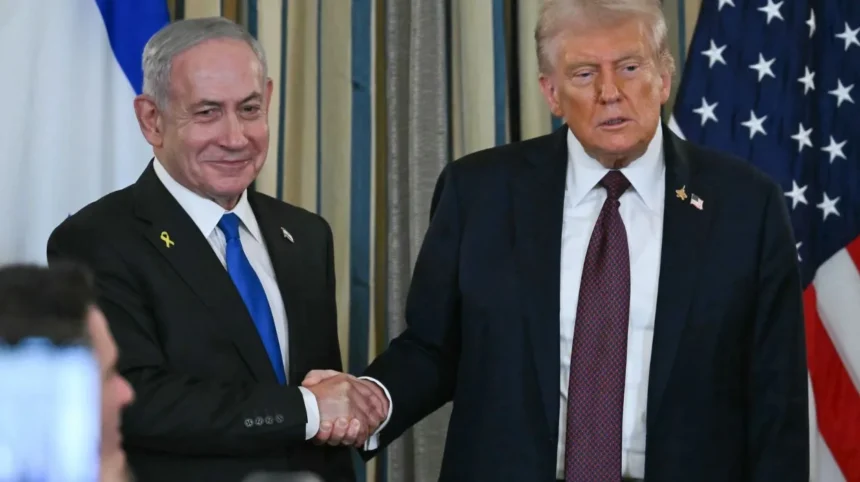
As reported by NDTV’s business news desk, US President Donald Trump convened the first meeting of his newly formed Board of Peace at the United States Institute of Peace in Washington, where he outlined funding commitments and security plans for Gaza’s reconstruction. According to the report, the initiative stems from Trump’s UN-endorsed 20-point peace plan first announced at the World Economic Forum in Davos and has drawn mixed reactions among US allies concerned it could sideline the United Nations. The meeting was chaired by Trump and attended by Vice President J.D. Vance, Secretary of State Marco Rubio, Jared Kushner, Special Envoy Steve Witkoff and representatives from participating nations, alongside FIFA President Gianni Infantino as the only non-political attendee.
According to NDTV Profit, Trump told the gathering that the United States would contribute 10 billion dollars to the Board of Peace as part of the broader effort to support Gaza’s recovery. He described the sum as small compared to the cost of war, while not clarifying whether congressional approval had been sought for the commitment. The same report notes that the Board of Peace has been framed by the administration as a mechanism to coordinate reconstruction, security, and oversight of international support for Gaza.
Who is expected to police Gaza?
As reported by NDTV Profit, Major General Jasper Jeffers briefed the Board of Peace on the planned International Stabilization Force (ISF), stating that Indonesia, Morocco, Kazakhstan, Kosovo and Albania have pledged troops for deployment in Gaza. Jeffers said that teams have been on the ground for months preparing infrastructure for the ISF, with operations planned to begin in the Rafah sector and then expand sector by sector across the territory. According to the report, the long-term target is 12,000 police officers and 20,000 ISF soldiers, with Indonesia designated to serve as deputy commander of the force.
NDTV Profit, citing reporting by Al Jazeera, notes that Indonesian President Prabowo Subianto has said his country is prepared to send up to 8,000 personnel to Gaza “to make this peace work.” The same account adds that Kazakhstan, Morocco and Albania have also pledged troops, while Egypt and Jordan are expected to train police to support security and law enforcement functions inside Gaza. According to NDTV Profit, Indonesian officials have emphasized that their mission aims to uphold international law amid the ongoing conflict.
Context and reactions: How is the plan being received?
According to NDTV Profit, the broader peace and reconstruction plan has drawn mixed reactions from US allies, some of whom are wary that the Board of Peace could effectively “look over” or sideline the United Nations in coordinating international efforts. The report notes that concerns have also been raised over suggestions that countries contributing 1 billion dollars might receive permanent membership on the board, prompting questions about influence and governance. Trump was quoted in the NDTV Profit piece as saying the board would be “almost looking over the United Nations and making sure it runs properly,” while insisting that Washington is “working very closely” with the UN despite his view that it has not met its “tremendous potential.”
The same report points out that UN Secretary-General António Guterres has warned of what he called an “imminent financial collapse” of the UN system without reforms to funding, with the United States currently owing more than 2.1 billion dollars in regular budget contributions. Trump said the United States would help the UN “money wise,” though he did not specify an amount in his remarks at the Board of Peace meeting. NDTV Profit also notes political debate in Washington over Trump’s Middle East posture, with US lawmakers Ro Khanna and Thomas Massie planning to seek a vote aimed at limiting the president’s ability to use force against Iran without congressional authorization.
Supporting details: funding and regional security concerns
According to NDTV Profit, Trump announced that nine countries—Kazakhstan, Azerbaijan, the United Arab Emirates, Morocco, Bahrain, Qatar, Saudi Arabia, Uzbekistan and Kuwait—have together pledged more than 7 billion dollars toward a relief package for Gaza. He added that the UN Office for the Coordination of Humanitarian Assistance would seek to raise an additional 2 billion dollars, with Japan expected to host fundraising events involving South Korea, the Philippines, Singapore, China and Russia. The report further notes that FIFA, represented at the meeting by President Gianni Infantino, will help raise 75 million dollars for projects in Gaza.
The NDTV Profit article also underscores the continued volatility in the region, reporting that Trump repeatedly described Iran as a threat to regional stability while urging Tehran to join the peace efforts. Amid speculation about possible US military action, Trump confirmed that 22 additional B‑2 stealth bombers had been ordered and reiterated that Iran “can’t have a nuclear weapon,” with further clarity on a potential deal or additional steps expected “probably over the next 10 days.” At the same time, the move by members of Congress to seek a vote restricting the president’s authority to use force against Iran underscores ongoing domestic scrutiny of his Middle East strategy, according to NDTV Profit.
Implications and future developments: What comes next for Gaza security?
According to NDTV Profit’s reporting, the deployment of the International Stabilization Force and the build‑up to a 20,000‑strong contingent of soldiers and 12,000 police officers remains in the planning and early infrastructure phase, with initial operations set to focus on the Rafah sector. The composition of the force—drawing troops from Indonesia, Morocco, Kazakhstan, Kosovo and Albania, and relying on Egypt and Jordan to train police—suggests an ongoing reliance on regional and Muslim‑majority partners to manage security on the ground. Future developments will depend on how quickly pledges of personnel and funding are translated into deployments and operational policing structures in Gaza, as well as how the mission navigates political sensitivities with Israel, regional states and international institutions.
NDTV Profit notes that Trump has presented the Board of Peace as an entity that will both coordinate reconstruction and “look over” the UN, which may shape debates about multilateral oversight and accountability as the Gaza initiative advances. The report indicates that in parallel, questions over US‑Iran tensions and congressional efforts to limit unilateral military action could influence the broader regional security environment in which the Gaza stabilization plan unfolds. How the International Stabilization Force is ultimately structured, deployed and accepted by local communities and regional actors will be key factors in determining who effectively polices Gaza under Trump’s 20‑point peace framework, according to the NDTV Profit coverage.
The latest reporting indicates that the United States and its partners are moving ahead with a multi‑billion‑dollar relief and reconstruction package, alongside plans for an International Stabilization Force aiming for 20,000 soldiers and 12,000 police officers, with Indonesia in a leading role and several countries pledging troops and training support. At the same time, political concerns about the Board of Peace’s relationship with the United Nations, questions over governance and membership, and wider regional tensions with Iran suggest that both the security and diplomatic dimensions of Gaza’s future remain in flux.