


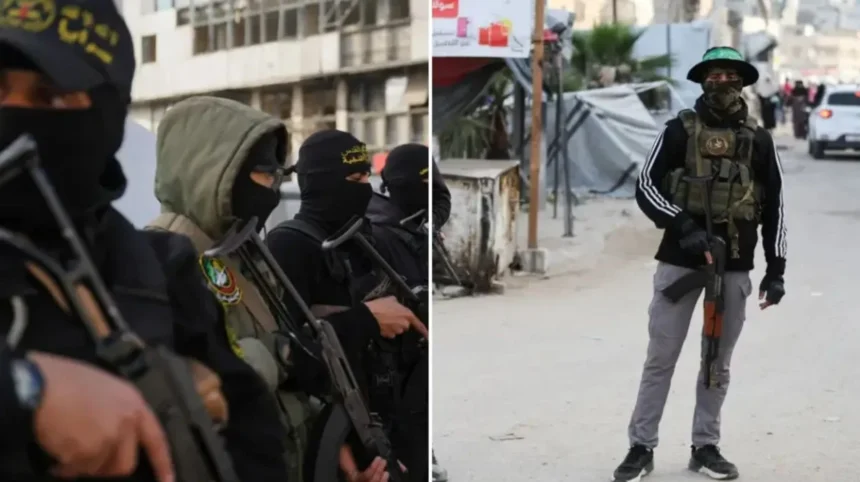
According to the New York Post, Hamas has been presented with a new Gaza disarmament proposal that would give the group 90 days to hand over its rocket launchers and missiles as part of a broader phased disarmament framework linked to reconstruction of the enclave.
As reported by The Times of Israel, the plan was outlined to Hamas negotiators during talks in Cairo and envisions all armed factions in Gaza gradually surrendering their weapons over several months, starting with heavy weaponry such as rockets and launchers.
The Times of Israel notes that the initiative is being advanced by mediators tied to United States President Donald Trump’s Board of Peace for Gaza, which has been tasked with translating the post‑war ceasefire understandings into a longer‑term security and governance arrangement in the Strip.
According to National Public Radio (NPR), the proposal is described by regional officials as a comprehensive framework aimed at the “complete decommissioning” of weapons held by Hamas and other armed groups in Gaza in exchange for large‑scale reconstruction and easing of restrictions.
Why is Hamas being given 90 days to hand over heavy weapons?
As detailed by The Times of Israel, the disarmament framework requires Hamas to hand over its heavy weapons — including rockets, rocket launchers and missiles — within a 90‑day period, and to provide maps of its extensive tunnel network under Gaza.
The Times of Israel reports that under the proposal, these weapons would be transferred to a reconstituted Palestinian police force operating under a new National Committee for the Administration of Gaza, which is intended to gradually replace Hamas as the governing authority.
According to NPR, mediators believe that a staged process focused first on heavy weapons is more realistic than earlier demands for an immediate and total surrender, and is seen as essential to unlock long‑term international funding for reconstruction.
JFeed, citing Arab diplomats familiar with the talks, reports that Hamas negotiators have signaled some willingness to relinquish heavy weaponry but have argued for retaining small arms for internal security, a stance that remains a key point of contention in the talks.
Supporting details and mediators’ role
The Times of Israel reports that the disarmament proposal was delivered during meetings in Cairo led by Nickolay Mladenov, the Board of Peace’s High Representative for Gaza, along with senior advisers to US special envoy Steve Witkoff.
According to The Times of Israel, the plan links the weapons handover to a phased drawdown of Israeli forces from parts of Gaza: as Palestinian police and an international stabilization force take control of areas where weapons have been collected, Israel would reduce its military presence.
JFeed adds that the broader framework includes later stages for collecting lighter weapons, potentially through a buyback scheme that would offer financial incentives and employment opportunities to fighters who agree to disarm.
NPR reports that mediating states, including the United States, Qatar, Turkey and Egypt, have coalesced around the view that a gradual disarmament process is the only workable path, even though it departs from Israel’s earlier public insistence on an immediate, comprehensive weapons surrender.
What are the implications and possible next steps in the Gaza disarmament plan?
The Times of Israel notes that Israeli officials have long opposed a gradual disarmament model but were aware of the current proposal and did not object when it was presented, partly because they reportedly assess that Hamas may reject it or seek extensive modifications.
According to JFeed, mediators expect Hamas to respond within days, potentially with a counterproposal that could extend negotiations but would keep the 90‑day heavy‑weapons benchmark at the center of any eventual agreement.
NPR reports that acceptance of the plan by Hamas could pave the way for expanded humanitarian access and large‑scale reconstruction in Gaza, while failure to reach an agreement risks prolonging the fragile post‑ceasefire status quo and delaying international investment.
The Times of Israel adds that the framework also ties progress on disarmament to the lifting of restrictions on reconstruction equipment and to incremental Israeli troop withdrawals, making the 90‑day deadline for rocket launchers and missiles a critical early test of whether the broader Gaza stabilization plan can move forward.
Taken together, the reports indicate that the 90‑day requirement for Hamas to surrender rocket launchers and missiles is emerging as a central benchmark in efforts to translate the existing ceasefire into a more durable security and political arrangement for Gaza, with mediators, Israel and Hamas all weighing the costs and potential benefits of the proposed disarmament path.