


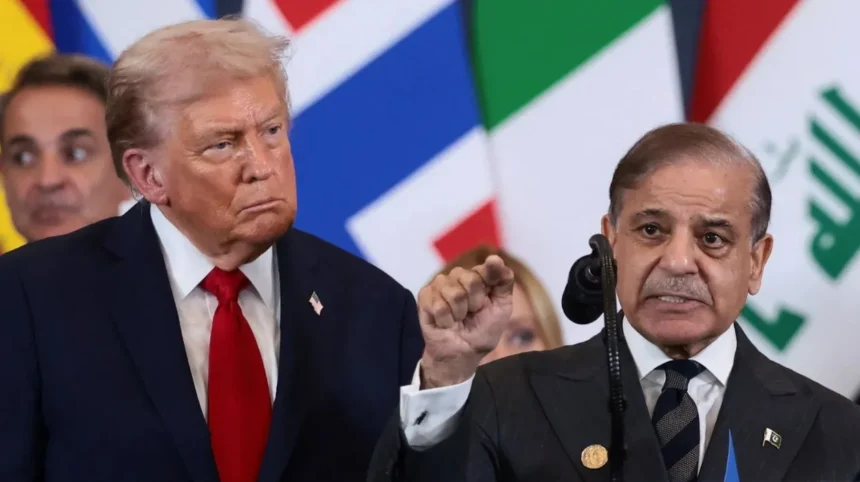
As reported by IANS from New Delhi, Pakistan has been included among the countries on the “Board of Peace,” a body reportedly formed by United States President Donald Trump to explore lasting peace solutions for the Gaza Strip after more than two years of intense hostilities in the enclave.
According to IANS, Pakistan’s selection has drawn criticism from commentators who point to the country’s record on religious persecution and its alleged “nurturing” of terrorism on its soil, arguing that this history raises questions about its capacity to act as a credible peacemaker.
IANS reports that the concerns are grounded in recent assessments of Pakistan’s domestic human rights situation, particularly in relation to Christians, Hindus and other non‑Muslim minorities.
Pakistan’s rights record under spotlight
According to IANS, a report by the Gatestone Institute describes Pakistan as one of the “most dangerous countries” for Christians and other non‑Muslim minorities, citing what it calls a deepening crisis marked by mob violence and “near‑total impunity” for perpetrators.
The report, as summarized by IANS, notes that Christians, Hindus and other minorities have faced physical attacks, forced displacement and structural exclusion, with Christians particularly vulnerable to blasphemy accusations that have in some cases escalated into mobs burning churches, targeting homes and destroying livelihoods.
IANS states that incidents of forced religious conversions, abductions of Hindu girls and coerced marriages are widely reported, with affected families often struggling to find legal recourse amid alleged intimidation of victims and bias within state institutions.
Context and reactions: Why is Pakistan’s inclusion questioned?
According to the IANS account of the Gatestone Institute report, rights advocates argue that Pakistan’s internal record undermines its credibility on a panel tasked with promoting peace and stability in Gaza, with the report explicitly making a “strong case” for excluding Pakistan from the Board of Peace.
IANS reports that the same analysis highlights the case of 21‑year‑old Christian farmworker Marcus Masih, who was allegedly tortured to death by his Muslim employers in Punjab Province, with the incident subsequently labeled a suicide by hanging, a characterization that drew international scrutiny.
The IANS piece further notes that after Masih’s death, the United States Commission on International Religious Freedom (USCIRF) urged Washington to redesignate Pakistan as a “Country of Particular Concern” over what it described as systematic and ongoing violations of religious freedom.
Supporting details and documented incidents
As detailed by IANS, the Gatestone Institute report lists a series of cases in 2024 and 2025, including an incident in March 2025 in which a man identified as Zohaib Iftikhar allegedly slit the throat of his Christian co‑worker, 22‑year‑old Waqas Masih, after accusing him of committing blasphemy by touching an Islamic textbook with “unclean hands.”
In May 2025, IANS reports that Christian laborer Kashif Masih was allegedly tortured to death by a group of men, including a former police officer, over an unproven theft allegation, a killing that sparked outrage among minority rights groups.
The IANS summary also cites the June 2024 case of 18‑year‑old Catholic worker Waqas Salamat, who was allegedly tortured to death by his employer and others for reportedly leaving his job without permission, with his family claiming he was subjected to hours of electric shocks.
Further, IANS notes that the Gatestone Institute report documents multiple attacks on places of worship and cases of forced conversions involving Hindu and Christian girls in Punjab and Sindh during 2025, including the reported abduction of 12‑year‑old Christian girl Saba Shafique in Sindh, who was allegedly forcibly converted to Islam and married to a 35‑year‑old man, Muhammad Ali.
Implications and future developments: What could Pakistan’s role mean for Gaza peace efforts?
According to IANS, the Gatestone Institute analysis concludes that Pakistan’s inclusion on the Board of Peace could weaken the credibility of any future peace‑building mechanism for Gaza, given the documented pattern of violence and discrimination against religious minorities inside the country.
IANS reports that critics cited in the analysis argue that, unless there are significant improvements in Pakistan’s human rights practices and accountability for abuses, questions will likely persist over its suitability to help oversee or support a long‑term peace framework in Gaza.
The IANS report indicates that, for now, the debate centers on whether the composition of the Board of Peace—particularly the participation of states facing serious rights concerns at home—will affect international perceptions of the initiative and its ability to contribute to durable stability in the Gaza Strip.
Pakistan’s appointment to the Board of Peace for Gaza has therefore opened a parallel discussion about the alignment between a state’s domestic rights record and its role in international peace initiatives, with rights organizations and analysts closely watching how Islamabad’s internal policies and the Gaza mechanism evolve in the months ahead.