


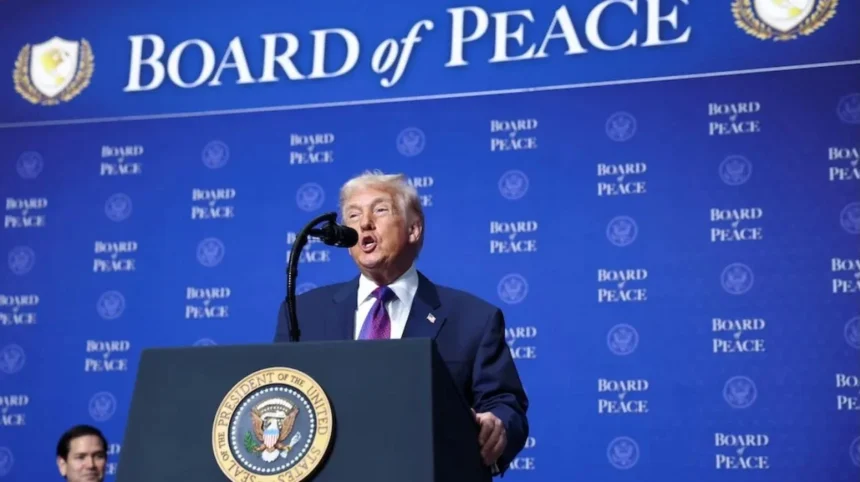
As reported by The New York Times, President Donald Trump’s newly established Board of Peace has presented Hamas with a detailed plan that would see the group gradually disarm in the Gaza Strip in exchange for phased Israeli troop withdrawals and increased humanitarian access.
According to The New York Times, the proposal outlines a months-long process in which Hamas and other armed factions would surrender rockets, launchers and other heavy weapons, while Israel would ease restrictions and allow more aid and commercial goods into Gaza.
As reported by The New York Times, the plan also envisages Hamas providing maps of its extensive tunnel network and eventually handing over assault rifles, although key logistical aspects of who would take custody of the weapons remain undefined.
According to The New York Times, the Board of Peace effort is led on the ground by Nickolay Mladenov, a former United Nations envoy who has been engaging Hamas officials in Cairo on the proposal, which is backed by the United States but has not been published in full.
As reported by NPR, a senior U.S. official described the document as a “thorough framework” for the total surrender and complete decommissioning of weapons held by Hamas and other armed groups in Gaza if the proposal is accepted.
According to multiple officials cited by The New York Times, the disarmament and implementation process could take up to eight months, marking a shift from Israel’s previous insistence on rapid or immediate disarmament toward a phased approach under U.S. pressure.
Context and Reactions: How Are Key Actors Responding
As reported by The New York Times, both Hamas and the Israeli government have so far declined to publicly comment on the specific proposal, which was delivered amid ongoing efforts to consolidate a cease-fire reached in October 2025.
According to The New York Times, Palestinian commentator Akram Atallah in Gaza argued that the proposal effectively calls for the dissolution of Hamas in its current armed form and warned it would not necessarily yield a sovereign Palestinian state.
As reported by NPR, regional officials say mediators handed the proposal to Hamas in Cairo, and some involved describe it as designed to unlock large-scale reconstruction in Gaza if Hamas agrees to lay down its weapons.
According to Deutsche Welle, Trump has publicly urged Hamas to move ahead with full disarmament under his broader postwar plan for Gaza, framing the process as essential to long-term stability and reconstruction.
As reported by Anadolu Agency, the Board of Peace was formally endorsed by a United Nations Security Council resolution in late 2025, and member states are preparing multi‑billion‑dollar pledges for Gaza’s reconstruction as part of a staged settlement that includes demilitarization.
Supporting Details: Governance, Timeline and International Role
According to Anadolu Agency, Trump announced the Board of Peace in January 2026 as an international body he chairs, tasked initially with managing the Gaza cease-fire and reconstruction and empowered with broad authority, including appointing its members.
As reported by The New York Times, the Gaza proposal assigns a central role to a Palestinian Committee for Administration created by the Board of Peace, which is expected to oversee hospitals, schools and basic services in the enclave, though its leaders have not yet entered Gaza.
According to The New York Times, in the first stage of implementation Israel would increase the flow of humanitarian aid and commercial goods, while Hamas would be required within about 90 days to turn over heavy weapons and provide tunnel maps before gradually surrendering lighter arms.
As reported by the BBC and Deutsche Welle, governments backing the Board of Peace have pledged between 5 and 7 billion dollars for Gaza relief and reconstruction, with Trump portraying these commitments as part of a broader vision to secure Gaza’s future under the new framework.
According to The New York Times, earlier Board of Peace contacts with Hamas already explored a demilitarization plan that might initially allow the group to retain some small arms, highlighting the incremental nature of the approach now being refined.
Implications and Future Developments: What Comes Next?
As reported by The New York Times, sources familiar with the talks expect Hamas to issue a formal response after the Muslim holiday of Eid al‑Fitr, and some analysts anticipate the group could counter with proposals aimed at delaying full disarmament while avoiding a collapse of the cease-fire.
According to NPR, acceptance of the proposal could trigger a major reconstruction drive and expanded international engagement in Gaza, whereas rejection or prolonged stalling risks renewed tensions and the potential for Israel to resume large‑scale military operations.
As reported by Anadolu Agency and Deutsche Welle, the Board of Peace’s authority and Trump’s central role have raised questions among some governments about whether the new structure might challenge or dilute the United Nations’ traditional lead in conflict resolution, an issue likely to influence future diplomatic debates.
According to The New York Times, the success or failure of the disarmament proposal will shape not only Gaza’s security landscape but also the credibility of the Board of Peace as a model for managing similar conflicts elsewhere, an outcome closely watched by regional and global actors.
In sum, Hamas is weighing a U.S.-backed, Board of Peace–crafted disarmament plan that ties a phased surrender of weapons in Gaza to Israeli withdrawals, increased aid and long‑term reconstruction, with key stakeholders awaiting the group’s formal response and the potential regional repercussions.