


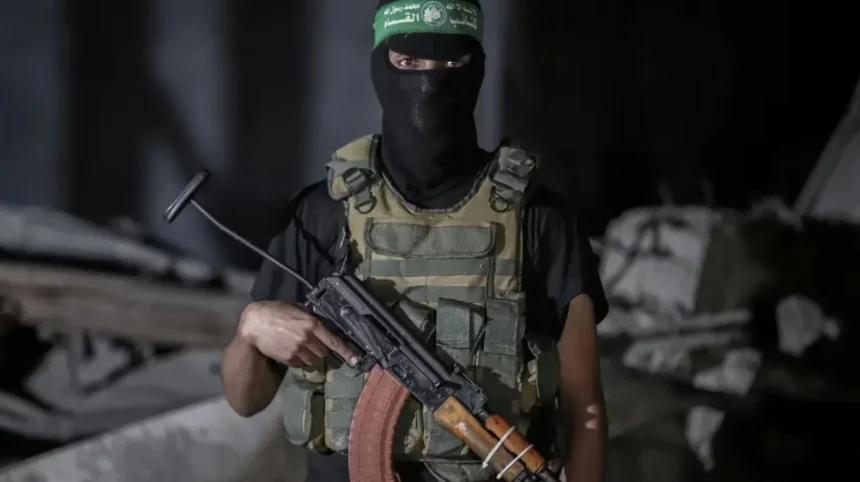
As reported by Abu Bakr Bashir and Daniel Estrin of NPR, mediators working for President Donald Trump have presented Hamas with a formal proposal to lay down its weapons in the Gaza Strip, according to a senior U.S. official. The plan would require Hamas and all other militant groups in Gaza to hand over their weapons, with responsibility for all arms shifting to an emerging governing authority. According to NPR, the demilitarization proposal was delivered to Hamas in Cairo last week, reflecting an effort to move beyond preliminary talks and put a concrete framework on the table.
NPR reports that a third person briefed on the discussions described the document as a comprehensive framework designed to ensure the “complete handover” and “full decommissioning” of weapons held by Hamas and other armed factions. If Hamas accepts the plan, this framework is intended to unlock large-scale reconstruction of Gaza, which has been devastated by years of conflict. The proposal also sits within a broader political track launched after Hamas and Israel agreed to President Trump’s ceasefire deal last October, aimed at ending two years of war that have battered Gaza and destabilized the wider region.
According to NPR, Trump’s Board of Peace was created to oversee efforts to demilitarize Hamas, set up a multinational stabilization force for Gaza, and secure an eventual Israeli military withdrawal from the territory. Hamas officials had previously signaled a willingness to discuss their arsenal but had been waiting for a formal written proposal from mediators. The current document is the first detailed plan of its kind to be formally conveyed, marking an escalation in the diplomatic push to change the security balance in Gaza.
What are the reactions and political stakes?
NPR reports that Hamas has been asked to respond to the disarmament proposal in about a week, after the Muslim Eid holiday. Senior Hamas officials did not immediately comment publicly, and one Hamas official told NPR that the group had not received any proposal, highlighting early uncertainty over how the initiative is being handled on the ground. This lack of a clear, unified response from Hamas underscores the political sensitivity of any move to relinquish weapons, which are central to the group’s identity and leverage.
According to NPR, implementation of the wider demilitarization and stabilization agenda has been hampered by major regional developments, notably the war launched by the U.S. and Israel against Iran on February 28. The conflict with Iran has triggered a broader regional crisis involving more than a dozen countries, diverting attention and resources from the Gaza track. NPR notes that the work of Trump’s Board of Peace has largely been put on hold amid this new war, complicating efforts to translate the proposal to Hamas into concrete steps on the ground.
NPR further reports that key elements of the envisioned postwar political structure in Gaza remain unrealized. Members of a Palestinian transitional committee designated to run postwar Gaza have not yet entered the territory, and neither a new Palestinian police force nor a multinational stabilization force has been deployed. This vacuum in governance and security arrangements heightens uncertainty about who would actually control arms and enforce demilitarization if Hamas agreed to the proposal.
Supporting details and expert perspectives
According to NPR, the current proposal is rooted in the wider trajectory of the Gaza conflict, which escalated sharply after the Hamas-led attack on southern Israel on October 7, 2023. Israel says that attack killed around 1,200 people inside Israel. Palestinian health officials, cited by NPR, report that Israel’s subsequent military response has killed more than 70,000 people in Gaza and left the enclave in ruins.
NPR notes that, despite a fragile ceasefire agreement associated with President Trump’s peace efforts, Israeli forces have continued to carry out operations that have killed hundreds of Palestinians in recent months, most of them civilians, according to Gaza health authorities. Israel maintains that these operations target Hamas militants, and NPR reports that several Israeli soldiers have also been killed in militant attacks during the same period. This ongoing violence underscores the fragility of the truce and the difficulty of moving toward full demilitarization.
Robert Danin, a former senior U.S. State Department and White House official specializing in the Middle East, told NPR that it is unlikely Hamas will rush to accept or even promptly respond to the demilitarization offer. Danin said Hamas believes time is on its side, arguing that with each passing day its influence and control in Gaza deepen, especially while the Board of Peace’s proposed alternative governance structures remain outside the territory. He added that the new war with Iran is likely to further reduce international pressure on Hamas to accept the plan, because attention is being pulled away to the broader regional conflict.
What are the implications and what happens next?
According to NPR, the demilitarization proposal explicitly links Hamas’ surrender of weapons to the scale and speed of Gaza’s reconstruction, suggesting that significant rebuilding aid would follow if the plan is accepted. However, with no functioning transitional authority, police force, or multinational presence on the ground, it remains unclear how any agreement to hand over weapons would be verified and enforced. The uncertainty around implementation raises questions about whether the proposal can move beyond a diplomatic outline to a workable security arrangement.
NPR reports that Hamas has roughly a week after the Eid holiday to formally respond, giving mediators and regional governments a narrow window to assess the group’s intentions. The Board of Peace and its partners must also contend with the ongoing war with Iran, which Danin says will make it harder to maintain focus and leverage on the Gaza file. As Danin told NPR, a core challenge now is identifying what practical tools are available to persuaders if Hamas chooses to delay or reject the plan, and what alternatives exist if demilitarization cannot be secured under current conditions.
For now, the proposal marks the most concrete attempt yet under President Trump’s current term to fundamentally alter the security landscape in Gaza by removing Hamas’ weapons in exchange for reconstruction. Its fate will depend on Hamas’ response, the ability of mediators to sustain pressure and incentives amid a wider regional war, and whether promised governance and security structures for postwar Gaza can move from paper to reality in the months ahead.