


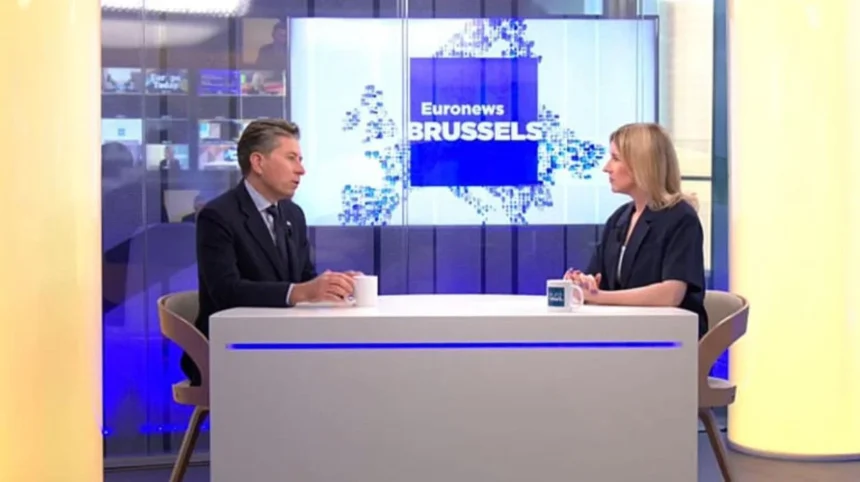
As reported by Euronews, United Nations Under-Secretary-General for Humanitarian Affairs Tom Fletcher said the United States-backed “Board of Peace” is “not an alternative to the UN.” Fletcher made the comments in an interview with Euronews’ “Europe Today,” responding to questions about whether the new body, championed by US President Donald Trump, could rival the UN’s role in global diplomacy. According to Euronews, he underlined that both Washington and participating countries had made clear the initiative is not intended to replace the UN.
Fletcher stressed that the UN remains a member-state organization of more than 190 countries with a unique mandate to coordinate responses to conflict and crisis. In his remarks, he said “we’re still here,” emphasizing that the UN was created for periods of impunity, brutality and polarization, and that it continues to operate despite mounting criticism over its effectiveness. Fletcher acknowledged that the UN is not perfect but rejected attempts to weaken it, arguing that its structures mirror the complexities and divisions of the international system.
His comments come amid heightened scrutiny of the UN, as wars and geopolitical tensions intensify, including conflicts in Gaza, Sudan, South Sudan, the Democratic Republic of the Congo and Lebanon. Fletcher noted that UN humanitarian staff are operating on the front lines of these crises and highlighted recent losses of colleagues who were killed while delivering aid. He framed the UN’s work as essential in an era of growing displacement, driven by conflict and climate change, and warned that today’s crises “can’t be put neatly back into a box.”
How are officials reacting to the Board of Peace?
According to Euronews, Fletcher said he does not feel threatened by the Board of Peace and described it as one of several diplomatic formats that can coexist with the UN. He noted that coalitions of countries often come together to address specific issues and that there is “enough conflict in the world” for various multilateral efforts to play a role. Fletcher reiterated that the UN’s legitimacy stems from its broad membership and the mandates granted by states, which he said remain difficult to secure in a polarized environment.
Reporting by Reuters has previously described Trump’s Board of Peace as an initiative aimed at going beyond the Gaza conflict to address wider global challenges. Trump has publicly denied that the board is intended as a replacement for the UN and has said it will work “alongside” the organization. Reuters noted that several key US allies have been cautious about joining, expressing concern that the board’s mandate could expand in ways that might undercut the UN’s central role.
According to Reuters, around 35 countries, including Israel, Saudi Arabia, Argentina and Indonesia, have pledged support for the Board of Peace, while Russia has been reported as considering participation. The US Secretary of State, Marco Rubio, has said the body will prioritize the implementation of a Gaza peace plan while potentially serving as a model for other regions. Some governments, such as Pakistan, have framed their decision to join the board as part of efforts to support a permanent ceasefire in Gaza, the scaling up of humanitarian aid and long-term reconstruction, while still anchoring their positions in relevant UN resolutions.
Supporting details and expert perspectives
Euronews reported that Fletcher linked the current scrutiny of the UN to a broader “time of impunity and division and polarisation,” arguing that criticism often overlooks the political realities that limit UN action. He emphasized that the organization can act only when states give it a mandate, making it a reflection of geopolitical fractures rather than an independent force that can override them. Fletcher argued that attempts to weaken the UN risk undermining one of the few global forums where nearly all governments can engage.
Video excerpts of Fletcher’s interview circulated by Euronews showed him saying that whenever people attack the UN, observers should ask what those critics stand to gain from weakening the organization. He underscored that the UN was “built for times like this,” reiterating that the institution was designed to operate amid war, polarization and humanitarian emergencies. In separate public appearances, Fletcher has also stressed that the UN will need to adapt to shifts in diplomacy and the changing nature of humanitarian crises, including the growing impact of climate change on displacement.
Analysts cited by Al Jazeera have said Trump is seeking to use early meetings of the Board of Peace to demonstrate tangible progress in Gaza, especially through funding commitments for humanitarian relief and reconstruction. Ahead of an initial summit, Trump said the board had “unlimited potential” and predicted it could become one of the most consequential international bodies in history. According to Al Jazeera’s reporting, he signaled that member states would announce billions of dollars in funding pledges and contribute personnel to support security and policing arrangements in Gaza.
What are the implications and what happens next?
Fletcher’s insistence that the Board of Peace is not a substitute for the UN underscores ongoing debates about whether new coalitions can supplement or erode existing multilateral institutions. As reported by Euronews, he has argued that despite flaws, the UN’s universal membership and legal framework provide a foundation that ad hoc groupings cannot replicate. His comments suggest that UN officials will continue to defend the organization’s central role even as governments experiment with alternative diplomatic platforms.
Reuters has reported that Trump envisions the Board of Peace working in parallel with the UN, particularly on Gaza, but questions remain over how its activities will interact with existing UN processes and Security Council mandates. The hesitancy of some allies to join, as well as concerns that the board could expand its mission, indicate that its long-term impact on the multilateral system is still uncertain. The participation of countries such as Pakistan, which explicitly link the initiative to UN resolutions and a two-state outcome for Palestine, highlights ongoing efforts to align new mechanisms with established international law.
For now, Fletcher’s intervention makes clear that the UN leadership intends to assert the organization’s relevance in what he calls a “fractured world,” even as pressure mounts from both critics and competing initiatives. He has framed the UN’s endurance as tied to its ability to keep operating in crises ranging from Gaza to African conflict zones, while adapting to new patterns of displacement and climate-related emergencies. The evolution of the Board of Peace, and whether it remains complementary to or in tension with the UN, will likely shape future debates about global governance and humanitarian action.
In sum, Fletcher’s message is that the Board of Peace, while potentially influential, cannot replace the UN’s broad membership and legal mandate, and that the global body will continue to navigate conflict, polarization and humanitarian need alongside any new peace initiatives.
sgfldfmywnesqqfydwuphzeksvrvvv
zdesseewzhhykfpwdmqgotjkoxrdgf