


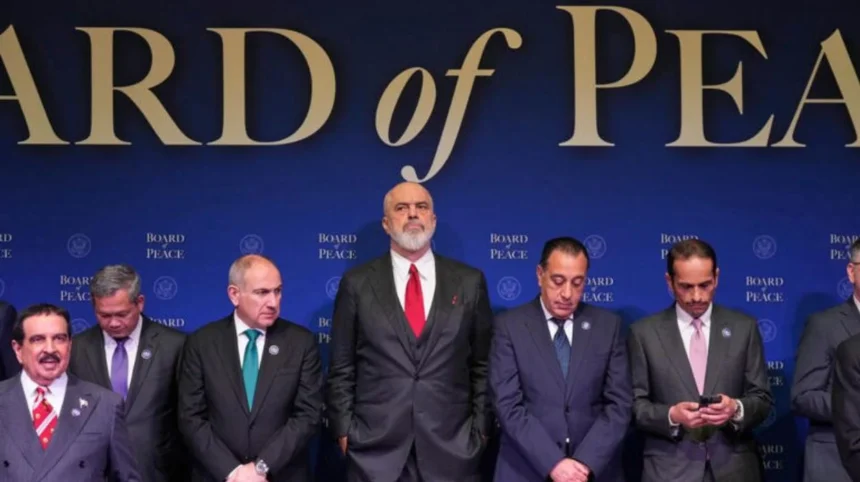
According to The Indian Express, India participated in the first meeting of US President Donald Trump’s international “Board of Peace” on Gaza as an “observer” nation in Washington, DC. The meeting was convened to discuss reconstruction, security and transitional governance in Gaza under Trump’s Gaza Peace Plan, framed around a 20‑point “Comprehensive Plan” backed by United Nations Security Council Resolution 2803. As reported by The Times of India, India was represented by Namgya Khampa, Chargé d’affaires at the Indian Embassy in Washington, rather than by a ministerial‑level delegation, underscoring that New Delhi has not yet joined the Board as a full member.
The Board of Peace is designed as a new international body to oversee enforcement of the Gaza ceasefire between Israel and Hamas and to coordinate large‑scale reconstruction and governance efforts in the territory. Trump has promoted the Board as a flagship institution of his broader Gaza initiative, saying it could eventually rival existing multilateral bodies in influence. According to NDTV, the concept was publicly rolled out at the World Economic Forum in Davos, before being operationalized through the inaugural meeting in Washington.
India’s Ministry of External Affairs (MEA) has publicly welcomed the Gaza Peace Plan and the efforts linked to UNSC Resolution 2803 while keeping its decision on formal Board membership under review. MEA spokesperson Randhir Jaiswal said India supports initiatives that pave the way for long‑term and lasting peace in Gaza and the wider region, signalling political backing for the plan even as the nature of India’s institutional role remains under consideration.
Context and Reactions: How Is India Positioning Itself?
As reported by The Economic Times, New Delhi deputed an observer to the meeting after Trump invited Prime Minister Narendra Modi to join the Board of Peace, but India has not yet taken a final call on becoming a member. Officials quoted by the outlet indicated that India wanted a “ringside view” of the deliberations because of potential implications for its strategic and economic interests in West Asia. The issue has featured in India’s recent diplomatic engagements, including an India–Arab League foreign ministers’ meeting and ahead of Modi’s planned visit to Israel, where West Asia peace dynamics are expected to be on the agenda.
According to NDTV, Jaiswal noted that Modi has welcomed “all such initiatives that pave the way for long‑term and lasting peace in the entire region, including Gaza,” while confirming that India is “presently reviewing” the invitation to join the Board. The presence of the Chargé d’affaires at the Washington meeting was seen as a signal that India is prepared to engage with the process even without committing to membership. The Indian Express reported that India’s observer status allows it to track how key regional and global players are approaching Gaza reconstruction and governance, at a time when India is balancing ties with Israel, Arab states and Palestine.
External commentary has highlighted the diplomatic complexity for New Delhi. Deutsche Welle reported that the Board of Peace tests India’s long‑standing approach of maintaining strong relations with both Israel and the Palestinians, amid questions about legal frameworks, stakeholder consent and political costs. Some analysts cited by DW argued that the governance role envisioned for the Board remains uncertain, while others pointed out that Hamas is excluded from the initiative even though it remains a significant actor in Gaza. These debates form part of the backdrop to India’s cautious, observer‑level engagement.
Supporting Details: Funding Commitments and Board Composition
According to NDTV, Trump announced at the inaugural meeting that nine members of the Board – including Kazakhstan, Azerbaijan, the United Arab Emirates, Morocco, Bahrain, Qatar, Saudi Arabia, Uzbekistan and Kuwait – had pledged a combined 7 billion dollars for a Gaza relief and reconstruction package. In addition, he said the United States would commit 10 billion dollars to the Board of Peace, though detailed allocations and spending priorities were not specified. The Times of India reported that, in total, more than two dozen countries are involved with or linked to the Board at this stage, among them Argentina, Armenia, Azerbaijan, Hungary, Pakistan, Saudi Arabia and the UAE.
The Economic Times noted that, ahead of the meeting, White House Press Secretary Karoline Leavitt indicated Trump would outline implementation of 5 billion dollars in pledges made by 20 participating states, alongside broader plans for security and reconstruction in Gaza. At the Washington session, discussions reportedly focused on maintaining security in Gaza during and after the conflict, setting up an International Stabilisation Force and boosting local policing to safeguard residents. These security elements are presented as complementary to the reconstruction and governance efforts that the Board is expected to coordinate.
The Indian Express emphasized that observer status offers India insight into how these financial and security mechanisms are being structured, without binding it to the political and operational commitments that full membership might entail. It also allows New Delhi to watch how other regional actors, including Pakistan and Turkey, engage with the Board, a factor that Indian officials are weighing carefully. Reports note that Pakistan has been encouraged by the Trump administration to contribute troops to the proposed stabilisation force, underscoring the Board’s broader geopolitical dimension.
Implications and Future Developments: What Comes Next for India and the Gaza Plan?
According to The Economic Times, India’s decision on whether to become a full‑fledged Board of Peace member remains pending, with internal deliberations expected to continue as the initiative’s structure and on‑ground impact become clearer. The issue is likely to be discussed further in Modi’s upcoming engagements with regional leaders, including during his planned visit to Israel, where Gaza’s reconstruction and security arrangements are central topics. India’s long‑stated support for a two‑state solution and dialogue‑based resolution of the Israel–Palestine conflict will shape how it calibrates any deeper involvement with the Board.
The Times of India reported that the Board of Peace is envisaged as a transitional body that could influence governance in Gaza and possibly evolve into a more permanent multilateral structure. As subsequent Board meetings flesh out institutional design, mandate and oversight mechanisms, observer countries such as India may reassess their roles based on how far the process aligns with international law and UN frameworks. Further announcements from Washington are expected on the deployment schedule and composition of the International Stabilisation Force, which will be a key test of the Gaza plan’s implementation.
For now, India’s participation in the inaugural meeting as an observer signals support for Trump’s Gaza Peace Plan and for efforts anchored in UNSC Resolution 2803, without locking New Delhi into a binding institutional commitment. The government has framed its position as one of constructive engagement aimed at promoting lasting peace and reconstruction in Gaza, while preserving strategic autonomy in how it engages with both Israel and the broader Arab world. Future decisions on membership and contributions will depend on how the Board of Peace evolves and how its actions are viewed in the region and at the United Nations.